What Is Cyber Security? Complete Beginner's Guide, Types And Best Practices (2026-27)
Today we are going to discuss the topic Cyber Security. Every time you check your bank balance on your phone, log into email, or your company processes a customer's data, cyber security is quietly working in the background to keep that information safe. In this complete guide you will learn what cyber security actually is, the CIA Triad (Confidentiality, Integrity, Availability) that underlies every security decision, the different types of cyber security (network, application, cloud, endpoint, IoT, and information security), the most common cyber threats such as malware, phishing, ransomware, and DDoS attacks, how a typical attack actually unfolds step by step, practical best practices for individuals and businesses, an overview of major security frameworks, and the career paths and certifications available if you want to work in this field. This tutorial breaks the process down step by step, using simple language and real-world examples, and finishes with a quiz and FAQ so you can test what you've learned.
📋 Table of Contents
- What Is Cyber Security?
- Why Cyber Security Matters in 2026
- The CIA Triad – Confidentiality, Integrity, Availability
- Key Cyber Security Terms Every Beginner Should Know
- Types of Cyber Security
- Common Types of Cyber Threats And Attacks
- How a Cyber Attack Actually Happens – The Attack Lifecycle
- Cyber Security Best Practices for Individuals
- Cyber Security Best Practices for Businesses
- Cyber Security Frameworks & Compliance
- Cyber Security Careers, Skills & Certifications
- Cyber Security Terms – Quick Reference Table
- Practice Quiz
- Frequently Asked Questions (FAQ)
✅ What Is Cyber Security?
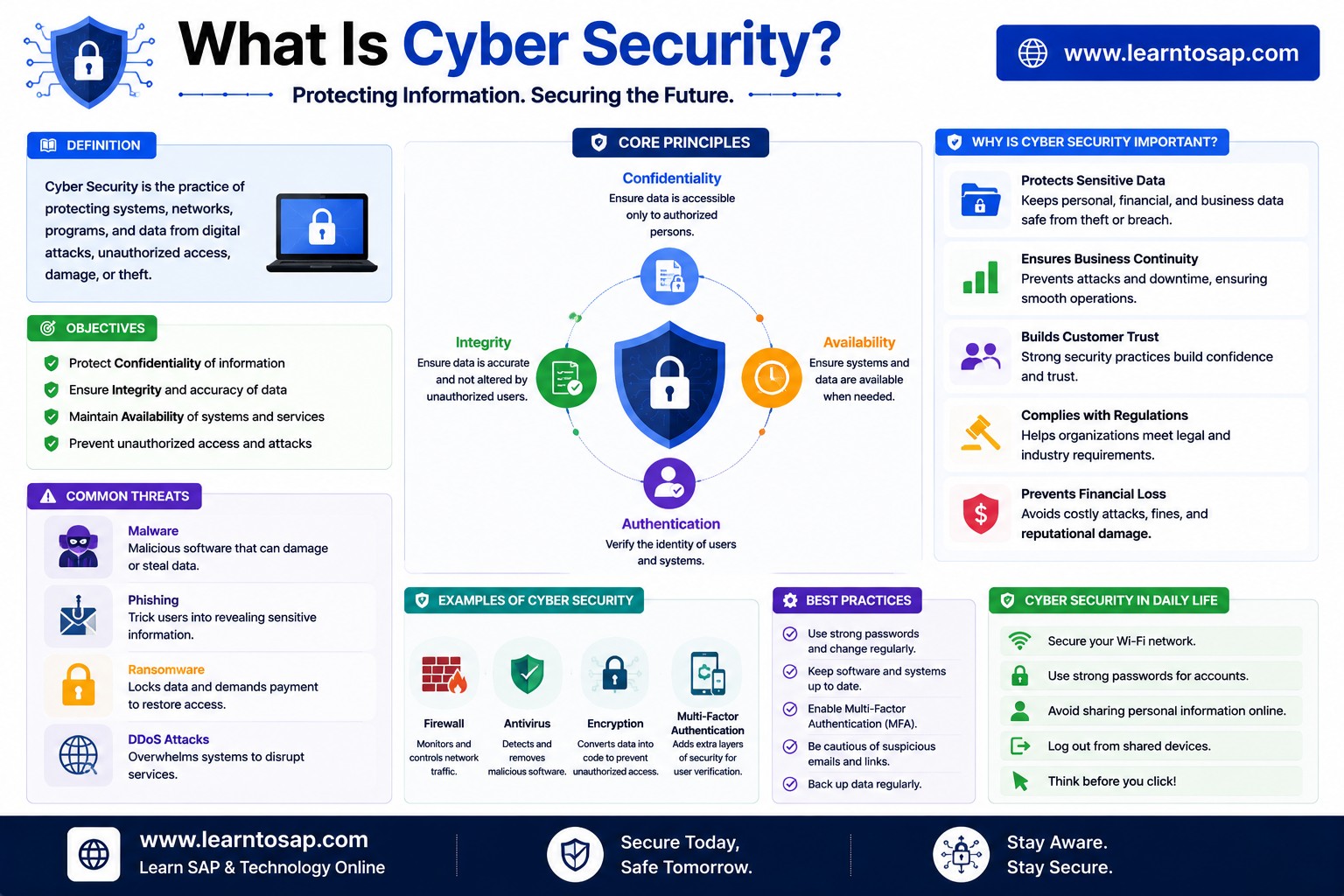
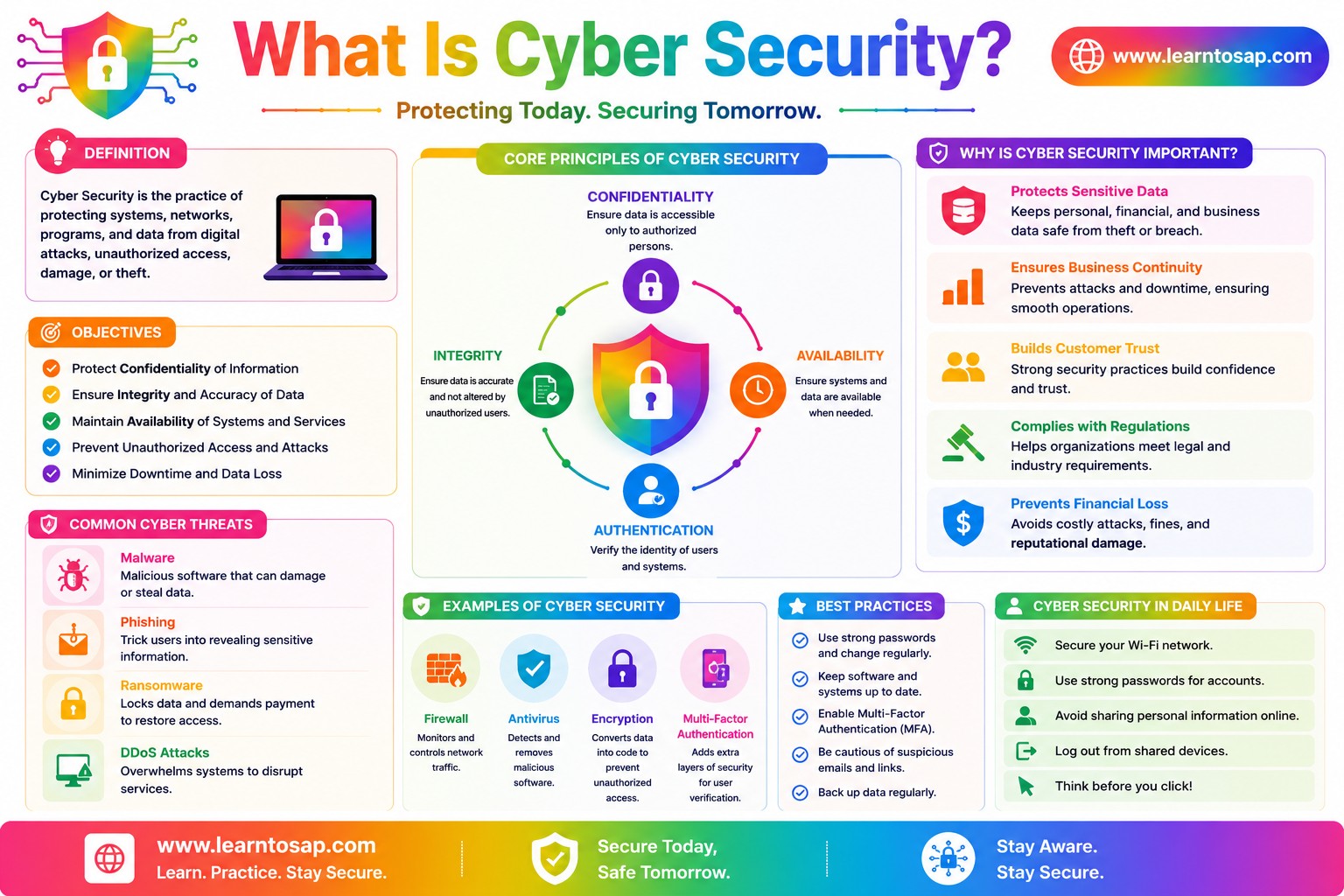
Cyber security is the practice of protecting computers, servers, mobile devices, networks, applications, and data from unauthorized access, damage, disruption, or theft. It is not a single tool or product - it is a combination of technology, well-defined processes, and trained people working together to reduce the risk of an attack succeeding, and to limit the damage if one does.
In this terms, think of cyber security as the digital comparable of the locks, alarms, security guards, and CCTV cameras that protect a physical building. A bank does not rely on a single lock on the front door - it layers multiple defenses: a security guard, a vault, CCTV, alarm systems, and background-checked staff. Cyber security works the same way. No single firewall or antivirus program is enough on its own; organizations layer firewalls, encryption, access controls, monitoring, employee training, and incident response plans so that if one layer fails, another layer catches the problem.
Cyber security is also confused with related but distinct terms. Information security is the broader discipline of protecting information in any form (digital or physical), while cyber security specifically focuses on protecting digital systems and data from cyber-based threats. IT security generally refers to protecting an organization's technology infrastructure, and network security is one specific slice of cyber security focused only on the network layer. As you go through this tutorial, you'll see how these pieces fit together.
✅ Why Cyber Security Matters in 2026-27
Cyber security has moved from being a back-office IT concern to a board-level business priority. Almost every part of daily life and business now runs through digital systems - banking, healthcare records, government services, manufacturing plants, power grids, retail checkout systems, and even home appliances connected to the internet. Every one of these digital touchpoints is a potential target, and every one of them needs to be defended.
Attackers today are not limited to lone hobbyists working from a bedroom. Modern threat actors include organized cybercrime groups running ransomware as a business model, state-sponsored groups conducting espionage or sabotage, and insider threats from disgruntled or careless employees. The tools available to attackers have also become more accessible - phishing kits, ransomware-as-a-service platforms, and stolen credential marketplaces mean that launching an attack no longer requires deep technical expertise.
The consequences of a successful attack go well beyond a technical inconvenience. A serious breach can mean direct financial loss (through fraud, ransom payment, or theft), regulatory fines under laws such as GDPR, reputational damage that drives customers away, legal liability from affected customers or partners, and in critical sectors like healthcare or energy, real-world physical safety risk. This is why cyber security is now treated as a core part of running any organization, not an optional add-on.
✅ The CIA Triad – Confidentiality, Integrity, Availability
Almost everyday security control that exists - from a password policy to a firewall rule to a backup schedule - exists to protect one (or more) of three core goals. This model is called the CIA Triad, and it is the single most important concept in all of cyber security.
Confidentiality means that data is only visible to the people who are supposed to see it. A hospital's patient records, for example, should only be accessible to authorized medical staff - not to every employee in the building. Confidentiality is enforced through tools like encryption (which scrambles data so it's unreadable without a key), strong authentication (passwords, multi-factor authentication), and access controls (permissions that limit who can open which files).
Integrity means that data has not been tampered with, whether by an attacker, a software bug, or an accidental change. If a bank transaction record could be silently altered by an attacker, the entire financial system would collapse. Integrity is protected with techniques such as cryptographic hashing (creating a unique fingerprint of data so any change is detectable), digital signatures, and strict change-control processes.
Availability means that systems, applications, and data are accessible to authorized users whenever they are needed. An e-commerce site that goes down during a major sale event, or a hospital system that becomes unreachable during an emergency, illustrates why availability matters just as much as secrecy. Availability is protected through redundant infrastructure, backups, disaster recovery planning, and defenses against Denial-of-Service attacks.
✅ Key Cyber Security Terms Every Beginner Should Know
Before diving deeper, it helps to understand a handful of terms that appear constantly across cyber security discussions, job postings, and news articles.
- Vulnerability – A weakness in a system, application, or process that could potentially be exploited by an attacker (for example, unpatched software or a misconfigured server).
- Threat – Anything with the potential to cause harm to a system, such as a hacker, a piece of malware, or even a natural disaster affecting a data center.
- Exploit – A specific technique or piece of code that takes advantage of a vulnerability to cause an unintended or harmful outcome.
- Risk – The likelihood that a threat will exploit a vulnerability, combined with the potential impact if it does. Risk = Threat × Vulnerability × Impact, in simple terms.
- Attack surface – The total sum of all points where an attacker could try to get into a system - every open port, exposed application, user account, and connected device adds to it.
- Zero-day – A vulnerability that is unknown to the software vendor and therefore has no official patch available yet, making it especially dangerous.
- Patch – A software update released to fix a known vulnerability or bug.
- Firewall – A system that monitors and controls incoming and outgoing network traffic based on defined security rules.
- Encryption – The process of converting readable data into an unreadable format that can only be reversed with the correct decryption key.
- Multi-factor authentication (MFA) – A login method that requires two or more independent proofs of identity, such as a password plus a one-time code sent to your phone.
✅ Types of Cyber Security
Cyber security is not one single discipline - it's a collection of specialized domains that each protect a different layer of technology. Understanding these categories helps explain why organizations need multiple teams and tools working together, rather than a single "security product."
🌐 Network Security
Protects the underlying network infrastructure from intrusion, misuse, and disruption. This includes firewalls, intrusion detection/prevention systems (IDS/IPS), VPNs, and network segmentation that limits how far an attacker can move if they get inside.
💻 Application Security
Focuses on finding and fixing security flaws within software applications - both during development (secure coding practices) and after deployment (vulnerability scanning, web application firewalls). Covers issues like SQL injection and cross-site scripting.
☁️ Cloud Security
Protects data, applications, and infrastructure hosted in cloud environments (AWS, Azure, Google Cloud). Because cloud resources are shared and configuration-driven, misconfigured storage buckets and overly broad access permissions are among the most common cloud security failures.
🖥️ Endpoint Security
Protects individual devices - laptops, desktops, phones, tablets - that connect to a network. Endpoint security tools include antivirus/anti-malware software, endpoint detection and response (EDR), and device encryption.
🗂️ Information Security
The broader discipline of protecting information itself, in any form, from unauthorized access or disclosure - including physical documents, verbal communication, and digital records, not just computer systems.
📡 IoT Security
Protects internet-connected devices outside the traditional computer/phone category - smart cameras, industrial sensors, medical devices, and smart home equipment - which often ship with weak default security settings.
👤 Operational Security (OPSEC)
Focuses on the processes and decisions people make when handling data - for example, who has permission to access sensitive records, and how those permissions are granted, reviewed, and revoked over time.
✅ Common Types of Cyber Threats And Attacks
Understanding the most common categories of threats is essential for recognizing risk, whether you're protecting a personal laptop or an entire organization's network.
🦠 Malware
Malware ("malicious software") is an umbrella term for any software designed to harm, exploit, or gain unauthorized access to a system. It includes viruses (which attach to files and spread when shared), worms (which self-replicate across networks without user action), trojans (which disguise themselves as legitimate software), and spyware (which secretly monitors user activity).
🔒 Ransomware
A specific type of malware that encrypts a victim's files or locks them out of their own systems, then demands payment - usually in cryptocurrency - in exchange for the decryption key. Ransomware has become one of the most financially damaging categories of cybercrime, frequently targeting hospitals, schools, and municipal governments.
🎣 Phishing
A social engineering technique where an attacker impersonates a trusted source - often through email - to trick a victim into revealing credentials, clicking a malicious link, or downloading malware. Variants include spear phishing (targeted at a specific individual), whaling (targeted at executives), and smishing/vishing (phishing via SMS or phone calls).
🌊 DDoS (Distributed Denial-of-Service)
An attack that floods a target system, server, or network with overwhelming traffic from many compromised devices at once, making the service unavailable to legitimate users. DDoS attacks directly target the "Availability" leg of the CIA Triad.
🕵️ Man-in-the-Middle (MITM) Attacks
An attacker secretly intercepts (and potentially alters) communication between two parties who believe they are communicating directly with each other - often exploited on unsecured public Wi-Fi networks.
💉 SQL Injection
An application-layer attack where malicious database queries are inserted into input fields (like a login form) to manipulate or extract data from a backend database that wasn't properly validating its inputs.
🎭 Social Engineering
A broad category of manipulation techniques that exploit human psychology - trust, urgency, fear, curiosity - rather than technical vulnerabilities, to convince a victim to take an action that compromises security.
🔓 Zero-Day Exploits
Attacks that take advantage of a software vulnerability before the vendor is even aware of it (and therefore before a patch exists), making them especially difficult to defend against with traditional signature-based tools.
🧑💼 Insider Threats
Security risks that originate from within an organization - a current or former employee, contractor, or business partner who misuses their legitimate access, whether maliciously or through carelessness.
✅ How a Cyber Attack Actually Happens – The Attack Lifecycle
Cyber attacks rarely happen in a single instant - they typically follow a multi-stage process. Understanding this lifecycle (often referred to as the "cyber kill chain") helps defenders identify where they can intervene before real damage occurs.
- Reconnaissance – The attacker researches the target, gathering information from public sources, social media, company websites, and leaked data to identify potential entry points.
- Initial Access – The attacker gains a foothold, often through a phishing email, a stolen credential, or an unpatched public-facing vulnerability.
- Execution & Persistence – Malicious code runs on the compromised system, and the attacker establishes a way to maintain access even if the system is rebooted or the initial entry point is closed.
- Privilege Escalation – The attacker attempts to gain higher-level permissions (such as administrator access) beyond their initial foothold.
- Lateral Movement – The attacker moves from the initially compromised system to other systems on the network, expanding their reach.
- Data Exfiltration or Impact – The final objective is carried out - stealing sensitive data, deploying ransomware, sabotaging systems, or achieving whatever goal motivated the attack.
✅ Cyber Security Best Practices for Individuals
Good personal cyber hygiene significantly reduces the chance of falling victim to the most common attacks, most of which target people rather than technology.
- Use strong, unique passwords for every account, ideally generated and stored by a password manager rather than reused or memorized.
- Enable multi-factor authentication (MFA) wherever it's offered - it remains one of the single most effective defenses against account takeover.
- Be skeptical of unexpected messages asking you to click a link, download a file, or provide sensitive information, even if they appear to come from someone you know.
- Keep software updated so that known vulnerabilities are patched before attackers can exploit them.
- Avoid public Wi-Fi for sensitive activity such as banking, or use a reputable VPN if you must connect on an untrusted network.
- Back up important data regularly, following the 3-2-1 rule: three copies of your data, on two different types of storage media, with one copy stored off-site or in the cloud.
- Check URLs and sender addresses carefully before entering credentials - phishing sites often use lookalike domains that differ by a single character.
✅ Cyber Security Best Practices for Businesses
Organizations face a broader set of responsibilities than individuals, since they must protect not only their own data but also customer, employee, and partner information.
- Apply the principle of least privilege - give every user and system only the minimum access needed to do their job, nothing more.
- Segment networks so that a breach in one area (such as a guest Wi-Fi network) cannot easily spread to critical systems.
- Maintain a patch management process to ensure known vulnerabilities in operating systems and applications are fixed on a predictable schedule.
- Run regular security awareness training for employees, since phishing and social engineering specifically target human behavior rather than technical controls.
- Deploy monitoring and logging (such as a SIEM - Security Information and Event Management system) so unusual activity can be detected quickly rather than discovered months later.
- Build and test an incident response plan in advance, so the organization knows exactly who does what during a breach, rather than improvising under pressure.
- Conduct regular vulnerability assessments and penetration tests to proactively find weaknesses before an attacker does.
- Encrypt sensitive data both at rest (in storage) and in transit (while being transmitted across networks).
✅ Cyber Security Frameworks And Compliance
Rather than inventing security programs from scratch, most organizations align their approach with established frameworks and standards, which provide structured, tested guidance.
| Framework / Standard | Focus |
|---|---|
| NIST Cybersecurity Framework | A flexible framework (Identify, Protect, Detect, Respond, Recover) widely used across industries, especially in the United States. |
| ISO/IEC 27001 | An international standard for establishing, implementing, and maintaining an Information Security Management System (ISMS). |
| GDPR | A European Union regulation governing how personal data of EU residents must be collected, stored, and protected. |
| PCI DSS | A standard specifically for organizations that store, process, or transmit payment card data. |
| OWASP Top 10 | A regularly updated list of the most critical security risks facing web applications, widely used by developers and security testers. |
Compliance with these frameworks is not just a legal or contractual requirement - it also provides a proven checklist that helps organizations avoid overlooking foundational security controls.
✅ Cyber Security Careers, Skills And Certifications
Cyber security offers one of the fastest-growing and most in-demand career paths in technology today, with roles suited to a wide range of interests and backgrounds.
- Security Analyst / SOC Analyst – Monitors systems for suspicious activity and responds to alerts, often the most common entry-level role.
- Penetration Tester (Ethical Hacker) – Simulates real attacks against systems, with permission, to find vulnerabilities before malicious actors do.
- Security Engineer – Designs, builds, and maintains the security infrastructure and tools an organization relies on.
- GRC Analyst (Governance, Risk, Compliance) – Focuses on policy, risk assessment, and ensuring the organization meets regulatory and framework requirements.
- Incident Responder – Investigates and contains active security incidents, often working under high time pressure.
- Cloud Security Engineer – Specializes in securing cloud infrastructure and configurations across platforms like AWS, Azure, or GCP.
Common entry-level certifications include CompTIA Security+, CompTIA Network+, and vendor-specific cloud security certifications. More advanced roles often pursue CEH (Certified Ethical Hacker), OSCP (Offensive Security Certified Professional), or CISSP (Certified Information Systems Security Professional) as their career progresses.
✅ Cyber Security Terms – Quick Reference Table
| Term | One-Line Meaning |
|---|---|
| CIA Triad | Confidentiality, Integrity, Availability - the three core security goals. |
| Vulnerability | A weakness that could be exploited. |
| Threat | Anything with the potential to cause harm. |
| Exploit | A technique used to take advantage of a vulnerability. |
| Malware | Umbrella term for malicious software. |
| Phishing | Deceptive messages used to trick victims into giving up information. |
| Ransomware | Malware that encrypts data and demands payment. |
| DDoS | Overwhelming a system with traffic to make it unavailable. |
| Zero-day | An unpatched, previously unknown vulnerability. |
| MFA | Requiring two or more proofs of identity to log in. |
✅ Practice – Yes / No Quiz
1. Does the CIA Triad stand for Confidentiality, Integrity, and Availability?
2. Is ransomware a type of malware that encrypts a victim's files and demands payment?
3. Are small businesses generally too small to be targeted by cyber attacks?
4. Does a DDoS attack primarily target the "Availability" leg of the CIA Triad?
5. Is a zero-day vulnerability one that already has an official patch available?