How to Create Invoice in SAP – VF01 TCode Explained (Step-by-Step Guide)
The invoice is the document that turns a delivery into money owed. This guide shows how to create an invoice with transaction VF01, using billing type F1, the billing date and the document number from the original screenshots. It explains what the invoice does in sales and finance, the related transactions VF02 and VF03, billing types, what happens when you save, common mistakes and troubleshooting. If you run into any errors while following along, feel free to send a screenshot to pramod@learntosap.com for help.
✅ How to Create Invoice in SAP Using VF01 TCode
Create Invoice: A Step-by-Step Guide
VF01 is a transaction code in SAP SD used to create invoices. It allows businesses to bill their customers for products or services delivered as part of a sales order. Invoice is crucial because it ensures accurate and timely billing, which is essential for financial stability. It also helps in tracking the revenue generated from sales activities.
In simple words, the invoice is the document that turns a delivery into money owed. Up to this point the company has taken an order, prepared the goods and shipped them. The billing document tells the customer how much to pay and tells finance how much revenue and receivable to record. This guide shows how to create the invoice with VF01 using the original screenshots, and then explains what happens behind the scenes.
📋 Where Billing Fits in Order-to-Cash
Billing is the closing stage of the sales process in SAP SD. The table shows each stage and the document it creates.
| Stage | What Happens | Document / Transaction |
|---|---|---|
| Quotation | The company offers a price. | VA21 |
| Sales order | The customer confirms the order. | VA01 |
| Outbound delivery | Goods are picked, packed and issued. | VL01N |
| Billing | The customer is invoiced. | VF01 |
| Payment | The customer pays and the receivable is cleared. | F-28 |
If you have followed the delivery process, such as picking, packing and post goods issue, the invoice is the natural next step. The same customer, material and price flow through every stage.
📝 Invoice Transactions at a Glance
Step-by-Step: Create Billing Document Using VF01
| Transaction | Purpose |
|---|---|
| VF01 | Create invoice. |
| VF02 | Modify invoice. |
| VF03 | Display invoice. |
| VF04 | Process the billing due list. |
| VF11 | Cancel a billing document. |
| FB03 | Display the accounting document created by billing. |
🔧 What You Need Before You Create an Invoice
- A delivered order. The document you bill, here 80018042, must be ready for billing, usually after the goods issue is posted.
- A customer master that is complete in the sales area, including payment terms and the account assignment group.
- Pricing that was determined in the sales order, so the invoice shows the right price, discounts and taxes.
- Account determination set up so that revenue and receivable accounts can be found.
- Authorization to create billing documents.
If one of these is missing, the invoice may stop with an error, or the accounting document may not be created.
🔧 Step-by-Step: Create Invoice with VF01
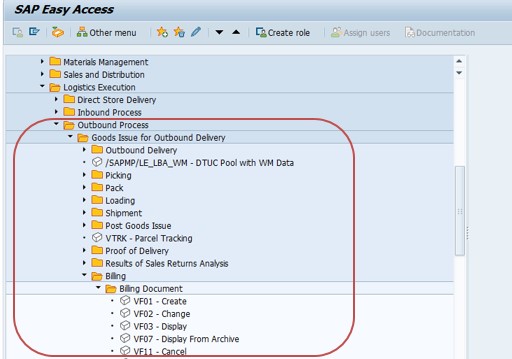
Following Path
Go to: Logistics Execution → Outbound Process → Billing → Create → VF01.
Menu names can differ slightly between releases, so you can also open the transaction directly by typing VF01 in the command field.
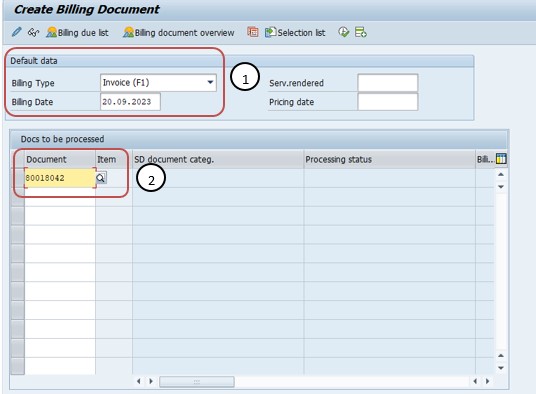
Select the billing type. Billing type: Invoice (F1).
Select the billing date. Billing date: 20-09-2023.
Select the document number. Document No: 80018042.
Select the Save button. Save the billing document. SAP shows a message that the document was saved.
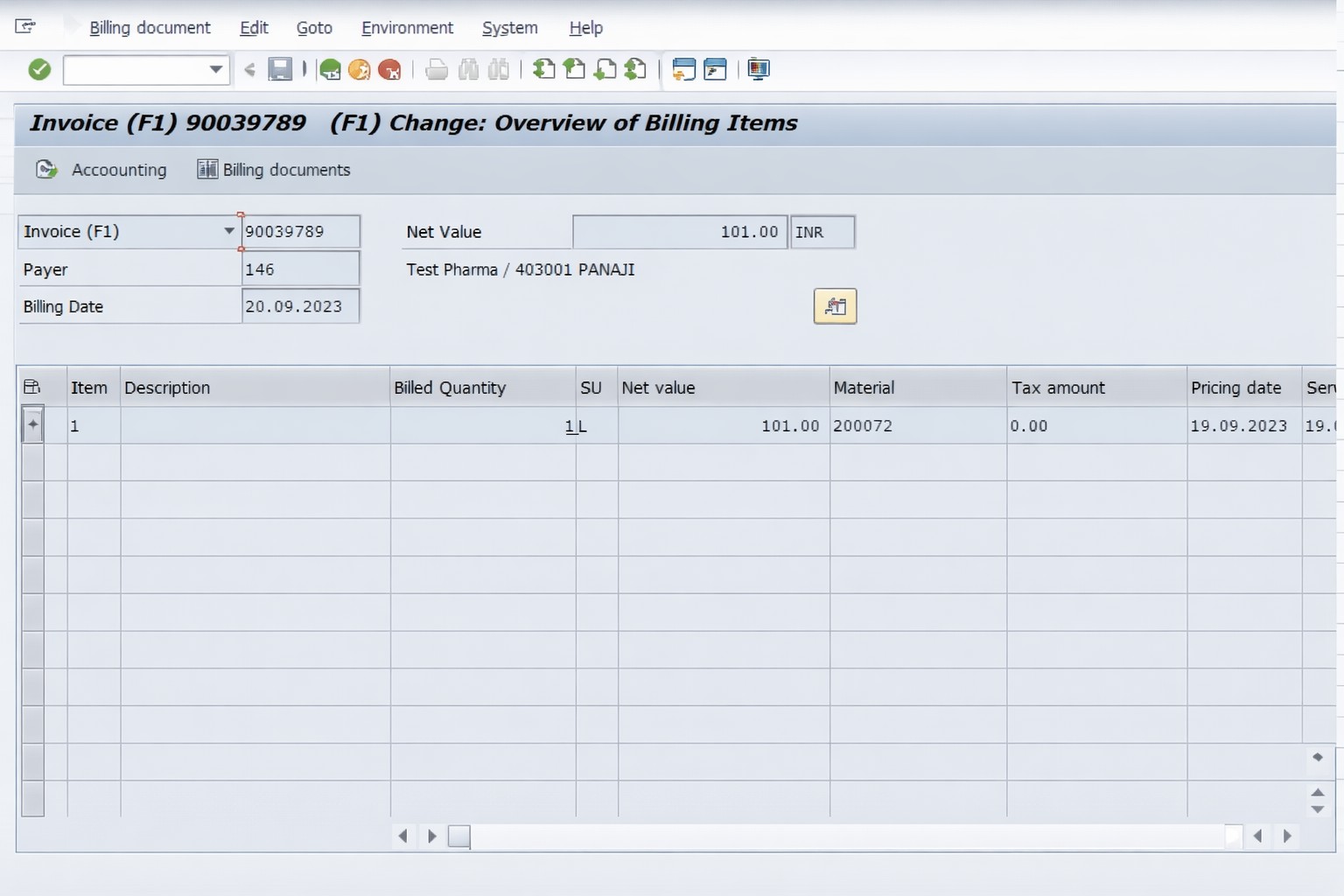
📋 Values Used in This Tutorial at a Glance
The table below summarizes every value from the steps above, so you can compare it with your own screen before you save.
| Item | Value Used | Note |
|---|---|---|
| Transaction | VF01 | Create invoice |
| Billing type | Invoice (F1) | Use the billing type your company assigns |
| Billing date | 20-09-2023 | As in the original screenshots |
| Document number | 80018042 | The document being billed |
| Final action | Save | Creates the billing document |
💡 Understanding Billing Types
The billing type controls how the invoice behaves: which number range it uses, how it posts to accounting and whether it can be copied from other documents. Invoice (F1) is used in this guide. Your company may use other billing types for different situations, such as invoices created directly from deliveries, credit memos, debit memos or cancellations.
| Document Type | Used For |
|---|---|
| Invoice | Billing the customer for goods or services delivered. |
| Credit memo | Reducing the amount the customer owes, for example after a return. |
| Debit memo | Increasing the amount the customer owes. |
| Cancellation | Reversing a billing document created by mistake. |
Billing types and their codes are configured per company, so confirm the types in your own system before you train users.
💰 What Happens When You Save the Invoice
Saving the billing document is more than a print job. In a standard setup, SAP creates an accounting document that records the customer receivable and the revenue, together with any tax. The customer account is debited, and the revenue and tax accounts are credited, based on the account determination of your company. The sales order document flow now shows the billing document, and the order is marked as billed.
The invoice also fixes the payment due date. SAP uses the payment terms from the customer master to calculate when the amount is due, and the open item appears in the customer account until the payment is received. Because the invoice changes both sales and finance data, it should be created only when the delivery is confirmed. The exact accounting entries depend on your configuration, so confirm them with your finance team.
🔄 Billing One Document or Many
This guide creates one invoice for one document. In daily work, finance teams often bill many deliveries at once. The billing due list, available with VF04, shows all documents that are ready for billing, and the user can select and bill them together. Many companies also run billing in the background on a schedule, so that every delivered order is billed overnight without manual work.
Whichever method you use, the same rules apply: the delivery must be complete, pricing must be correct and the customer data must be maintained. A good habit is to review the due list regularly, because documents that stay in it for long usually have a problem, such as a billing block or missing data.
💼 Real-World Scenario: Billing a Delivery at Learn Pharma, Pune
At Learn Pharma in Pune, the warehouse posted goods issue for a delivery on 20-09-2023. Finance executive Pooja Patil received a request from sales manager Rohan Kulkarni to invoice the customer the same day.
Pooja opened VF01, selected billing type Invoice (F1), entered the billing date and the document number 80018042, and saved. SAP created the billing document and the accounting document. Finance lead Sameer Joshi checked the entry with FB03 and confirmed that the receivable and the revenue were posted as expected.
Pooja sent the invoice to the customer, and the payment due date was calculated from the customer's payment terms. She added the steps to her work instruction, so a new colleague could create the next invoice without help.
📝 Header and Item Data in the Billing Document
The billing document has header data and item data. Knowing where each piece of information lives makes it easier to check an invoice before it goes to the customer.
| Level | Examples | Why It Matters |
|---|---|---|
| Header | Billing type, billing date, payer, payment terms, currency, document number. | Controls who is billed, when and in which currency. |
| Item | Material, billed quantity, net value, tax, pricing conditions. | Shows exactly what the customer is charged for. |
| Accounting | Receivable, revenue and tax postings. | Shows how the invoice affects the ledger. |
| Status | Billing status, accounting status, cancellation status. | Shows whether the document is complete and posted. |
Before sending the invoice, compare the header and item values with the sales order. Any difference in price or quantity should have a clear reason, such as a change agreed with the customer.
💰 How Pricing Reaches the Invoice
The price on an invoice normally comes from the sales order. When the order was created, SAP determined the pricing procedure and the condition records, and these values are copied into the billing document. This means the customer is billed the price that was confirmed, even if the price list changed afterwards, unless your company has chosen to re-determine pricing at billing.
If the invoice price differs from the order, check the pricing screen of both documents. Typical causes are manual changes in the order, a new condition record that applies at billing time, or a copy control setting that re-determines prices. Finance and sales should agree on the rule in advance, because customers react quickly to price differences on an invoice.
Taxes are also part of the invoice. They are determined from the customer, the material and the tax settings, and they are posted to separate accounts. Always confirm the tax result with your tax team when a new customer or a new product is billed for the first time.
📅 Payment Terms and the Due Date
Every invoice has a payment due date. SAP calculates it from the payment terms in the customer master, which may say, for example, that payment is due in thirty days or that a discount applies for early payment. The due date drives collections: it decides when the item becomes overdue and when reminders are sent.
Because the terms come from the master data, a wrong entry there affects every invoice for that customer. When you create the first invoice for a new customer, check the terms on the billing document and compare them with the contract. A small correction in the master data is much cheaper than correcting dozens of invoices later.
📄 Sending the Invoice to the Customer
After the billing document is saved, it has to reach the customer. In SAP this is handled by output determination. Depending on your setup, the invoice can be printed, sent by email or transmitted electronically. The output type, the language and the form are configured per company, and they can be overridden for a specific customer.
If the output does not appear, check that the output type is determined for the billing document and that the customer has a valid email address or printer assignment. It also helps to review the layout once after any change to the company logo, the bank details or the tax text, because errors in these areas appear on every invoice.
⛔ Billing Blocks and Credit Checks
Sometimes an invoice cannot be created because the document is blocked. A billing block can be set on the sales order, on the delivery or on the customer. Typical reasons are a price dispute, a missing approval or a credit limit problem. The block protects the company, but it also holds up revenue, so the person who sets it should record the reason and follow up.
Review blocked documents regularly. A list of blocked orders, with the reason and the responsible person, helps finance and sales to clear them quickly. Once the reason is solved, the block is removed and the document appears again in the billing due list.
✅ Checklist Before You Create the Invoice
| Check | Done When |
|---|---|
| Delivery | Goods issue is posted and the delivery is complete. |
| Customer data | Payer, payment terms and tax data are correct. |
| Pricing | The price, discounts and taxes match the sales order. |
| Blocks | No billing or credit block exists. |
| Billing type | The correct billing type, such as F1, is chosen. |
| Date | The billing date is correct for the period. |
Walking through this list takes only a few minutes, and it prevents most cancellations of invoices.
📊 How Billing Connects Sales and Finance
Billing is the point where the sales module hands over to finance. Everything before it deals with quantities and prices. Everything after it deals with amounts in the ledger. Because of this, many companies review billing results together at month end. Sales checks that every delivered order has been invoiced, and finance checks that every invoice has an accounting document.
A simple month-end routine is to look at the billing due list for old items, compare the total of invoices with the revenue accounts, and clear any difference with an explanation. When sales and finance use the same documents and the same numbers, closing the month becomes faster and there are fewer arguments about which figures are correct.
Write the routine down and share it with both teams. A one-page month-end billing checklist, with an owner for each line, turns a stressful task into a predictable one and gives new colleagues a clear picture of how their work connects to the rest of the order-to-cash process.
❗ Common Mistakes When Creating an Invoice
- Billing a delivery before the goods issue is posted.
- Entering the wrong document number, so the wrong order is billed.
- Choosing the wrong billing type for the situation.
- Ignoring pricing differences between the order and the invoice.
- Saving without checking the accounting document.
- Cancelling and re-creating invoices without informing finance.
🔧 Troubleshooting: When the Invoice Does Not Work
| Symptom | Likely Cause | What to Check |
|---|---|---|
| Document not found for billing. | Goods issue is not posted or the document number is wrong. | Check the delivery status and the document number. |
| Billing is blocked. | A billing block is set on the order or customer. | Check blocks in the sales order and customer master. |
| No accounting document created. | Account determination is missing. | Check the revenue account determination with the finance team. |
| Price differs from the order. | Pricing was changed or re-determined. | Compare the pricing screen of the order and the invoice. |
| Cannot save the invoice. | A mandatory field or number range problem. | Read the message and check the billing type settings. |
✅ Best Practices for Invoicing
- Bill only completed deliveries, and keep the billing due list clean.
- Review the pricing of each invoice before sending it to the customer.
- Check the accounting document for new billing types or new customers.
- Keep customer payment terms and tax data up to date.
- Use background billing for high volumes, with a review of errors.
- Document the billing process and the responsible roles.
🔄 Cancelling or Correcting an Invoice
If an invoice is created by mistake, do not change the accounting document directly. In a normal setup the billing document is cancelled with VF11, which creates a cancellation document and reverses the accounting. After that, the delivery can be billed again correctly. For small changes before the invoice is released to accounting, VF02 may be used, depending on your configuration. Always follow your company's approval process, because billing documents are legal and financial records.
📱 This Process in SAP S/4HANA
Billing remains a core function in SAP S/4HANA, although screens, Fiori apps and some transactions can differ from the classic examples used here. Confirm the exact steps in your own release before you train users. The business principle does not change: the delivered goods are billed, and the billing document posts the receivable and the revenue.
🎓 Interview-Style Questions and Answers
Q: What is VF01 used for?
It creates an invoice, also called a billing document, in SAP SD.
Q: Which transactions are related?
VF02 to modify and VF03 to display.
Q: What happens when the invoice is saved?
The billing document is created and the accounting document records the receivable and revenue.
Q: How do you bill many deliveries at once?
With the billing due list in VF04, or with background billing.
Q: How do you cancel an invoice?
With VF11, which creates a cancellation document.
📚 Quick Glossary of Terms Used in This Guide
- Billing Document: The invoice or related document created in billing.
- Billing Type: A key that controls how a billing document behaves, such as F1.
- Billing Due List: The list of documents ready to be billed.
- Account Determination: The rules that find the G/L accounts for postings.
- Payment Terms: The rules that set the payment due date.
- Document Flow: The chain of documents linked to a sales order.
🎯 Conclusion
Creating an invoice with VF01 is the step that turns a delivery into revenue. Open the transaction, select billing type Invoice (F1), enter the billing date and the document number and save. Then check the billing document and the accounting document, and keep the document flow clean. With the same steps repeated for every delivery, billing becomes fast, accurate and easy to audit. If you run into any errors while following along, feel free to send a screenshot to pramod@learntosap.com for help.