How To Create One-Time Vendor in SAP (FK01) – Step-by-Step Guide
A one-time vendor is a shared account that serves many occasional suppliers, so the vendor list stays clean. This guide shows how to create one with transaction FK01, using company code 1211, the account group CPD, the name Test Pharma Vendor 1, reconciliation account 375000 and the original screenshots. It explains how the account works when documents are posted, how to control the risk, common mistakes, troubleshooting and best practices. If you encounter any errors in SAP, send a screenshot to pramod@learntosap.com and I will help you resolve the issue.
✅ FK01 Transaction in SAP: Create One-Time Vendor
Create One-Time Vendor: A Step-by-Step Guide
Not every supplier deserves a permanent record. A caterer hired once for an event, a repair shop used in an emergency or a consultant paid for a single task rarely appears again. SAP solves this with the one-time vendor: one shared account that can be used for many such suppliers. This guide shows how to create that account with transaction FK01 using the original screenshots, and then explains how it works, how to control it and which mistakes to avoid.
In simple words, the one-time vendor is a shared envelope for payables. Each invoice goes into the same envelope, and the name, address and bank details of the real supplier are written on the document itself.
📝 What Is a One-Time Vendor?
One-time vendors in SAP FICO are vendors that are used for a single transaction or for occasional purchases and do not require setting up a permanent vendor master record. Instead of creating a full vendor master record with all the details, you can use FK01 to create one-time vendor accounts quickly.
📋 One-Time Vendor Compared with a Regular Vendor
| Point | One-Time Vendor | Regular Vendor |
|---|---|---|
| Number of records | One shared account for many suppliers. | One record for each supplier. |
| Name and address | Entered in each document. | Stored once in the master record. |
| Account group | A special one-time group, here CPD. | A standard vendor group. |
| Best for | Rare, one-off purchases. | Suppliers used again and again. |
| Payment run | Often paid manually or with extra checks. | Included in the automatic payment program. |
Because the details change with every document, a one-time vendor needs stricter control than a regular vendor. A later section explains how.
📝 Vendor Creation Transactions at a Glance
Create Vendor in SAP TCode FK01
| Transaction | Purpose |
|---|---|
| FK01 | Create a vendor in financial accounting (used in this guide). |
| MK01 | Create a vendor for purchasing. |
| XK01 | Create a vendor centrally with all views. |
| FK03 | Display a vendor in financial accounting. |
| FS00 | Create or check the reconciliation account. |
| FB60 | Enter a vendor invoice. |
🔧 What You Need Before You Create the Account
- An account group for one-time vendors, here CPD, set up by the configuration team.
- A company code, here 1211, ready for accounts payable.
- A reconciliation account, here 375000, created for vendors.
- A decision on payment terms and the rules for paying one-time vendors.
- Authorization to create vendor master records.
If the account group does not exist yet, ask the configuration team to create it first, and then return to this tutorial.
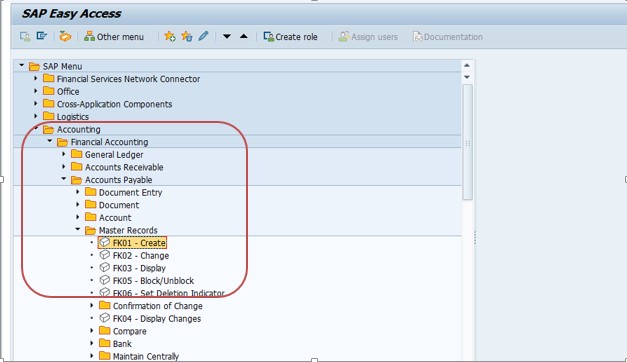
📍 Navigation Path for FK01
Follow Path
ACCOUNTING → FINANCIAL ACCOUNTING → ACCOUNTS PAYABLE → MASTER RECORDS → FK01
You can also open the transaction directly by typing FK01 in the command field, which is faster once you know where the setting lives.
🔧 Step-by-Step: Create a One-Time Vendor with FK01
Go to Tcode FK01
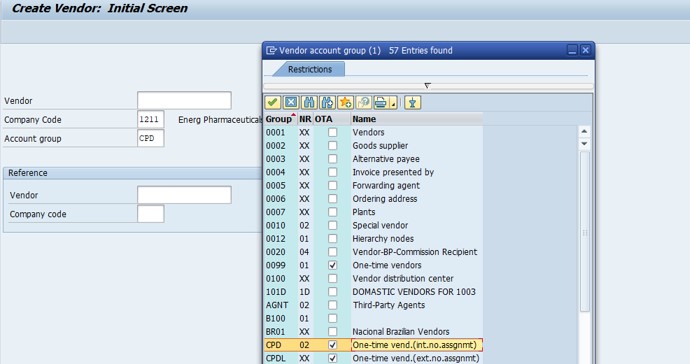
Select the company code. Company Code: 1211.
Select the account group. Account Group: CPD (One Time Vendor).
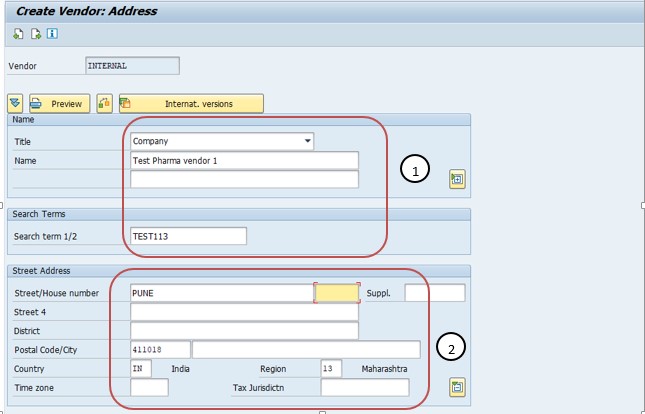
Select the title. Title: Company.
Select the name. Name: Test Pharma Vendor 1.
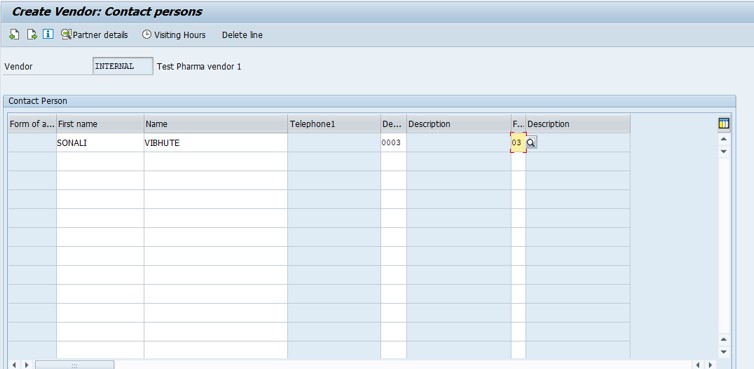
Select the contact person. Contact Person: XYZ.
Select the reconciliation account. Recon Account: 375000.
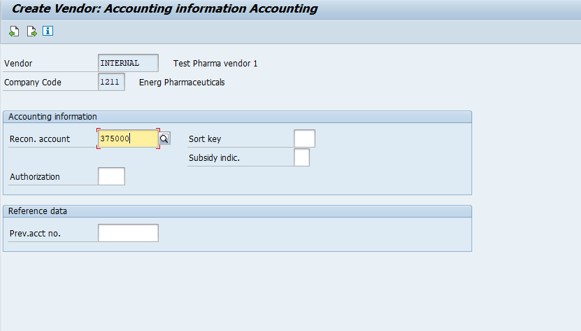
Select the Save button. SAP shows a message that the vendor was created.
📋 Values Used in This Tutorial at a Glance
The table below summarizes every value from the steps above, so you can compare it with your own screen before you save.
| Field | Value Used | Note |
|---|---|---|
| Transaction | FK01 | Create vendor (accounting) |
| Company code | 1211 | Use your own company code |
| Account group | CPD (One Time Vendor) | Special group for shared accounts |
| Title | Company | Form of address |
| Name | Test Pharma Vendor 1 | Name of the shared account |
| Contact person | XYZ | Placeholder in the example |
| Reconciliation account | 375000 | Collects vendor postings |
| Final action | Save | Creates the account |
💰 How a One-Time Vendor Works When You Post
The master record created in this guide holds only the shared settings: the account group, the company code and the reconciliation account. The name, address and bank details of each real supplier are not stored here. When a user posts an invoice to the one-time vendor, SAP opens an extra screen for the data of that specific supplier. The user types the name, address and bank details, and SAP saves them with the document and not with the master record.
This keeps the vendor list clean, because a single repair shop or caterer does not become a permanent record. It also means that reports show these payables together under one account, and that the real supplier is found by opening the document. Exact screen names differ between releases, so test the posting with FB60 in a quality system before you train users.
📊 The Reconciliation Account 375000
The reconciliation account is a G/L account that collects the postings of all vendors in the company code. In this guide it is 375000. When an invoice is posted to the one-time vendor, SAP posts the payable to the vendor account and, automatically, to the reconciliation account in the general ledger. This keeps the sub-ledger and the general ledger equal at all times.
The account must exist and be marked as a reconciliation account for vendors, which you can check with FS00. If it is missing or has the wrong type, the vendor cannot be saved, or postings fail later. Agree the account number with the finance team, and use the same one for vendors of the same type.
🔒 Controlling the Risk of One-Time Vendors
- Limit who can post. Only a small group should be allowed to post to the one-time vendor.
- Require approval. Invoices to the one-time account should be approved by a manager before payment.
- Check bank details twice. Because the details are typed in the document, a second person should verify them.
- Set value limits. Large payments should go to a regular vendor record with a proper onboarding check.
- Review regularly. Check the postings to the account every month for repeated names or unusual amounts.
- Block automatic payment. Pay one-time vendors manually or with extra checks.
One-time vendors are a common place for fraud and mistakes, because there is no stored history for the supplier. The controls above are inexpensive and catch most problems early.
📦 When to Use a One-Time Vendor
- A supplier used once for an event or a short project.
- An emergency repair where onboarding a full vendor is not worth the time.
- Refunds to people who are not regular suppliers.
- Small, occasional purchases below the company limit.
- Testing and training, where master data should not be polluted.
If the same supplier appears for the third time, create a regular vendor record. Regular records give you history, payment terms, tax data and proper reporting.
💼 Real-World Scenario: Paying a One-Off Supplier at Learn Pharma, Pune
At Learn Pharma in Pune, the office needed an urgent repair of the air conditioning. The repair shop had never worked with the company and was unlikely to return. Accounts payable executive Pooja Patil asked master data lead Sameer Joshi whether she should create a full vendor record.
Sameer explained that the company already had a one-time vendor for such cases. Functional consultant Neha Deshmukh had created it with FK01, using company code 1211, the account group CPD, a company title, the name Test Pharma Vendor 1, a contact person and the reconciliation account 375000.
Pooja posted the repair invoice to the one-time vendor and typed the shop's name, address and bank details in the extra screen. The finance lead checked the details and approved the payment. The vendor list stayed clean, and the document showed exactly who was paid. Neha added the rule to the work instruction.
❗ Common Mistakes with One-Time Vendors
- Using the one-time account for suppliers that are used again and again.
- Forgetting to enter the supplier's name and bank details in the document.
- Paying large amounts through the one-time account without a proper check.
- Choosing the wrong account group, so the account behaves like a regular vendor.
- Using a wrong or missing reconciliation account.
- Allowing too many users to post to the account.
🔧 Troubleshooting: When the One-Time Vendor Does Not Work
| Symptom | Likely Cause | What to Check |
|---|---|---|
| Account group not offered. | The group is not defined or not assigned. | Check the account group configuration. |
| Cannot save the vendor. | Reconciliation account missing or wrong. | Check the account with FS00. |
| Data screen for the supplier does not appear. | The group is not marked as one-time. | Check the one-time indicator of the account group. |
| Payment run skips the invoice. | One-time vendors are excluded from the run. | Check the payment program settings. |
| Cannot create the account. | Missing authorization or required field. | Read the message and check the required fields. |
✅ Best Practices for One-Time Vendors
- Create one one-time vendor per company code, and keep the number small.
- Name the account clearly so nobody mistakes it for a real supplier.
- Train users to enter the supplier's data in every document.
- Require approval and a second check of bank details.
- Move repeat suppliers to regular vendor records.
- Document the rules in a work instruction and review them once a year.
📊 Who Owns the One-Time Vendor
| Role | Responsibility |
|---|---|
| Master data lead | Creates the account and approves changes. |
| Finance lead | Checks the reconciliation account and approves payments. |
| Accounts payable | Enters the supplier's data in each document. |
| Internal audit | Reviews postings and the use of the account. |
| Key user | Tests posting and reports problems. |
Writing down these responsibilities avoids the situation where everyone uses the account and nobody checks it.
📱 One-Time Vendors in SAP S/4HANA
In SAP S/4HANA, vendors are normally created as business partners, and one-time accounts are set up through a special business partner grouping. Screens and transactions therefore differ from the classic examples used here. Confirm the exact steps in your own release before you train users. The business principle does not change: one shared account serves many occasional suppliers, and the supplier's data is entered in the document.
🎓 Interview-Style Questions and Answers
Q: What is a one-time vendor?
A shared vendor account for occasional suppliers, whose details are entered in each document.
Q: Which transaction creates it?
FK01, with the one-time account group CPD.
Q: Why use it?
It avoids permanent records for single transactions and keeps the vendor list clean.
Q: What is a reconciliation account?
A G/L account that collects the postings of all vendors.
Q: Where are the supplier's bank details stored?
In the document, not in the master record.
📚 Quick Glossary of Terms Used in This Guide
- One-Time Vendor: A shared account for occasional suppliers.
- CPD: The account group used for one-time accounts.
- Account Group: A group that controls how vendors are created and which fields appear.
- Reconciliation Account: A G/L account that collects vendor postings.
- Company Code: The smallest unit for which a complete set of accounts can be drawn up.
- Master Data: Long-lived records such as vendors and materials.
🎯 Conclusion
A one-time vendor keeps your vendor list clean while still letting you pay occasional suppliers. Open FK01, select company code 1211 and the account group CPD, enter the title, the name and the contact person, choose the reconciliation account 375000 and save. Then test a posting, enter the supplier's data in the document and keep tight control over who uses the account. If you run into any errors while following along, feel free to send a screenshot to pramod@learntosap.com for help.