How to Create One-Time Customer in SAP | FD01 Tcode Explained
A one-time customer is a shared account that serves many occasional buyers, so the customer list stays clean. This guide shows how to create one with transaction FD01, using the account group One Time Customer, company code 1211, reconciliation account 190000 and the original screenshots. It explains each tab of the customer master, how the account works when documents are posted, common mistakes, troubleshooting and best practices. If you run into any errors while following along, feel free to send a screenshot to pramod@learntosap.com for help.
✅ Create One-Time Customer in SAP FD01
Create One-Time Customer: A Step-by-Step Guide
A one-time customer is a clever shortcut in SAP. Instead of creating a permanent customer record for every person or company that buys only once, a company creates one special account and uses it for all of them. This guide shows how to create that account with transaction FD01 using the original screenshots, and then explains what each tab does, how the account behaves when documents are posted, and how to keep it under control.
In simple words, the one-time account is a shared envelope. Each purchase goes into the same envelope, and the name and address of the buyer are written on the document itself.
📝 What Is a One-Time Customer?
Using one-time customer master data (FD01) in SAP FICO streamlines processes by avoiding the creation of permanent customer records for infrequent transactions. It reduces data clutter, improves data security, and offers flexibility, cost-efficiency, and enhanced control. This functionality is particularly useful for organizations dealing with varying payment methods, business units, or rapidly changing market conditions, enabling quick adaptation to transaction-specific needs while maintaining clean and organized customer data.
📋 One-Time Customer Compared with a Regular Customer
| Point | One-Time Customer | Regular Customer |
|---|---|---|
| Number of records | One shared account for many buyers. | One record for each customer. |
| Name and address | Entered in each document. | Stored once in the master record. |
| Account group | A special one-time group. | A standard group such as Sold-to party. |
| Best for | Rare, one-off sales. | Repeat customers. |
| Reporting | Combined under one account. | Separate for each customer. |
Because reporting is combined, a one-time account is not suitable for customers who buy often. Move such customers to regular records, so that credit limits, dunning and statements work for them individually.
📝 Customer Creation Transactions at a Glance
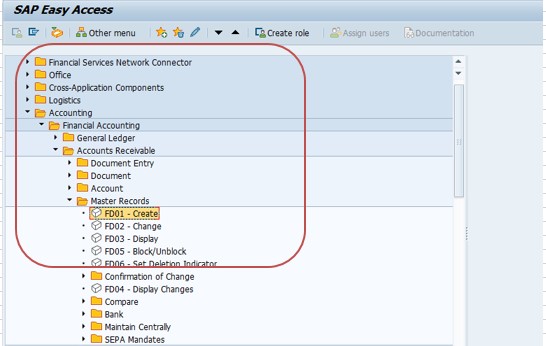
Go to Tcode FD01
| Transaction | Purpose |
|---|---|
| FD01 | Create a customer in financial accounting (used in this guide). |
| XD01 | Create a customer with sales and accounting data. |
| VD01 | Create a customer with sales data. |
| FD03 | Display a customer in financial accounting. |
| FS00 | Create or check the reconciliation account. |
| OBD2 | Maintain customer account groups. |
🔧 What You Need Before You Create the Account
- An account group for one-time customers, set up by the configuration team.
- A company code, here 1211, that is ready for accounts receivable.
- A reconciliation account, here 190000, created for customers.
- Payment terms and payment methods agreed with finance.
- Authorization to create customer master records.
If the account group does not exist yet, read the guide to create a new customer account group first, and then return to this tutorial.
📍 Navigation Path for FD01
Follow Path
ACCOUNTING → FINANCIAL ACCOUNTING → MASTER RECORDS → FD01
You can also open the transaction directly by typing FD01 in the command field, which is faster once you know where the setting lives.
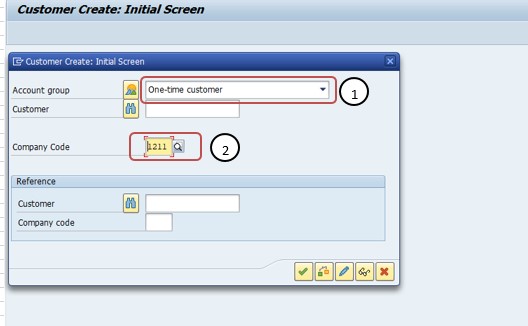
Select account group: One Time Customer. Company code: 1211.
💡 The Tabs of the Customer Master Explained
The FD01 screen is organized in tabs. Each tab answers a different question about the customer. The descriptions below explain what each one is for.
✅ General Data
This includes the customer's name, address, and communication details. Using one-time customers is beneficial when dealing with sporadic or infrequent transactions with a specific entity. By not cluttering your customer database with unnecessary data, you maintain a cleaner and more manageable system.
✅ Company Code Data
Specify the relevant company code for the one-time customer. This is especially useful when you have multiple company codes and want to keep financial transactions segregated. One-time customers can help keep your customer data organized and prevent errors that might occur when dealing with different codes.
✅ Accounting Information
The third tab is where you set up accounting information for the one-time customer. This data includes payment terms, reconciliation accounts, and payment methods. One-time customers can be advantageous when you need to quickly adapt to specific payment requirements or when dealing with different payment methods for various transactions.
✅ Sales Area Data
If you're using the one-time customer for sales purposes, this tab allows you to define sales area data such as sales organization, distribution channel, and division. By having a separate one-time customer, you can easily manage transactions in distinct sales areas without confusion.
✅ Company Code Data (Assignment)
This tab is where you assign the one-time customer to a specific company code. Again, it helps maintain financial transparency and prevents errors in your accounting records.
✅ Control Data
The sixth tab lets you control certain aspects of the one-time customer, such as dunning, interest calculation, and payment block. This level of control is beneficial when you need to enforce specific financial policies or rules for individual transactions.
✅ Payment Transactions
The last tab is dedicated to payment transactions. Here, you can specify data related to payments, such as payment methods, bank details, and currency information. Managing payment-related data separately for one-time customers ensures that financial transactions are processed correctly.
| Tab | Typical Content | Used in This Guide |
|---|---|---|
| General Data | Name, search term, address, communication. | Name and search term |
| Company Code Data / Accounting | Reconciliation account, payment terms. | Recon account 190000 |
| Payment Transactions | Payment methods, bank details. | Payment data |
Tab names and their order differ between releases and between FD01, XD01 and VD01, so compare with your own screen before you save.
🔧 Step-by-Step: Create a One-Time Customer with FD01
Go to Tcode FD01
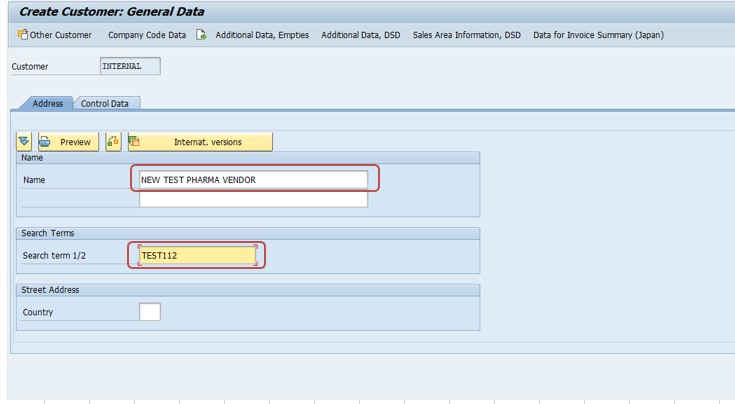
Select Create. Name: New Test Pharma Vendor.
Select the search term. Search Term: TEST112.
Select General Data.
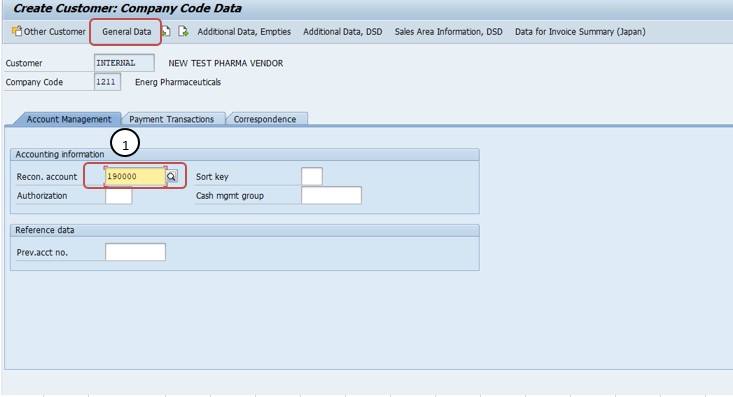
Select the reconciliation account. Recon Account: 190000.
Select General Data again and confirm the reconciliation account 190000.
Select Payment Data.
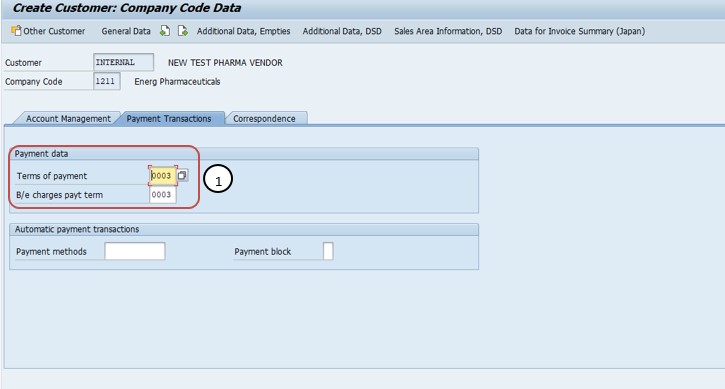
Save. SAP shows a message that the customer was created.
📋 Values Used in This Tutorial at a Glance
The table below summarizes every value from the steps above, so you can compare it with your own screen before you save.
| Field | Value Used | Note |
|---|---|---|
| Transaction | FD01 | Create customer (accounting) |
| Account group | One Time Customer | Special group for shared accounts |
| Company code | 1211 | Use your own company code |
| Name | New Test Pharma Vendor | Name of the shared account |
| Search term | TEST112 | Used to find the account |
| Reconciliation account | 190000 | Collects customer postings |
| Payment data | As shown on screen | Payment methods and terms |
| Final action | Save | Creates the account |
💰 How a One-Time Account Works When You Post
The master record created in this guide holds only the shared settings: the account group, the company code, the reconciliation account and the payment data. The name and address of each real buyer are not stored here. When a user posts an invoice to the one-time account, SAP opens an extra screen for the data of that specific customer. The user types the name, address and, where needed, bank details, and these are saved with the document and not with the master record.
This is why the account keeps the customer list clean: thousands of small buyers do not become thousands of master records. It is also why reports show them together under one account. If you need to see which real customer is behind a document, open the document and look at the one-time data. Exact screen names and fields differ between releases, so test the posting with FB70 in a quality system before you train users.
📊 The Reconciliation Account 190000
The reconciliation account is a G/L account that collects the postings of all customers in the company code. In this guide it is 190000. When an invoice is posted to the one-time customer, SAP posts the receivable to the customer account and, automatically, to the reconciliation account in the general ledger. This keeps the sub-ledger and the general ledger equal at all times.
The account must exist and be marked as a reconciliation account for customers, which you can check with FS00. If it is missing or has the wrong type, the customer cannot be saved, or postings fail later. Agree the account number with the finance team, and use the same one for all customers of the same type, unless the business needs separate accounts for different groups.
📦 When to Use a One-Time Customer
- Cash sales or walk-in customers who will not return.
- Small, occasional orders where creating a full record is not worth the effort.
- Refunds or credits to people who are not regular customers.
- Testing and training, where the master data should not be polluted.
- Short projects with many unique buyers, for example an event.
Do not use the account for customers who buy often, who need credit limits or statements, or who receive regular reminders. For them, a full customer record is the better choice.
💼 Real-World Scenario: Walk-in Buyers at Learn Pharma, Pune
At Learn Pharma in Pune, the sales counter often served walk-in buyers who purchased samples once and never returned. Each time, the team created a new customer record, and after a year the customer list was full of names nobody used. Master data lead Sameer Joshi asked functional consultant Neha Deshmukh for a cleaner solution.
Neha opened FD01, selected the account group One Time Customer and company code 1211, entered the name and the search term, chose the reconciliation account 190000, filled the payment data and saved. Sales coordinator Pooja Patil then posted the next walk-in sale to the new account and typed the buyer's name and address in the one-time data screen.
The customer list stopped growing, reports stayed tidy, and finance could still find each buyer through the document. Neha recorded the setup in the master data guide, so new colleagues knew when to use the one-time account and when to create a regular customer.
⚙ Control Data: Dunning, Interest and Payment Blocks
The Control Data settings decide how the account behaves in the receivables process. Dunning controls whether reminders are created for open items. Interest calculation controls whether late-payment interest is charged. A payment block stops the account from being included in an automatic payment run. For a shared one-time account, these settings need careful thought, because they apply to everything posted to it, not to a single buyer.
Many companies switch dunning off for one-time accounts, since reminders to a shared account would be meaningless, and collect payment at the time of sale instead. Others keep a clearing process that checks open items by hand. Whatever you choose, agree it with finance and write it in the work instruction, so users know what to expect.
🏦 Payment Methods and Bank Details
The payment data in this guide defines how money is received from or paid to the account. Typical entries are the allowed payment methods, the payment terms and, where needed, bank details. For a one-time account, bank details of the individual buyer are usually entered in the document, because they differ every time. The master record holds only the general rules.
Check that the payment terms match your sales practice. If walk-in buyers pay immediately, the terms should say so, so that open items do not look overdue. Review the settings with the finance team whenever the way of collecting payment changes, for example when a new card or online payment method is introduced.
📅 A Simple Routine for Managing the One-Time Account
| Step | Action | Owner |
|---|---|---|
| 1 | Create the one-time account with FD01 and agree the settings. | Master data lead |
| 2 | Train users to enter the buyer's data in each document. | Finance lead |
| 3 | Review postings to the account every month. | Accounts receivable |
| 4 | Move repeat buyers to regular customer records. | Master data lead |
| 5 | Check the reconciliation account at month end. | Finance lead |
| 6 | Update the work instruction once a year. | Project team |
Following the same six steps keeps the one-time account useful instead of turning it into a place where problems hide.
❗ Common Mistakes with One-Time Customers
- Using the one-time account for customers who buy every month, which hides their history.
- Forgetting to enter the buyer's name and address in the document, so nobody knows who bought.
- Choosing the wrong account group, so the account behaves like a regular customer.
- Using a wrong or missing reconciliation account.
- Allowing credit limits or dunning on an account that serves many different buyers.
- Giving everyone the right to post to the one-time account without a control.
🔧 Troubleshooting: When the One-Time Account Does Not Work
| Symptom | Likely Cause | What to Check |
|---|---|---|
| Account group not offered. | The group is not defined or not assigned. | Check the account group configuration. |
| Cannot save the customer. | Reconciliation account missing or wrong. | Check the account with FS00. |
| Data screen for the buyer does not appear. | The group is not marked as one-time. | Check the one-time indicator of the account group. |
| Wrong name on the document. | The user typed the data in the wrong field. | Open the document and check the one-time data. |
| Cannot create the account. | Missing authorization or required field. | Read the message and check the required fields. |
✅ Best Practices for One-Time Customers
- Create one one-time account per company code, and keep the number small.
- Name the account clearly so nobody mistakes it for a real customer.
- Train users to enter the buyer's data in every document.
- Limit the right to post to the account and review postings regularly.
- Move repeat buyers to regular customer records.
- Document the rules in a work instruction and review them once a year.
📊 Who Owns the One-Time Account
| Role | Responsibility |
|---|---|
| Master data lead | Creates the account and approves changes. |
| Finance lead | Checks the reconciliation account and payment terms. |
| Sales team | Enters the buyer's data in each document. |
| Auditor | Reviews postings and the use of the account. |
| Key user | Tests posting and reports problems. |
Writing down these responsibilities avoids the situation where everyone uses the account and nobody checks it.
📱 One-Time Customers in SAP S/4HANA
In SAP S/4HANA, customers are normally created as business partners, and one-time accounts are set up through a special business partner grouping. Screens and transactions therefore differ from the classic examples used here. Confirm the exact steps in your own release before you train users. The business principle does not change: one shared account serves many occasional buyers, and the buyer's data is entered in the document.
🎓 Interview-Style Questions and Answers
Q: What is a one-time customer?
A shared customer account for occasional buyers, whose name and address are entered in each document.
Q: Which transaction creates it?
FD01, with the one-time account group.
Q: Why use it?
It avoids permanent records for rare transactions, keeps the customer list clean and improves data security.
Q: What is a reconciliation account?
A G/L account that collects the postings of all customers.
Q: Where is the buyer's address stored?
In the document, not in the master record.
📚 Quick Glossary of Terms Used in This Guide
- One-Time Customer: A shared account for occasional buyers.
- Account Group: A group that controls how customers are created and which fields appear.
- Search Term: A short text used to find the account.
- Reconciliation Account: A G/L account that collects customer postings.
- Company Code: The smallest unit for which a complete set of accounts can be drawn up.
- Master Data: Long-lived records such as customers and materials.
🎯 Conclusion
A one-time customer keeps your customer list clean while still letting you sell to occasional buyers. Open FD01, select the account group One Time Customer and company code 1211, create the account with the name and search term, choose the reconciliation account 190000, fill the payment data and save. Then test a posting and enter the buyer's data in the document. If you run into any errors while following along, feel free to send a screenshot to pramod@learntosap.com for help.