SAP: "Material Does Not Need to Be Handled in Batches"
This message appears when you try to create or maintain a batch for a material whose batch management indicator is currently switched off. Unlike a genuine error, this is often just SAP correctly confirming the material isn't set up for batch tracking - it only needs a fix if the material actually should be batch-managed. This guide covers both paths: confirming it's fine as-is, or activating batch management if you genuinely need it. If you encounter any errors in SAP, feel free to send a screenshot to pramod@learntosap.com for help.
✅ Material 400080 Does Not Need to Be Handled in Batches
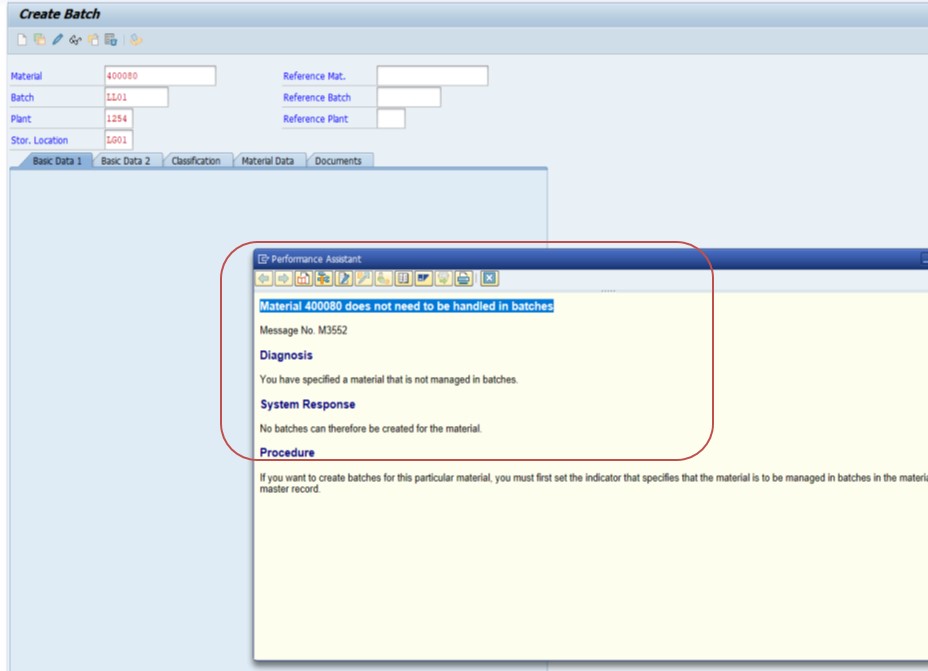
🔧 Step 1: Check Material Master Batch Settings
Go to transaction MM02 (Change Material) and enter the material number - for example, 400080.
Go to the Sales: General/Plant and Warehouse Management views. In the Sales: General/Plant view, confirm whether the Batch Management field is unchecked.
🔧 Step 2: Check the Plant-Level Batch Setting
If batch management is active at the plant level, go back to MM02, choose the Plant Data/Storage 1 view, and confirm the Batch Management indicator for the specific plant where the material is stored.
🔧 Step 3: If Batches Are Genuinely Needed - Change Material Type (MMAM)
If batch management is genuinely required and the material is currently a value-only type, you may need to switch it to a standard material type (e.g., ROH for raw materials, FERT for finished products) that supports batch management, enabling quantity and batch tracking.
Run transaction MMAM. Enter Material No. 400080, select New Material Type - Finished Product (FERT), and Old Material Type - LEARN FIN MATERIAL (LROH).
Select Execute.
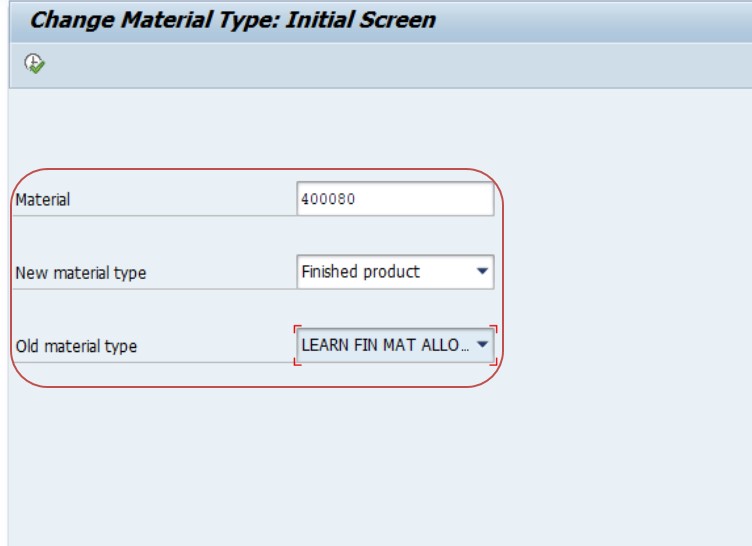
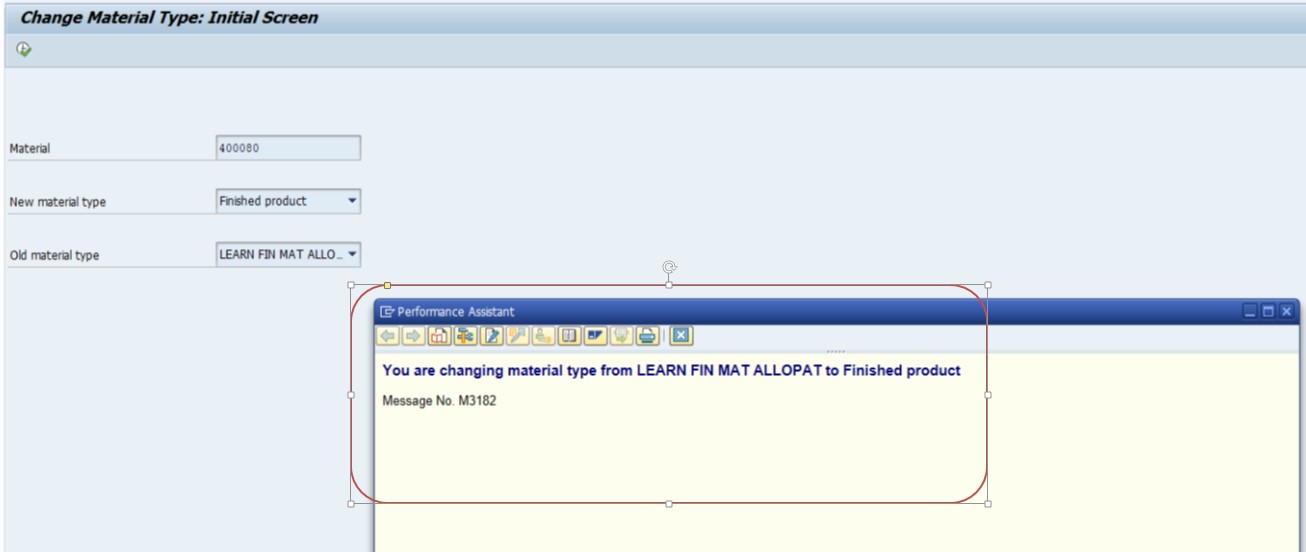
Save, then go back to the material master and try the batch management tick.
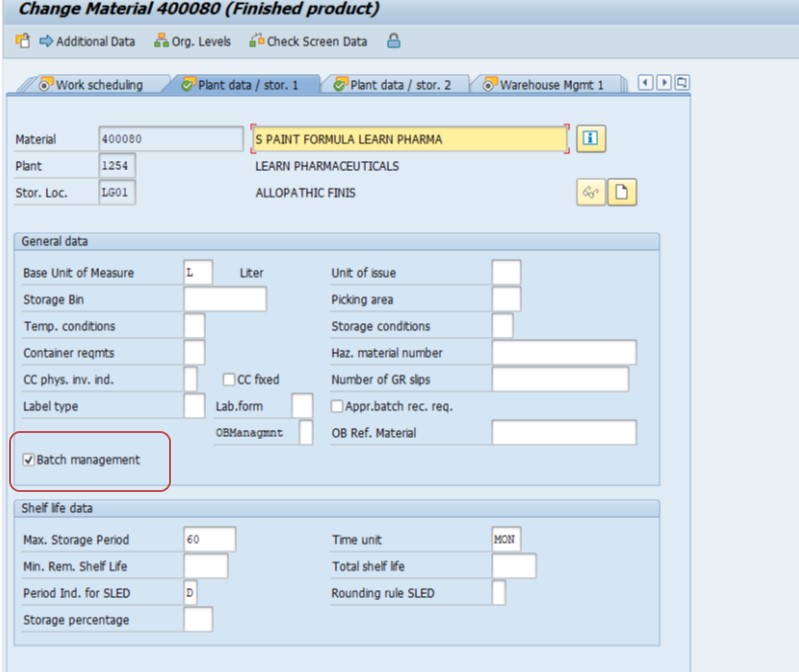
Try to create the batch (for example via MSC1N) and confirm it now succeeds.
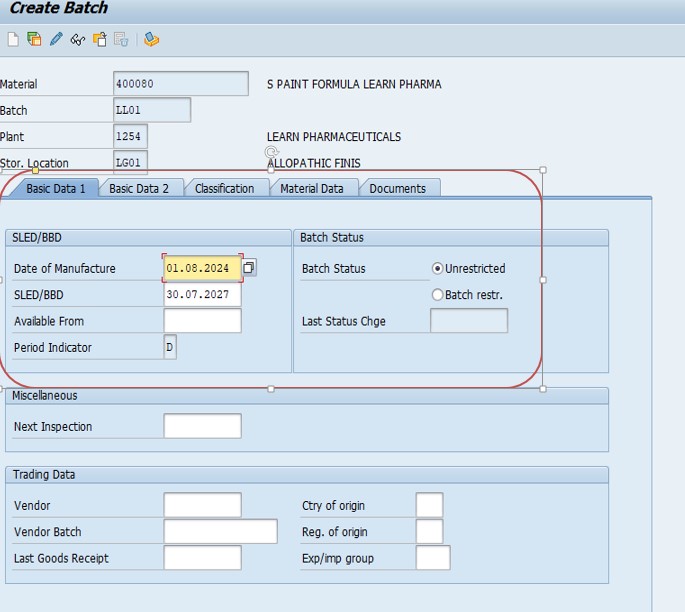
Save.
🔍 Is This Actually an Error, or Just Information?
Unlike most of the error messages covered elsewhere on this site, "Material does not need to be handled in batches" isn't inherently a problem to fix. It's SAP accurately reporting the current state of the material master - batch management is off, and you've attempted an action (typically creating a batch record via MSC1N, or a goods movement expecting a batch entry) that only makes sense for batch-managed materials. If the material genuinely doesn't need batch tracking, seeing this message actually confirms the system is behaving exactly as configured, and there's nothing to correct.
This message becomes a real action item only in one specific situation: the material actually does need batch tracking (perhaps a new regulatory requirement, or a process change), and nobody has activated batch management for it yet. In that case, this guide's steps - confirming the current setting, then activating batch management (via MM02, and MMAM first if the material type doesn't support it) - are the correct path forward.
🔄 This Message vs. "Batch Management Requirement Cannot Be Changed"
These two SAP messages are exact mirror images of each other, and it's worth being clear on the distinction since they're easy to confuse when searching for a fix.
| Message | When It Appears | What It Means |
|---|---|---|
| "Material does not need to be handled in batches" (this guide) | Attempting to create/use a batch for a material with batch management currently off | Often informational - confirms the current (correct) setting, unless batches are genuinely now needed |
| "Batch management requirement cannot be changed" | Attempting to directly toggle the batch management indicator on or off | A genuine block - SAP won't allow the direct change, usually due to material type or existing stock/transactions |
In short: this guide's message tells you the material currently isn't batch-managed and something tried to treat it as if it were. The other message tells you that you tried to change that setting directly and SAP wouldn't let you. If your goal is to make this material batch-managed, you'll likely encounter both messages in sequence - first this one (confirming it's currently off), then potentially the other one if you try to flip the indicator directly rather than going through the proper MMAM conversion path covered in Step 3 above.
💼 Real-World Scenario: A Warehouse Team Confused by an "Error" That Wasn't One
Smita Mishra, an SAP MM support analyst, received a ticket from a warehouse supervisor reporting an "error" every time staff tried to scan in a new batch number for material 400080 during receiving. The supervisor assumed something was broken and wanted it fixed immediately so receiving could continue as usual.
Checking the material master in MM03, Smita confirmed batch management was indeed switched off for 400080 - it had never been configured as a batch-managed material, and the "error" the warehouse was seeing was simply SAP correctly refusing to let a batch number be recorded for a material that wasn't set up to track batches at all. Rather than treating this as a bug to patch, Smita asked the supervisor a clarifying question: did this specific material actually need batch-level traceability, or had the receiving team's scanning process recently changed to prompt for a batch number on every material regardless of whether it was relevant?
It turned out to be the latter - a recent update to the warehouse's barcode scanning workflow had inadvertently started prompting for batch entry on all materials, including ones like 400080 that had never needed it. The actual fix wasn't a material master change at all; it was correcting the scanning workflow configuration to only prompt for batch entry on materials that were genuinely batch-managed. This scenario is a useful illustration of why understanding "is this actually an error" (as covered earlier in this guide) matters - treating this message as an automatic signal to activate batch management, without first confirming whether that's genuinely needed, can lead to unnecessary material master changes when the real fix lies somewhere else entirely.
✅ A Quick Decision Framework Before You Do Anything
Given the informational nature of this message discussed above, it's worth working through a short decision sequence before touching any configuration, rather than jumping straight to activating batch management.
- First, ask: was this material ever intended to be batch-managed? Check with the material's business owner (planning, quality, procurement) rather than assuming based on the message alone.
- If no, and nothing has changed: this message is expected behavior. No configuration change is needed - the process attempting to use a batch (a scan, a manual entry, an interface) is the thing worth reviewing instead.
- If no, but the message is appearing broadly across many unrelated materials: suspect a workflow, interface, or scanning configuration issue prompting for batch entry universally, as in the real-world scenario in this guide, rather than a material master problem.
- If yes, batch tracking is now genuinely needed: proceed with this guide's three-step fix - confirm current settings, convert material type via MMAM if needed, then activate batch management.
Working through this sequence first avoids the common mistake (covered later in this guide) of reflexively activating batch management as a default response, when the actual root cause and correct fix might lie somewhere else entirely.
🔒 Who Should Activate Batch Management for a Material
Because activating batch management is a meaningful change to how a material's stock is tracked going forward - not a routine field edit - most organizations restrict this change to experienced MM configuration staff, following the same governance principle covered in this site's related guide on the "cannot be changed" scenario. A material that suddenly becomes batch-managed changes expectations for every future goods movement, warehouse task, and quality process involving it, so the decision shouldn't rest purely with whoever happened to encounter this message first.
Given the decision framework above, many organizations also find it useful to require a documented confirmation from the material's business owner before activating batch management, ensuring the change reflects a genuine, considered business need rather than a reflexive technical fix applied the first time someone hits this message during receiving or another operational process.
🧪 Testing Checklist If You Do Activate Batch Management
- Confirm the decision framework above genuinely points to activation being the correct fix, not just a convenient one, before proceeding.
- Check current stock and open documents (MMBE and equivalent open-order reports) before attempting any material master or material type change.
- Test the full activation sequence in a sandbox first - MMAM if needed, then the batch management indicator, then a test batch creation via MSC1N - confirming each step works before touching production.
- Test the specific process that originally triggered this message (receiving, a scan, a goods movement) after activation, confirming it now works as the business actually needs.
- Communicate the change to affected teams - warehouse, quality, planning - since batch management activation changes what they'll see and need to enter going forward for this material.
💼 A Second Scenario: A Genuine, Correctly-Identified Need for Batch Tracking
Contrast the earlier scenario in this guide with a different outcome. Pooja Mishra, a quality manager at a specialty foods company, encountered this same message while trying to enter a batch/lot number for material 400080 during a new supplier traceability initiative - the company had recently signed a major retail customer requiring full lot-level traceability for food safety compliance, a genuinely new business requirement that hadn't existed when the material was originally set up.
Unlike the earlier scenario's false alarm, this was a legitimate case for activating batch management. Pooja confirmed with the MM configuration team that material 400080 was still a value-only material type, requiring the MMAM conversion (Step 3 in this guide) before batch management could be activated at all. After confirming zero current stock and no open purchase orders, the team executed the conversion, activated batch management on both the Sales: General/Plant and Plant Data/Storage 1 views, and successfully created the first traceable batch via MSC1N.
The key difference between this scenario and the earlier one isn't the message itself - both started with the exact same "does not need to be handled in batches" notification - it's what came next. In this case, working through the decision framework earlier in this guide confirmed a genuine, new business requirement justified the change, while the earlier scenario revealed a workflow misconfiguration as the real issue. Both outcomes are legitimate responses to the same message; the decision framework is what correctly separates them.
❗ Common Mistakes When Encountering This Message
- Immediately activating batch management as a reflexive fix, without first confirming whether the material genuinely needs batch tracking - as the real-world scenario above illustrates, the actual root cause can lie elsewhere entirely.
- Attempting to flip the batch management indicator directly rather than following the correct MMAM-first path for materials whose material type doesn't support batches, running into the separate "cannot be changed" error covered in a related guide.
- Activating batch management on a material that already has significant stock without first clearing it, risking a blocked conversion or inconsistent stock records.
- Not checking both the Sales: General/Plant view and the Plant Data/Storage 1 view, since batch management settings can appear at more than one level depending on your SAP configuration.
- Treating every instance of this message as needing the same fix, without considering that a workflow, interface, or scanning configuration issue (rather than the material master itself) might be the real cause, as in the scenario above.
✅ Prevention Checklist
- Before activating batch management in response to this message, confirm with the material's business owner whether batch tracking is genuinely needed, rather than assuming the message itself is a mandate to change configuration.
- If a scanning, interface, or workflow tool is prompting for batch entry universally, review whether that tool's configuration correctly distinguishes batch-managed materials from non-batch-managed ones.
- Document which materials are intentionally non-batch-managed, so support staff encountering this message in the future can quickly confirm it's expected rather than re-investigating from scratch each time.
- When batch management genuinely does need to be activated, follow the full path (clear stock, MMAM if needed, then activate) rather than attempting a direct indicator change that will likely be blocked.
📑 Similar-Looking SAP Batch Messages and How They Differ
| Message / Symptom | Root Cause | Action Needed? |
|---|---|---|
| Material does not need to be handled in batches | Batch entry attempted for a material with batch management off | Only if batch tracking is genuinely now needed - otherwise informational |
| Batch management requirement cannot be changed | Direct attempt to toggle the batch management indicator, blocked by material type or existing stock | Yes - requires MMAM conversion and/or clearing stock first |
| Batch [X] does not exist for material [Y] | A specific batch number was entered that hasn't been created yet, unrelated to whether batch management itself is active | Yes - create the batch via MSC1N, or correct the batch number entered |
| Enter a batch | The material is batch-managed but no batch was specified on a transaction that requires one | Yes - select or enter the correct batch for the transaction |
These messages all involve batches, but only some represent a genuine configuration issue - "Material does not need to be handled in batches" and "Enter a batch" are essentially opposite reminders about whether batch management is (or isn't) active, while the other two relate to specific batch records rather than the underlying batch management setting itself.
📊 Reviewing Batch Management Settings Across Your Material Master
For organizations that have gone through multiple rounds of batch management activation over time - some deliberate, some perhaps prompted reactively by this exact message - it's worth periodically reviewing which materials are batch-managed and confirming that still reflects genuine business need, rather than assuming the current state is necessarily correct or complete.
- Query the material master (MARA/MARC) for the batch management indicator across all materials, comparing against which material categories or product lines genuinely require lot-level traceability today.
- Flag any batch-managed material with no batch activity in recent history, which may indicate a case where batch management was activated unnecessarily (or is no longer needed) and could be simplified.
- Flag any non-batch-managed material in a product category where peers are batch-managed, a potential candidate for the genuine-need scenario covered in this guide's second real-world example.
- Document the business reasoning behind each material's batch management status, making this kind of review faster and less ambiguous the next time it's needed.
This periodic review is particularly valuable for organizations in industries where traceability requirements tend to expand gradually - new customer requirements, new regulations, or new quality initiatives can each independently create a genuine need for batch tracking on materials that were originally set up without it, and a proactive review catches these needs before they surface reactively as a support ticket about this exact message.
📱 This Message in SAP S/4HANA
The batch management concept and the underlying logic behind this message are unchanged in SAP S/4HANA. Material master maintenance can be done via classic MM02 or the Fiori "Manage Product Master Data" app, both reading and enforcing the same batch management indicator, and batch creation can be done via classic MSC1N or the equivalent Fiori batch management apps - the fix path in this guide applies identically regardless of which interface triggered the message.
🔗 Cross-Module Impact: Warehouse and Quality Processes
As the real-world scenario above illustrates, this message often surfaces at the point of physical warehouse activity - receiving, scanning, or a Warehouse Management task expecting a batch entry - rather than purely within core MM transactions. This means the real fix, when one is actually needed, sometimes lies in WM or scanning interface configuration rather than the material master itself, particularly if the message is appearing broadly across many non-batch-managed materials rather than for one specific material that genuinely needs batch tracking.
Quality Management is the other module commonly involved in the decision of whether a material should be batch-managed in the first place, since batch-level inspection lots and usage decisions depend entirely on batch management being active. If a quality process is being designed or changed to require batch-level traceability for a material that currently isn't batch-managed, that's exactly the scenario where this guide's Step 3 (activating batch management, via MMAM first if needed) becomes the genuine, correct fix rather than something to second-guess.
📋 Related SAP Transactions
| Transaction | Purpose |
|---|---|
| MM02 | Change the material master, including the batch management indicator. |
| MM03 | Display the material master to check current batch management status without changing it. |
| MMAM | Change a material's material type, needed if the current type doesn't support batch management. |
| MSC1N | Create a batch master record for a material once batch management is active. |
| MMBE | Check current stock for a material before attempting any batch management change. |
🎓 Interview-Style Questions and Answers
Q: Is "Material does not need to be handled in batches" always an error that needs fixing?
No - it's often purely informational, correctly confirming that batch management is off for a material that was never intended to be batch-managed. It only needs action if the material genuinely requires batch tracking and the indicator was never activated.
Q: What's the difference between this message and "Batch management requirement cannot be changed"?
This message appears when attempting to use a batch on a material with batch management off. The other appears when attempting to directly toggle the batch management indicator itself, and represents a genuine configuration block rather than an informational confirmation.
Q: If batch entry is being requested for many materials that don't need it, where would you look first?
Check the interface, scanning workflow, or process configuration requesting batch entry, rather than assuming every affected material needs batch management activated - a workflow prompting universally regardless of material setup is a common root cause distinct from the material master itself.
📚 Quick Glossary of Terms Used in This Guide
- Batch management indicator: The material master setting (Sales: General/Plant and Plant Data/Storage 1 views) controlling whether a material is tracked by batch.
- MSC1N: The transaction used to create a batch master record for a material.
- MMAM: The transaction used to change a material's material type, needed when the current type doesn't support batch management.
- Value-only material: A material type that doesn't support detailed quantity or batch tracking.
- Usage decision: A Quality Management outcome recorded against a batch, only possible once batch management is active for that material.
🎯 Conclusion
"Material does not need to be handled in batches" is often not a problem at all - it's SAP correctly confirming a material's current, intentional configuration. The real question worth asking first is whether this material genuinely needs batch tracking; if not, no action is needed. If it does, this guide's three steps - confirming the current setting, converting the material type via MMAM if necessary, and activating batch management - get you there. Keep this guide bookmarked, and remember to check whether a workflow or interface issue might be the real cause before changing material master configuration.