SAP MM: How to Close or Delete Purchase Orders Step-by-Step (ME22N Guide)
Managing Purchase Orders (POs) efficiently is a crucial aspect of any procurement process in SAP Materials Management (SAP MM). Purchase Orders often need to be closed out when the goods or services have been received, and the transaction is completed. This guide explores three essential methods to achieve this: Delivery Completion, Blocking, and Delivery Tolerance, walking through each Step-by-Step Process using transaction ME22N. If you encounter any errors while following along, feel free to send a screenshot to pramod@learntosap.com, and I will help you resolve the issue.
✅ How to Close Purchase Orders in SAP – Complete MM Overview
Managing Purchase Orders (POs) efficiently is a crucial aspect of any procurement process in SAP Materials Management (SAP MM). Purchase Orders often need to be closed out when the goods or services have been received, and the transaction is completed. Left open indefinitely, a completed Purchase Order continues to show up as an outstanding commitment in reporting, in MRP calculations, and in any follow-on process that checks for open procurement documents - which is exactly why deliberately closing out a PO matters even after the practical business need has already been satisfied.
In this guide, we explore the significance of closing POs in SAP MM and discuss three essential methods to achieve this: Delivery Completion, Blocking, and Delivery Tolerance. Each method serves a different situation - Delivery Completion suits a PO that has been fulfilled well enough that no further deliveries are expected, Blocking suits a PO that needs to be temporarily paused rather than permanently closed, and Delivery Tolerance suits an organization that wants minor over- or under-deliveries handled automatically rather than requiring manual closure every time.
Two Types of Contract
Contracts are long-term agreements specifying terms such as pricing, quantities, and delivery schedules. They are often used for recurring procurement needs over a specified period, providing stability in procurement planning - and the same closure logic discussed here for standard Purchase Orders applies just as much to individual release orders created against a contract, once the contract's committed quantity has been fulfilled.
📋 Checking Purchase Order Status Before Closing It
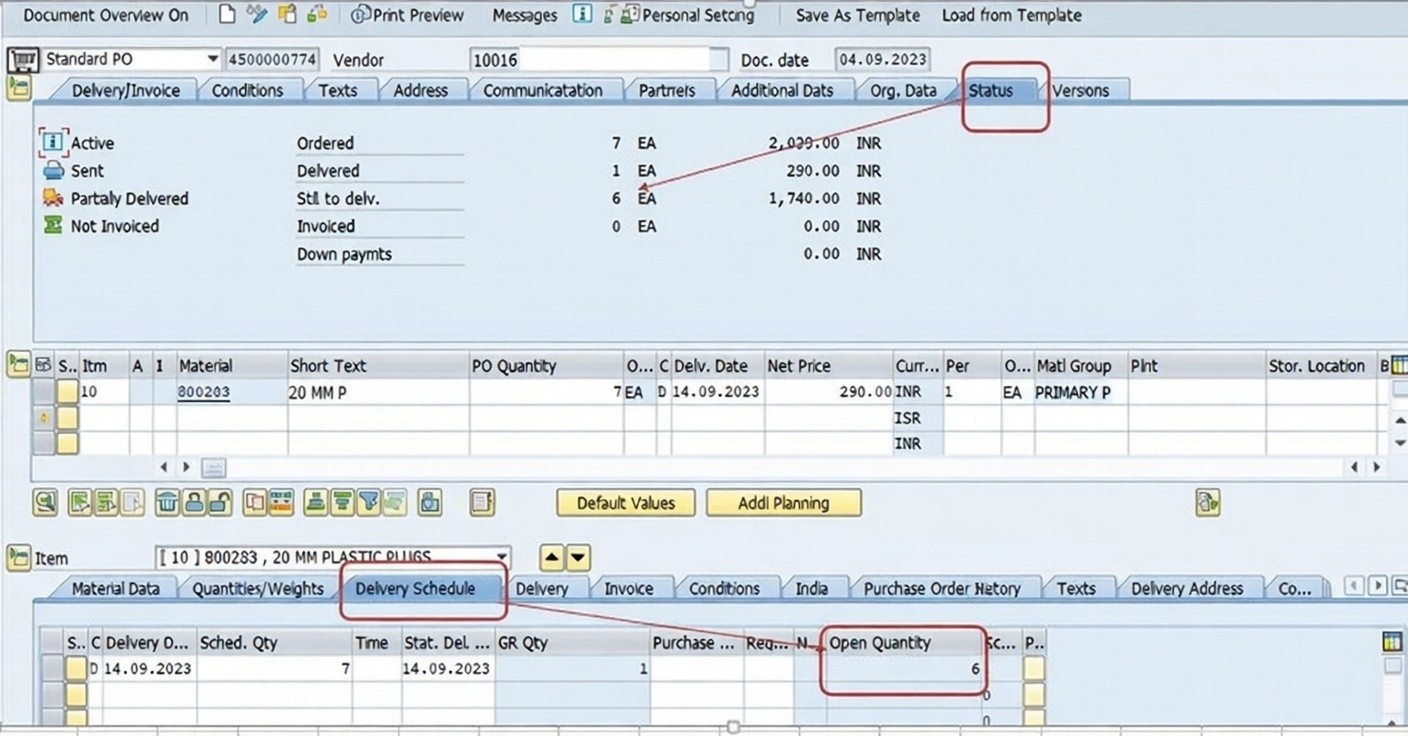
Create PO - ME21N - 7 Qty. A Purchase Order was originally created for a quantity of 7 units.
Create MIGO - 1 Qty. A partial Goods Receipt was posted for only 1 unit, leaving the remaining quantity still technically open on the Purchase Order.
Go to Tcode - ME22N. Open the Purchase Order in change mode to review its current status.
Check Status - Open 6 Qty. With 7 units ordered and only 1 received, the Purchase Order's status correctly reflects 6 units still open.
Check Delivery Schedule - Open Quantity - 6 Qty. The delivery schedule tab confirms the same 6-unit open quantity, which is exactly the figure a buyer needs to decide whether to keep waiting on delivery, or to close the Purchase Order deliberately if no further delivery is actually expected.
🔧 SAP Purchase Order Closure Process Explained – ME22N Tutorial
With the open quantity confirmed at 6 units, there are three common ways to bring this Purchase Order to a formal close, each suited to a different situation.
1) Delivery Completion
The most common method to close a Purchase Order in SAP MM is by marking it as "Complete" when all the ordered items or services have been successfully delivered, or when the organization has decided no further delivery against the remaining open quantity is expected.
Following Path:
Go to the Purchase Order transaction (T-code: ME22N).
Select the PO you want to close.
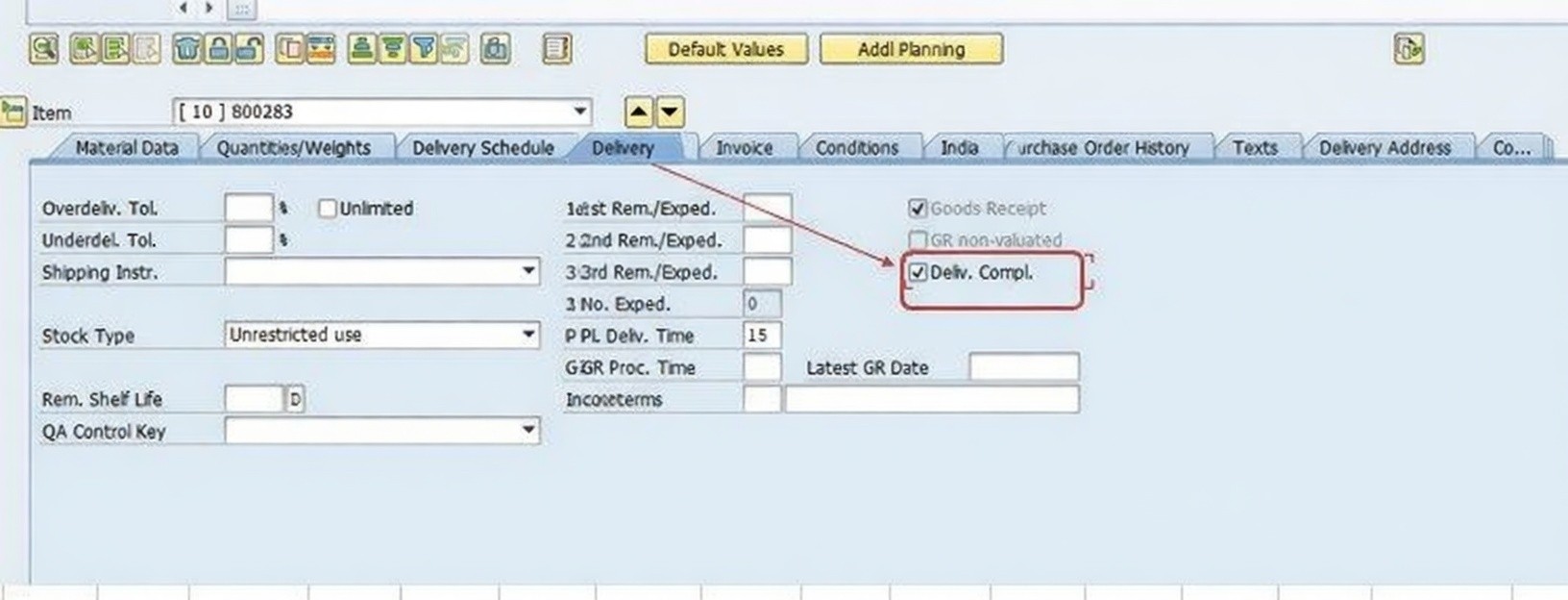
In the "Item Overview" screen, check (select) the "Delivery Complete" checkbox.
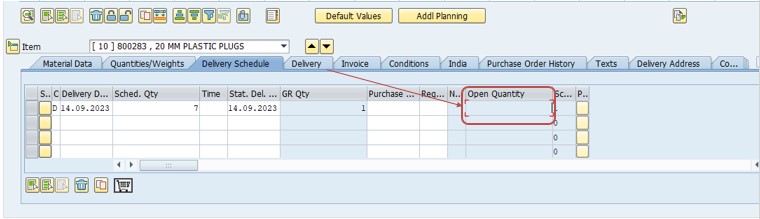
Save your changes, then check Open Qty - Nil.
2) Blocking
Sometimes, you might need to temporarily close a PO for various reasons, such as quality issues or delayed delivery. SAP MM allows you to block a PO.
Following Path:
Go to the Purchase Order transaction (T-code: ME22N).
Select the PO you want to close.
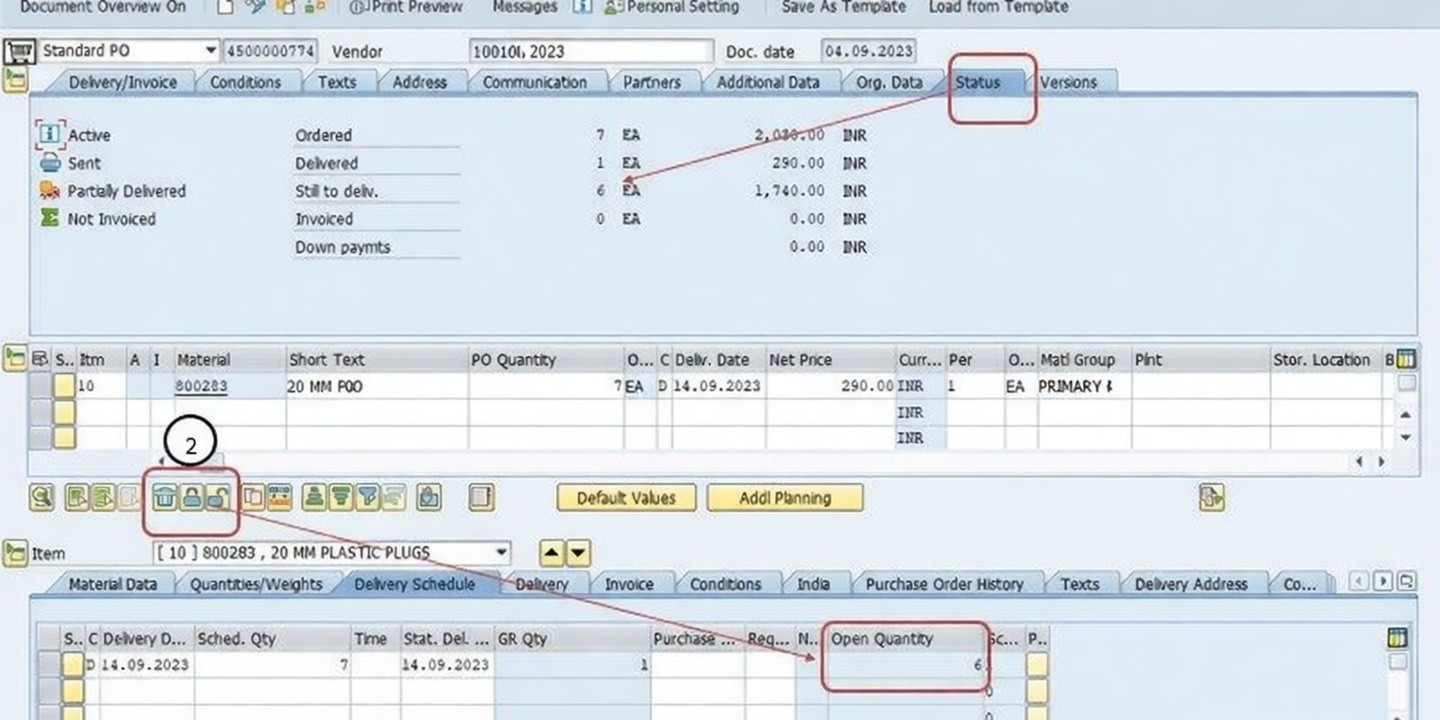
Choose the "Blocked" status.
Save your changes, then check Open Qty - Nil.
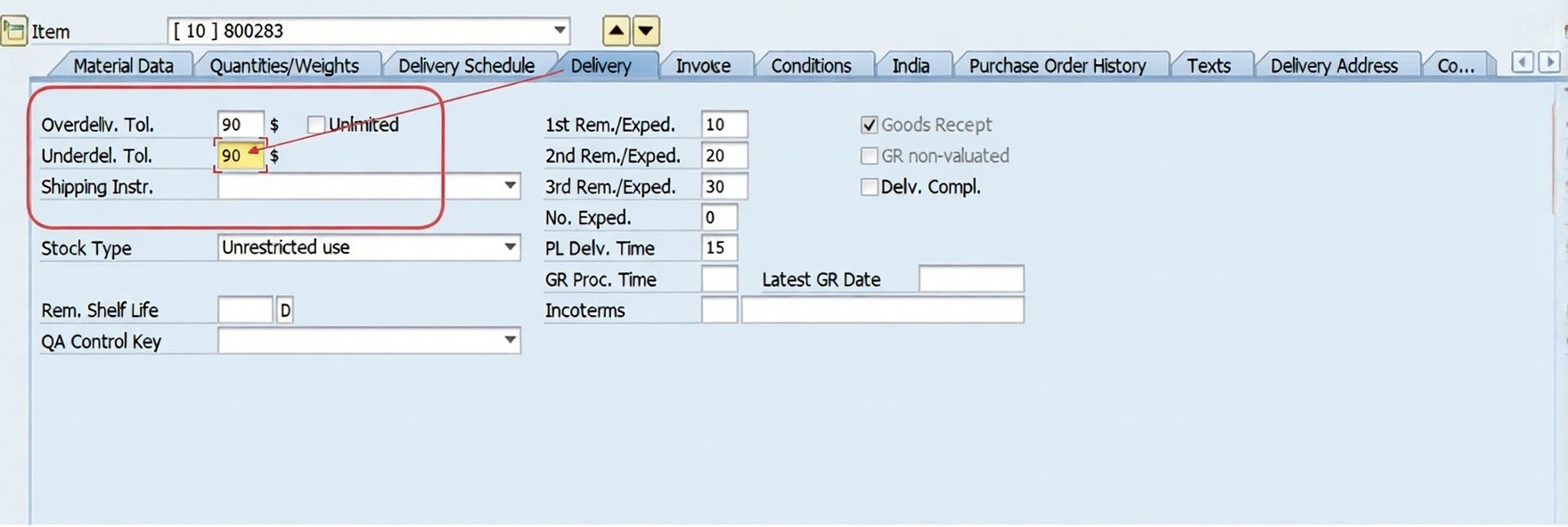
3) Delivery Tolerance
"Delivery Tolerance" allows you to automatically close a PO when the delivered quantity falls within a defined tolerance of the ordered quantity. This is useful for handling minor overdeliveries or underdeliveries without requiring manual closure every time.
Following Path:
Use transaction code "OMGL" to configure tolerance limits.
Define the tolerance limits for overdeliveries.
Specify the action to be taken when the tolerance limits are exceeded (e.g., "Close PO").
Save your changes, then check Open Qty - Nil.
📋 Key Fields Involved in Closing a Purchase Order
| Field | What It Captures |
|---|---|
| Delivery Complete Checkbox | Indicates no further goods receipts are expected against this line, setting the open quantity to nil regardless of actual quantity received. |
| Blocked Status | Temporarily halts further processing on the Purchase Order without permanently closing it. |
| Open Quantity | The remaining ordered quantity that has not yet been received or otherwise closed out. |
| Delivery Schedule Tab | Shows scheduled and remaining open quantities at the line item level. |
| Tolerance Limits (OMGL) | Configured thresholds defining how much a delivered quantity can vary from the ordered quantity before an action, such as automatic closure, is triggered. |
| Deletion Flag | Marks a Purchase Order or line item for deletion, distinct from closure, typically used when an order was created in error or is no longer needed at all. |
📋 Related SAP Transactions
| Transaction | Purpose |
|---|---|
| ME21N | Create a new Purchase Order. |
| ME22N | Change an existing Purchase Order, including setting Delivery Complete, Blocked status, or a deletion flag. |
| ME23N | Display a Purchase Order without allowing changes. |
| MIGO | Post a Goods Receipt against a Purchase Order. |
| OMGL | Configure delivery tolerance limits used for automatic Purchase Order closure. |
| ME2M | List Purchase Orders by material, useful for reviewing open POs that may need closure. |
| ME2N | List Purchase Orders by number or other selection criteria, another useful tool for identifying open orders. |
❗ Common Mistakes When Closing or Deleting Purchase Orders
- Marking Delivery Complete on a PO where more delivery is genuinely still expected, prematurely closing a legitimate open order.
- Using Blocking as a permanent closure method instead of Delivery Completion, leaving the PO in a temporary state indefinitely.
- Setting a deletion flag on a Purchase Order that already has a Goods Receipt or Invoice posted against it, which can cause inconsistencies rather than a clean removal.
- Configuring overly generous tolerance limits in OMGL, allowing meaningfully incomplete deliveries to auto-close without proper review.
- Not communicating a Blocked status to the vendor, leading to confusion about why an expected delivery hasn't been processed.
- Forgetting to review open Purchase Orders periodically, allowing genuinely completed orders to linger open in reporting and MRP.
- Closing a PO without first confirming whether an associated Purchase Requisition or Contract also needs a status update to stay consistent.
✅ Best Practices for Purchase Order Closure
- Review open Purchase Orders on a regular schedule, rather than letting completed orders accumulate as apparent open commitments.
- Use Delivery Completion only once you're confident no further delivery is genuinely expected on that line.
- Reserve Blocking for situations that are truly temporary, and follow up to resolve the underlying issue rather than leaving a PO blocked indefinitely.
- Set delivery tolerance limits in OMGL deliberately, based on realistic and acceptable variance for your organization's typical deliveries, not as a blanket convenience setting.
- Document the reason for closing or blocking a PO, particularly when quality or vendor performance issues are involved, so the history is clear later.
- Check whether a linked Purchase Requisition or Contract also needs updating when a PO is closed, to keep the full document chain consistent.
- Communicate closures and blocks to the vendor where relevant, to avoid confusion about outstanding deliveries.
📈 How Purchase Order Closure Affects Downstream Reporting and Planning
Whether a Purchase Order is open or closed directly affects several processes that read PO status as an input. MRP calculations often factor in open PO quantities when determining whether additional procurement is needed, so a completed PO left open can suppress a legitimate new requirement, or an incomplete PO closed too early can leave a genuine shortage unaddressed. Procurement reporting on outstanding commitments similarly depends on accurate open/closed status to give management a realistic view of what is still pending versus what has already been resolved.
This is why the decision of which closure method to use - Delivery Completion, Blocking, or Delivery Tolerance - isn't just administrative housekeeping. Each choice sends a different signal to every downstream process that reads Purchase Order status, and getting that signal wrong tends to surface as an inaccurate MRP proposal or a misleading open-commitment report well after the closure decision was actually made.
✅ Validating a Purchase Order Closure
Before considering a Purchase Order closure complete, it's worth running through a short validation checklist. Display the PO (ME23N) and confirm the open quantity now shows nil, or reflects the tolerance-adjusted expectation if Delivery Tolerance was used. Confirm the correct method was applied for the situation - Delivery Completion for a genuinely finished order, Blocking for a temporary pause. If a deletion flag was used instead, confirm no Goods Receipt or Invoice already exists against that line, since deletion is intended for orders that never should have proceeded, not completed ones. Finally, check whether any linked Purchase Requisition or Contract also needs a corresponding status update.
Skipping this validation is one of the more common reasons a Purchase Order reappears as an unexpected open item in a later procurement report, or an MRP run generates a proposal that doesn't match what was actually intended.
🎓 Interview-Style Questions and Answers
Q: What are the three main methods for closing a Purchase Order in SAP MM, and when should each be used?
Delivery Completion is used when a PO has been fulfilled, or fulfilled enough that no further delivery is expected. Blocking is used for a temporary pause, such as a quality issue or delayed delivery. Delivery Tolerance, configured in OMGL, is used to automatically close POs where delivered quantity falls within an acceptable variance from the ordered quantity.
Q: What is the difference between closing a Purchase Order and deleting it?
Closing a Purchase Order, through methods like Delivery Completion or Blocking, signals that no further action is expected on an order that has otherwise proceeded normally. Deleting a Purchase Order, using a deletion flag, is intended for orders that should not have been created or processed at all, and is generally not appropriate once a Goods Receipt or Invoice already exists against the line.
Q: What does the Delivery Schedule tab in ME22N show?
The Delivery Schedule tab shows the scheduled delivery quantities and dates for a Purchase Order line, along with the remaining open quantity that has not yet been received.
Q: Why might an organization configure Delivery Tolerance rather than manually closing each Purchase Order?
Organizations that regularly experience small, expected variances between ordered and delivered quantity can configure Delivery Tolerance in OMGL so these minor discrepancies close automatically, reducing the manual effort of reviewing and closing every slightly under- or over-delivered PO individually.
📚 Quick Glossary of Terms Used in This Guide
- Delivery Completion: A checkbox on a Purchase Order line indicating no further deliveries are expected, setting the open quantity to nil.
- Blocking: A temporary status applied to a Purchase Order to pause further processing without permanently closing it.
- Delivery Tolerance: A configured threshold, set in OMGL, defining how much a delivered quantity can vary from the ordered quantity before an automatic action, such as closure, is triggered.
- Open Quantity: The remaining ordered quantity on a Purchase Order line that has not yet been received or closed out.
- Deletion Flag: A marker on a Purchase Order or line item indicating it should be excluded from further processing and reporting, typically used for orders created in error.
- OMGL: The SAP transaction used to configure delivery tolerance limits at a Materials Management configuration level.
📝 Governance for Purchase Order Closure
Because Purchase Order status feeds directly into MRP and procurement reporting, most organizations maintain governance around who is authorized to mark a PO Delivery Complete, block it, or delete it, and how often open Purchase Orders should be reviewed to catch orders that are effectively finished but not yet formally closed. This matters because procurement leadership relies on accurate open-commitment reporting to understand what is genuinely still outstanding, and production planning relies on accurate PO status to avoid either over- or under-procuring materials.
Data quality governance around PO closure follows the same underlying logic as elsewhere in SAP master data and transactional processes: a PO closed carelessly - the wrong method chosen, a genuinely open order marked complete prematurely, a deletion flag applied where a Goods Receipt already exists - tends to surface as a reporting inconsistency or a planning error well after the closure decision was made. A periodic open-PO review cycle, paired with clear rules for when each closure method applies, keeps this process reliable as order volume grows.
💼 Real-World Scenario: Closing Out a Partially Delivered Purchase Order
Buyer Pooja Mishra at Learn Pharmaceuticals had a Purchase Order originally created for 7 units of a raw material, but only 1 unit had ever been delivered by the vendor before the underlying business need changed and the remaining quantity was no longer required. Rather than letting the PO sit open indefinitely with 6 units still showing as outstanding, Anita needed to formally close it out.
She opened transaction ME22N, checked the status and delivery schedule, and confirmed the open quantity was indeed 6 units. Since the organization had decided no further delivery was needed - the remaining quantity had simply become unnecessary rather than delayed or disputed - Delivery Completion was the appropriate method rather than Blocking. She navigated to the Item Overview screen, ticked the Delivery Complete checkbox, and saved her changes.
Checking the PO afterward, the open quantity now showed nil, and the order no longer appeared as an outstanding commitment in the next procurement report or MRP run. Because Anita had chosen the closure method that matched the actual situation - permanently finished, not temporarily paused - the PO's status now accurately reflected reality for anyone reviewing procurement data going forward.
📱 This Process in SAP S/4HANA
Transaction ME22N and the underlying Delivery Completion, Blocking, and Delivery Tolerance mechanisms work largely the same way in SAP S/4HANA as in classic ECC, since Purchase Order status management remains a core Materials Management capability. What has changed in S/4HANA is the availability of Fiori apps such as "Manage Purchase Orders," which give buyers a more modern, list-based way to identify open Purchase Orders, review remaining quantities, and apply closure actions without navigating the full ME22N transaction screen. Many S/4HANA implementations continue to use ME22N for detailed closure actions, while Fiori-based apps are increasingly favored for bulk review and closure of multiple open Purchase Orders at once.
🎯 Conclusion
Closing out completed Purchase Orders is a small but important piece of keeping SAP MM data trustworthy, and choosing the right method - Delivery Completion, Blocking, or Delivery Tolerance - matters as much as remembering to close the order at all. Reviewing status and delivery schedule before acting, applying the method that actually matches the situation, and following up on temporary blocks rather than leaving them indefinitely are what separate accurate, reliable procurement reporting from one cluttered with stale open commitments. Keep this guide handy the next time your organization needs to close or delete a Purchase Order in SAP.