SAP ME11: How to Create a Purchase Info Record – Step-by-Step
"Purchase Info Record" (short for Purchase Information Record) refers to a master data element within the SAP system that contains essential information about the purchasing relationship between a company and a specific vendor for a particular material or service. The Purchase Info Record serves as a central repository for procurement-related data, enabling efficient and standardized communication between the purchasing department and the vendors. This guide walks you through the Step-by-Step Process to create a Purchase Info Record using transaction ME11. If you encounter any errors while following along, feel free to send a screenshot to pramod@learntosap.com, and I will help you resolve the issue.
✅ Steps to Create Purchase Info Record in ME11
"Purchase Info Record" (short for Purchase Information Record) refers to a master data element within the SAP system that contains essential information about the purchasing relationship between a company and a specific vendor for a particular material or service. The Purchase Info Record serves as a central repository for procurement-related data, enabling efficient and standardized communication between the purchasing department and the vendors. It helps streamline the procurement process and ensures consistent information sharing throughout the organization.
It helps to think of the Purchase Info Record as the memory SAP keeps of a specific vendor-material relationship, independent of any one Purchase Order or requisition. Once an info record exists for a vendor-material combination, the system can automatically propose net price, delivery time, and other conditions the next time that same material needs to be sourced from that vendor - during Source Determination on a Purchase Requisition, or when creating a Purchase Order directly. Without an info record, every purchase for that material starts from a blank slate, relying entirely on whoever happens to remember the last agreed price.
Why Use ME11 in SAP MM?
TCode - ME11.
| Transaction | Purpose |
|---|---|
| ME11 | Create Info Record. |
| ME12 | Modify Info Record. |
| ME13 | Display Info Record. |
📋 How a Purchase Info Record Fits Into Procurement
Info Record Creation: A buyer creates a Purchase Info Record in ME11 for a specific vendor-material combination, recording pricing, delivery time, and other agreed conditions.
Source Determination: When a new Purchase Requisition or Request for Quotation is raised for that material, SAP checks for an existing info record and can automatically propose the vendor and pricing recorded there.
Purchase Order Creation: If the info record's vendor and pricing are accepted, they flow directly into the Purchase Order created in ME21N, reducing manual entry and pricing lookups.
Ongoing Price and Condition Updates: As vendor pricing or delivery terms change over time, the info record is updated in ME12, keeping future Purchase Orders aligned with the latest agreed conditions.
Purchasing Analysis: Because info records are tied to specific vendor-material pairs over time, they form a useful historical reference for analyzing how pricing and delivery performance have evolved for a given relationship.
🔧 Steps to Create a Purchase Info Record Using ME11
Go To: Logistics → Materials Management → Master Data → Info Record → Create - ME11.
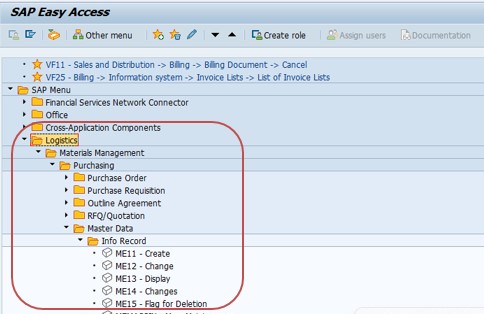
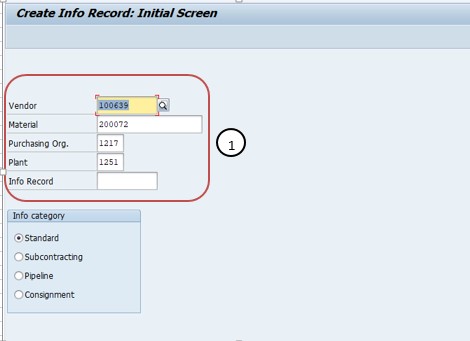
Go to Tcode ME11. Run transaction ME11 to open the Create Purchase Info Record screen.
Select Vendor No - 100639. Enter the vendor number this info record will establish a purchasing relationship with.
Select Material No - 200072. Enter the material number the info record will cover.
Select Purchase Org - 1217. Enter the purchasing organization responsible for this vendor-material relationship.
Select Plant - 1251. Enter the plant the info record's terms apply to, since pricing and delivery time can vary by plant.
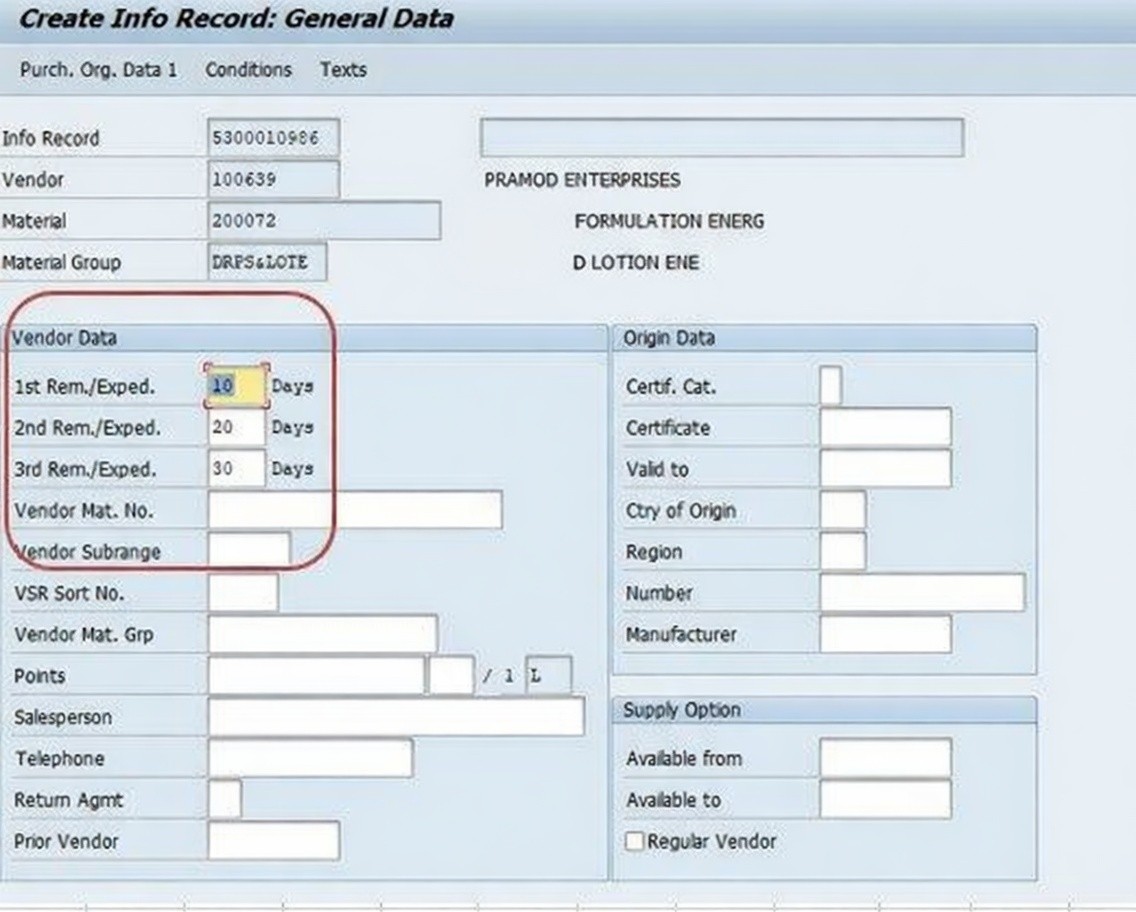
Maintain Purchase Info Record Details. With the header data set, complete the fields that define the actual terms of the vendor-material relationship.
1) Purchase Organization Data 1
Purchase Organization Data 1 refers to a section within the master data of a material in SAP. It includes information related to purchasing for a specific purchase organization, such as the standard order quantity, tolerance limits for over- and under-deliveries, and other procurement-related parameters.
2) Delivery Time
Delivery Time in SAP refers to the time it takes for a vendor to deliver ordered materials to the purchasing company. It is often specified in terms of days or weeks and is a critical factor in determining lead times and planning for production and inventory management.
3) Purchasing Group
Purchasing Group is a responsible entity within an organization for managing procurement activities for specific materials or groups of materials. It's a way to organize procurement responsibilities based on various criteria such as product categories or business units. Each Purchasing Group is assigned to a set of buyers or procurement professionals who handle procurement tasks for that group.
4) Net Price
Net Price is the actual price of a material after all discounts, rebates, and allowances have been applied. It represents the final amount that the purchasing organization needs to pay to the vendor for the goods or services purchased. Net Price is a crucial element for cost analysis, financial planning, and procurement decisions.
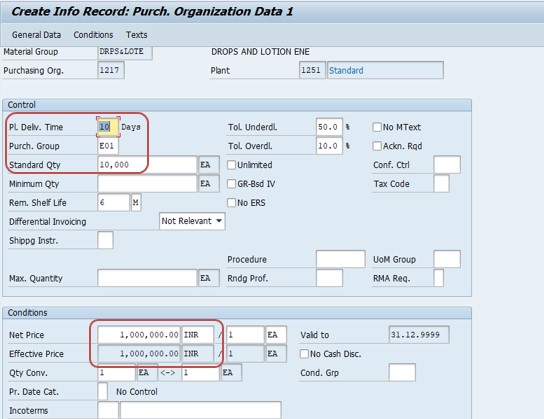
Then Save Purchase Info Record. Once vendor, material, organizational data, delivery time, purchasing group, and net price have all been entered correctly, save the info record. It is now available to be proposed automatically during Source Determination for future requisitions or Purchase Orders involving this vendor-material combination.
📋 Key Fields Involved in a Purchase Info Record
A quick reference for the main fields captured when creating a Purchase Info Record in ME11.
| Field | What It Captures |
|---|---|
| Vendor Number | The supplier this info record establishes a documented purchasing relationship with. |
| Material Number | The specific material or service this info record's pricing and terms apply to. |
| Purchasing Organization | The organizational unit responsible for this vendor-material relationship. |
| Plant | The receiving plant this info record's terms apply to, since pricing and delivery time can differ by plant. |
| Purchase Organization Data 1 | Standard order quantity, tolerance limits for over- and under-deliveries, and other procurement parameters. |
| Delivery Time | The vendor's typical lead time to deliver the material, used in planning and lead time calculations. |
| Purchasing Group | The buyer or buying team responsible for managing procurement of this material. |
| Net Price | The agreed final price per unit after discounts, rebates, and allowances, used as the default pricing reference. |
📋 Related SAP Transactions
| Transaction | Purpose |
|---|---|
| ME11 | Create a new Purchase Info Record for a vendor-material combination. |
| ME12 | Change or update an existing Purchase Info Record, such as revising net price or delivery time. |
| ME13 | Display a Purchase Info Record without allowing changes. |
| ME1M | List all Purchase Info Records maintained for a specific material. |
| ME1L | List all Purchase Info Records maintained for a specific vendor. |
| ME51N | Create a Purchase Requisition, where Source Determination can reference an existing info record. |
| ME21N | Create a Purchase Order, which can pull vendor and pricing directly from an info record. |
❗ Common Mistakes When Creating a Purchase Info Record
- Entering an outdated net price that no longer reflects the vendor's current agreement, leading to inaccurate defaults on future Purchase Orders.
- Creating an info record at the wrong plant, when pricing or delivery terms actually differ across the organization's plants.
- Leaving delivery time blank or inaccurate, which weakens lead time planning during MRP and production scheduling.
- Assigning an inconsistent purchasing group compared to how similar materials are normally organized, complicating reporting later.
- Forgetting to update the info record in ME12 after a price renegotiation, leaving the old net price to keep being proposed.
- Creating duplicate info records for the same vendor-material-plant combination instead of updating the existing one, causing confusion about which is current.
- Not maintaining tolerance limits under Purchase Organization Data 1, leaving over- or under-delivery checks less precise than they could be.
✅ Best Practices for Purchase Info Record Maintenance
- Update the net price in ME12 as soon as a vendor renegotiation is finalized, so future Source Determination proposals stay accurate.
- Maintain a separate info record per plant when pricing or delivery time genuinely differs by location, rather than forcing one record to cover all plants.
- Keep delivery time realistic and current, checking it periodically against actual vendor performance rather than leaving it at its original estimate indefinitely.
- Use ME1M or ME1L periodically to review all info records tied to a material or vendor, catching outdated or duplicate records.
- Align purchasing group assignment with how your organization actually structures buying responsibility, for consistent reporting.
- Document the source of the net price - such as a contract or recent quotation - so the figure can be verified later if questioned.
- Treat info record maintenance as an ongoing task tied to vendor negotiations, not a one-time setup activity.
📈 How Purchase Info Record Data Powers Downstream Procurement
The Purchase Info Record's influence extends across the procurement cycle for as long as it remains the default reference for a vendor-material relationship. During Source Determination on a Purchase Requisition, the info record's vendor and net price can be proposed automatically, saving the buyer from manually searching for pricing. When a Purchase Order is created, whether directly or by adopting an approved requisition, the info record's terms can flow straight into the PO's pricing and delivery date fields. And because the info record persists independently of any single transaction, it becomes a running historical reference for how pricing and delivery performance for that vendor-material pair have evolved over time.
Because so much downstream procurement leans on this one piece of master data, an outdated or inaccurate info record - stale pricing, an unrealistic delivery time - doesn't just sit quietly in the background. It actively proposes the wrong default the next time that material needs to be purchased, which is why keeping info records current matters just as much as creating them accurately in the first place.
✅ Validating a Purchase Info Record Before Relying on It
Before treating a newly created info record as a reliable default for future purchases, it's worth running through a short validation checklist. Display the info record (ME13) and confirm the vendor, material, purchasing organization, and plant are all correct. Confirm the net price matches the actual agreed price, referencing the underlying contract or quotation if one exists. Check that delivery time reflects the vendor's realistic lead time rather than an optimistic estimate. Finally, confirm tolerance limits under Purchase Organization Data 1 are set appropriately for how strictly over- and under-deliveries should be controlled for this material.
Skipping this validation is one of the more common reasons a Purchase Order later needs manual price correction - usually because the info record it defaulted from was carrying an outdated net price or an unrealistic delivery time.
🎓 Interview-Style Questions and Answers
Q: What is a Purchase Info Record, and why does it matter?
A Purchase Info Record is a master data element that captures the purchasing relationship between a company and a vendor for a specific material, including pricing, delivery time, and other terms. It matters because it lets SAP automatically propose these agreed terms for future purchases instead of requiring a fresh lookup each time.
Q: What is the difference between ME11, ME12, and ME13?
ME11 creates a new Purchase Info Record, ME12 changes or updates an existing one, and ME13 displays an info record without allowing any changes.
Q: How does an info record interact with Source Determination?
During Source Determination on a Purchase Requisition or RFQ, the system checks for an existing Purchase Info Record for the material and can automatically propose the vendor and net price recorded there, speeding up sourcing decisions.
Q: Why might an organization maintain separate info records for the same material at different plants?
Because vendor pricing and delivery time can genuinely differ by plant location, maintaining a separate info record per plant ensures each site gets accurate, location-specific defaults rather than a single, potentially inaccurate average.
📚 Quick Glossary of Terms Used in This Guide
- Purchase Info Record: A master data element capturing the purchasing relationship, including pricing and terms, between a company and a vendor for a specific material.
- Purchase Organization Data 1: A section of info record data capturing standard order quantity, tolerance limits, and other procurement parameters.
- Delivery Time: The vendor's typical lead time to deliver a material, used for lead time planning and MRP.
- Purchasing Group: The buyer or buying team responsible for managing procurement of a specific material or group of materials.
- Net Price: The final agreed price per unit after all discounts, rebates, and allowances, used as the default pricing reference.
- Source Determination: The system function that identifies possible procurement sources, including info records, for a requisitioned material.
📝 Governance for Purchase Info Record Maintenance
Because Purchase Info Records directly influence pricing defaults proposed for future purchases, most organizations maintain governance around who is authorized to create or update net price and delivery time in ME11 and ME12, how frequently info records should be reviewed against actual vendor performance, and how quickly a renegotiated price should be reflected in the system. This matters because procurement leadership relies on info records being current in order to trust the pricing defaults that Source Determination and Purchase Order creation surface to buyers.
Data quality governance for info records follows the same underlying logic as other master data in SAP: an info record maintained carelessly - an outdated net price, an unrealistic delivery time, a duplicate record - tends to surface as a pricing discrepancy or a delivery date that doesn't match vendor reality, well after the info record was actually created or last updated. A periodic review cycle, tied to contract renewal or vendor negotiation cadence, keeps info record data trustworthy over time.
💼 Real-World Scenario: Establishing a New Vendor-Material Pricing Agreement
Buyer Pooja Mishra at Learn Pharmaceuticals had just finalized a new pricing agreement with vendor 100639 for material 200072, a raw material regularly used in production. Rather than relying on everyone remembering the newly agreed price, she set out to formalize the relationship as a Purchase Info Record so future Purchase Orders would default to the correct terms automatically.
Pooja opened transaction ME11, entered vendor number 100639, material number 200072, purchasing organization 1217, and plant 1251. Under Purchase Organization Data 1, she entered the standard order quantity and tolerance limits the two parties had agreed to for over- and under-deliveries. She recorded the vendor's confirmed delivery time and assigned the info record to purchasing group E01, matching how raw material procurement was organized in her department.
Finally, Pooja entered the newly negotiated net price and saved the info record. The following month, when a Purchase Requisition was raised for the same material at the same plant, Source Determination automatically proposed vendor 100639 at the newly agreed net price and delivery time - exactly the outcome the info record existed to enable, saving the next buyer from having to track down the new pricing manually.
📱 This Configuration in SAP S/4HANA
Transaction ME11 and the underlying Purchase Info Record data model work largely the same way in SAP S/4HANA as in classic ECC, since the info record remains a core Materials Management master data object supporting Source Determination and pricing defaults. What has changed in S/4HANA is the availability of Fiori apps such as "Manage Purchasing Info Records," which offer a more modern, list-based way to view, create, and update info records alongside improved analytics on price history across vendors and materials. Many S/4HANA implementations continue to use ME11, ME12, and ME13 for detailed info record maintenance, while Fiori-based apps are increasingly favored for reviewing and comparing pricing across a broader set of vendor-material combinations.
🎯 Conclusion
The Purchase Info Record is the piece of master data that turns a one-time price agreement with a vendor into a reusable default for every future purchase of that material, and getting it right in ME11 saves real time down the line. Entering the correct vendor, material, purchasing organization, and plant, carefully maintaining delivery time, purchasing group, and net price, and keeping the record updated as terms change are what separate an info record that speeds up routine procurement from one that quietly proposes outdated pricing. Keep this guide handy the next time your organization needs to formalize a vendor-material purchasing relationship in SAP.