How to Create Debit Memo Request in SAP SD (VA01) – Step-by-Step Guide
A Debit Memo Request (DMR) is the controlled way to correct an incorrect invoice in SAP SD. This guide shows how to create one with transaction VA01, using Create with Reference, the Debit Memo Request order type, sales organization 2001, distribution channel 31, division 31, order 20210 and the billing block from the original screenshots. It explains when a request is needed, how it differs from a credit memo request, how billing turns it into a debit memo, common mistakes and troubleshooting. If you run into any errors while following along, feel free to send a screenshot to pramod@learntosap.com for help.
✅ What Is a Debit Memo Request in SAP?
Create Debit Memo Request in SAP SD: Step-by-Step Guide
Debit Memo Request (DMR) is a document used in the SAP SD module to correct an incorrect invoice or billing document. It serves as a formal request to adjust the customer's account because of an error or discrepancy. In SAP, the request does not change the account by itself. It is a sales document that goes through review and is then billed, and the resulting debit memo is what posts to the customer account.
In simple words, an invoice was wrong, and the company needs a controlled way to fix it. The request records why the correction is needed, links to the original order, and gives a manager the chance to approve it before any money moves. This guide shows how to create a debit memo request with VA01 using the original screenshots, and then explains billing, approval and common pitfalls.
💡 When Is a Debit Memo Request Necessary?
Debit Memo Requests are often necessary when the following situations occur:
- Pricing Errors: If the customer was charged the wrong price for a product or service.
- Quantity Discrepancies: When the customer was billed for more items than they received or fewer items than they ordered.
- Damaged Goods: If goods were damaged during transit, and the customer shouldn't be charged for them.
- Quality Issues: When the quality of delivered goods does not meet the agreed-upon standards.
The table in the next section sets the two documents side by side.
📋 Debit Memo Request and Credit Memo Request Compared
| Point | Debit Memo Request | Credit Memo Request |
|---|---|---|
| Effect on the customer | Increases the amount owed. | Reduces the amount owed. |
| Typical reason | Undercharged price or quantity, extra cost. | Overcharge, damage, quality issue, return. |
| Order type (standard) | Debit Memo Request (DR). | Credit Memo Request (CR). |
| Billing result | Debit memo. | Credit memo. |
| Created with | VA01 | VA01 |
The standard order type keys can differ in your system, so confirm them before you train users.
📋 Where the Debit Memo Request Fits in Order-to-Cash
The request is a correction step that sits after billing. The table shows the stages around it.
| Stage | What Happens | Document / Transaction |
|---|---|---|
| Sales order | The original order is entered. | VA01 |
| Delivery | Goods are delivered. | VL01N |
| Invoice | The customer is billed, possibly with an error. | VF01 |
| Debit memo request | The correction is requested with reference to the order. | VA01 |
| Debit memo | The request is billed and the account is adjusted. | VF01 |
Because the request refers to the original order, the history of the sale stays together in the document flow.
📝 Debit Memo Transactions at a Glance
Steps to Create Debit Memo in SAP SD – Go to Tcode VA01
| Transaction | Purpose |
|---|---|
| VA01 | Create debit memo request. |
| VA02 | Change the request, for example to release a billing block. |
| VA03 | Display the request and its document flow. |
| VF04 | Process the billing due list. |
| VF01 | Create the debit memo from the request. |
| FB03 | Display the accounting document. |
🔧 What You Need Before You Create the Request
- An existing sales order to refer to, here order number 20210.
- The sales area, here sales organization 2001, distribution channel 31 and division 31.
- A clear reason for the correction, agreed with sales or finance.
- Authorization to create the debit memo request order type.
- Pricing information, so the correct amounts can be entered.
Without a clear reason and a reference, the request is hard to approve, and it may be rejected during review.
🔧 Step-by-Step: Create a Debit Memo Request with VA01
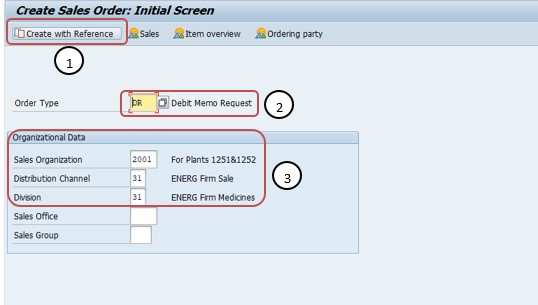
Create Debit Memo Request – VA01
Select Create with Reference. This copies the data of an existing document into the request.
Select the order type. Order Type: Debit Memo Request.
Select the sales area. Sales Organization: 2001. Distribution Channel: 31. Division: 31.
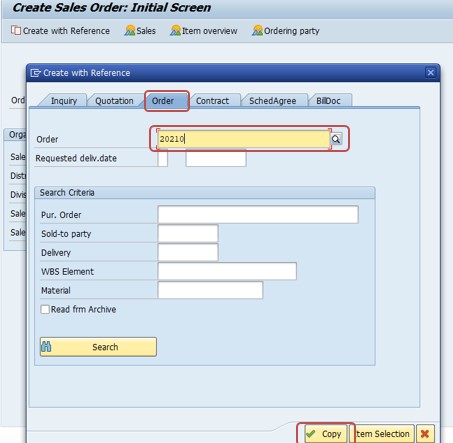
Select the reference order. Order No: 20210. Then select Copy.
Select the billing block. Billing Block: Prices Incomplete.
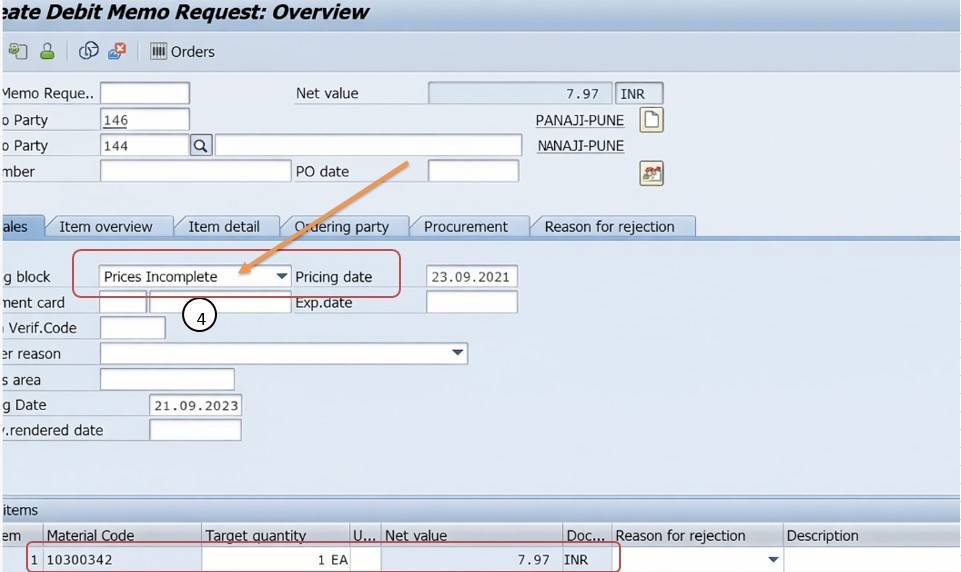
Save the debit memo request. SAP shows a message with the number of the new request.
📋 Values Used in This Tutorial at a Glance
The table below summarizes every value from the steps above, so you can compare it with your own screen before you save.
| Item | Value Used | Note |
|---|---|---|
| Transaction | VA01 | Create sales document |
| Method | Create with Reference | Copies data from an existing order |
| Order type | Debit Memo Request | Standard key is usually DR |
| Sales organization | 2001 | Use your own sales organization |
| Distribution channel | 31 | Use your own channel |
| Division | 31 | Use your own division |
| Reference order | 20210 | The order being corrected |
| Billing block | Prices Incomplete | Holds the request until prices are reviewed |
| Final action | Save | Creates the request |
⛔ Why a Billing Block Is Set on the Request
In this guide the request is saved with the billing block Prices Incomplete. A billing block stops the request from being billed until someone has reviewed it. This is a useful control for corrections, because a wrong debit memo changes a customer's account and can annoy a customer if it is sent by mistake.
The typical routine is that sales creates the request, the pricing or finance team checks the amounts and the reason, and then the block is released with VA02. Only after that does the request appear in the billing due list for VF04 or VF01. If the block is never released, the request stays open, and the correction never reaches the customer. A weekly list of requests with open blocks keeps this from happening.
💰 From Request to Debit Memo
After the block is released, the request is billed. In VF01 the user selects the request number and saves, and SAP creates a debit memo with a billing document number. In a standard setup the system also creates an accounting document that debits the customer account and credits the revenue, so the amount the customer owes increases by the corrected amount. The document flow of the original order then shows the order, the delivery, the invoice, the request and the debit memo in one chain.
Check the result with FB03, and confirm the amount, the tax and the due date. The exact accounting entries depend on your configuration, so confirm them with your finance team before using the process in production.
💼 Real-World Scenario: Correcting a Price at Learn Pharma, Pune
At Learn Pharma in Pune, finance executive Pooja Patil found that order 20210 had been invoiced at an old, lower price. The customer owed more than the invoice showed. Sales manager Rohan Kulkarni agreed that the price should be corrected.
Pooja opened VA01, chose Create with Reference, selected the order type Debit Memo Request, entered sales organization 2001, distribution channel 31 and division 31, and copied order 20210. She set the billing block Prices Incomplete and saved the request.
Finance lead Sameer Joshi checked the prices, released the block with VA02, and Pooja created the debit memo with VF01. The customer received the corrected amount, and Pooja noted the steps in her work instruction.
💰 Pricing in a Debit Memo Request
When you create the request with reference to order 20210, SAP copies the items and, depending on the copy control settings, the prices. For a correction, the amount that matters is usually the difference between what was billed and what should have been billed. Some companies enter only the difference as the item value, while others copy the full price and rely on the review step to adjust it.
That is where the billing block in this guide helps. With the block set, the pricing team can open the request, compare it with the original invoice, and adjust the conditions before the request is released. Agree the method in advance, write it into the work instruction, and use it consistently, because mixed methods are the most common source of wrong debit memos.
Taxes follow the same logic. If the correction changes the taxable amount, the tax in the debit memo changes with it. Confirm the tax result with your tax team the first time you use a new type of correction.
✅ A Simple Approval Routine for Corrections
| Step | Action | Owner |
|---|---|---|
| 1 | Identify the wrong invoice and the reason. | Sales or finance |
| 2 | Create the request with reference to the order. | Sales operations |
| 3 | Review amounts, tax and the reason text. | Pricing team |
| 4 | Release the billing block. | Finance lead |
| 5 | Create the debit memo. | Billing clerk |
| 6 | Inform the customer and file the documents. | Customer service |
A routine like this keeps corrections traceable. Anyone who looks at the document flow later can see who created the request, who approved it and when it was billed.
🔄 Corrections That Involve Several Items
An invoice may contain many items, and the error may affect only some of them. When you copy the order into the request, SAP copies all items by default. Remove the items that do not need correction, or set their quantity to zero, so the debit memo covers only the amounts that are really in question.
If the same error affects many invoices, for example a price list that was loaded wrongly for a whole month, creating one request per invoice becomes slow. In that case, talk to the SAP team about a mass process or a scheduled correction, and test it with a few documents first. Whatever method you choose, keep a list of the affected invoices and the resulting debit memos, so the finance team can reconcile the total.
📊 Tracking Open Requests
| Question | Where to Look |
|---|---|
| Which requests still have a billing block? | The list of sales documents, filtered by billing block. |
| Which requests are ready for billing? | The billing due list with VF04. |
| Which debit memos were created this month? | The billing document list, filtered by billing type. |
| Which customers receive many corrections? | A report on debit memos by customer. |
Many corrections for the same customer or product point to a root cause, such as a wrong price in the master data. Fix the cause once, and the number of requests falls.
📞 Communicating with the Customer
A debit memo asks the customer to pay more, so the way it is communicated matters. Before the document is sent, the account manager should explain the reason to the customer and agree on the new amount. A short note that refers to the original invoice number, the order number and the cause of the correction prevents disputes and speeds up payment.
Keep copies of the original invoice, the request and the debit memo together in the customer file, and name them in a consistent way so they can be found quickly by any colleague. If the customer later questions the amount, anyone in the team can show the complete trail in a few minutes. A polite, clear explanation also protects the relationship, which is worth more than the correction itself.
📝 Documentation and Audit Trail
Corrections are sensitive documents, and auditors usually look at them closely. Make sure that every debit memo request has a reason in the document text, a reference to the original order and a named approver. Keep screenshots of the key steps, such as the order type, the reference and the billing block, in your project documentation.
It also helps to review all debit memos once a quarter. The review should check that each one has an approved request, that the amounts match the explanation and that no request was billed twice. A short quarterly check finds small problems before they grow, and it shows the auditors that the process is under control. Share the results with the sales and finance leads, so that both teams see the same numbers and agree on any improvements to the routine.
❗ Common Mistakes When Creating a Debit Memo Request
- Using a debit memo request when a credit memo request is needed, so the customer owes more instead of less.
- Creating the request without a reference, so the original data is not copied.
- Forgetting to release the billing block, so the request is never billed.
- Entering the wrong sales area, so the reference order is not found.
- Not recording the reason for the correction.
- Billing the request twice.
🔧 Troubleshooting: When the Request Does Not Work
| Symptom | Likely Cause | What to Check |
|---|---|---|
| Reference order not found. | Wrong sales area or order number. | Check the order in VA03 and the sales area. |
| Order type not available. | No authorization or order type missing. | Check authorization and the order type configuration. |
| Request is not in the billing due list. | A billing block is still set. | Release the block with VA02. |
| Debit memo not created. | Pricing or account determination problem. | Read the message and check pricing and accounts. |
| Amount is wrong. | Prices were copied from the order unchanged. | Review the pricing screen of the request. |
✅ Best Practices for Debit Memo Requests
- Write the reason for the correction in the document text.
- Use a billing block so that every request is reviewed before billing.
- Keep a list of open requests and release or reject them quickly.
- Keep one person responsible for each correction from request to debit memo.
- Review the customer account after billing.
- Train the team to tell debit memos and credit memos apart.
📱 This Process in SAP S/4HANA
Debit memo requests remain available in SAP S/4HANA, although screens and Fiori apps can differ from the classic examples used here. Confirm the exact steps in your own release before you train users. The business principle does not change: a controlled request is created, reviewed and then billed.
🎓 Interview-Style Questions and Answers
Q: What is a debit memo request?
A sales document used to correct an incorrect invoice, which is billed later as a debit memo.
Q: Which transaction creates it?
VA01, with the order type Debit Memo Request.
Q: What does Create with Reference do?
It copies data from an existing document, such as order 20210, into the new request.
Q: Why set a billing block?
It stops the request from being billed until it has been reviewed.
Q: How does a debit memo differ from a credit memo?
A debit memo increases the amount the customer owes, and a credit memo reduces it.
📚 Quick Glossary of Terms Used in This Guide
- Debit Memo Request (DMR): A sales document that requests a correction that increases the customer's balance.
- Debit Memo: The billing document created from the request.
- Credit Memo Request: The opposite document, used to reduce the customer's balance.
- Billing Block: A block that stops a document from being billed.
- Create with Reference: A function that copies data from an existing document.
- Document Flow: The chain of documents linked to a sales order.
🎯 Conclusion
A debit memo request gives your company a controlled way to correct an invoice. Open VA01, choose Create with Reference, select the order type Debit Memo Request, enter sales organization 2001, distribution channel 31 and division 31, copy order 20210, set the billing block and save. Then release the block and bill the request. If you run into any errors while following along, feel free to send a screenshot to pramod@learntosap.com for help.