How to Create Customer Material Info Record in SAP (VD51) – Step-by-Step Guide
A Customer Material Info Record (CMIR) links a customer to a material and stores the customer's own number and description. This guide shows how to create one with transaction VD51, using customer 146, sales organization 2001, distribution channel 31 and the material from the original screenshots. It explains what the record stores, how it is used in a sales order, how it differs from a purchasing info record, common mistakes and troubleshooting. If you run into any errors while following along, feel free to send a screenshot to pramod@learntosap.com for help.
✅ Customer Material Info Record – VD51
How to Create Customer Material Info Record in SAP: Step-by-Step Guide
Customer Material Info Record in SAP SD is a handy tool that helps businesses ensure they meet customer expectations by customizing products according to their unique preferences. It simplifies order processing, reduces errors, and ultimately leads to happier customers and cost savings.
Example: Imagine you run a business that sells various products to different customers. Each customer may have unique requirements, such as specific packaging or labeling for the products they order from you. A Customer Material Info Record (CMIR) in SAP SD is like a special note that helps you keep track of these individual customer preferences and requirements for each product.
In simple words, your company calls a product by one number, and your customer may call the same product by another. The CMIR is the table that connects the two. This guide shows how to create one with transaction VD51 using the original screenshots, and then explains where the record is used and how to keep it clean.
💡 Why Use a Customer Material Info Record?
- Faster order entry. The sales team can enter the customer's own material number, and SAP finds your material.
- Fewer errors. There is no manual translation between two numbering systems, so mistakes are reduced.
- Customer-specific data. Descriptions, packaging notes and delivery rules can be stored for each customer and material.
- Better service. Documents can show the customer's own number, which makes invoices and delivery notes easier for the customer to process.
- Cost savings. Less rework and fewer returns reduce cost and improve satisfaction.
📋 Where the CMIR Fits in the Sales Process
The CMIR is master data. It is created once and then used every time the customer orders the material. The table shows where it is read.
| Stage | What Happens | Role of the CMIR |
|---|---|---|
| Inquiry or quotation | The customer asks for a price using their own part number. | SAP finds your material from the customer's number. |
| Sales order | The order is entered for the customer. | The customer material number and description are proposed. |
| Delivery | Goods are picked and shipped. | Customer-specific delivery rules can apply. |
| Billing | The customer is invoiced. | The customer's own number can appear on the document. |
Because the record is used in many documents, a wrong entry affects many orders. That is why this guide ends with best practices for maintaining it.
📝 SAP CMIR Creation Steps: Go to Tcode VD51
Go to the following transaction codes:
| Transaction | Purpose |
|---|---|
| VD51 | Create customer-material info record. |
| VD52 | Modify customer-material info record. |
| VD53 | Display customer-material info record. |
| VA01 | Create a sales order that uses the record. |
| XD03 | Display customer master data. |
| MM03 | Display material master data. |
🔧 What You Need Before You Create a CMIR
- A customer master that is extended to the sales area, here customer 146 in sales organization 2001 and distribution channel 31.
- A material master that is extended to the same sales organization and distribution channel.
- The customer's own information, such as their material number and description, if they use one.
- Authorization to create customer-material records.
If the customer or the material is not extended to the sales area, SAP will not accept the record, and you will need to extend the master data first.
🔧 Step-by-Step: Create a Customer Material Info Record with VD51
Following Path
Go to: Logistics → Sales and Distribution → Master Data → Agreements → Customer Material Information → Create – VD51.
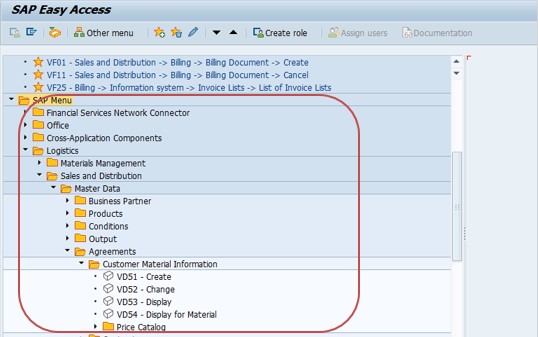
Go to Tcode VD51
Select the customer number. Customer No: 146.
Select the sales organization. Sales Organization: 2001.
Select the distribution channel. Distribution Channel: 31.

Select the material number. Material No: 20072.
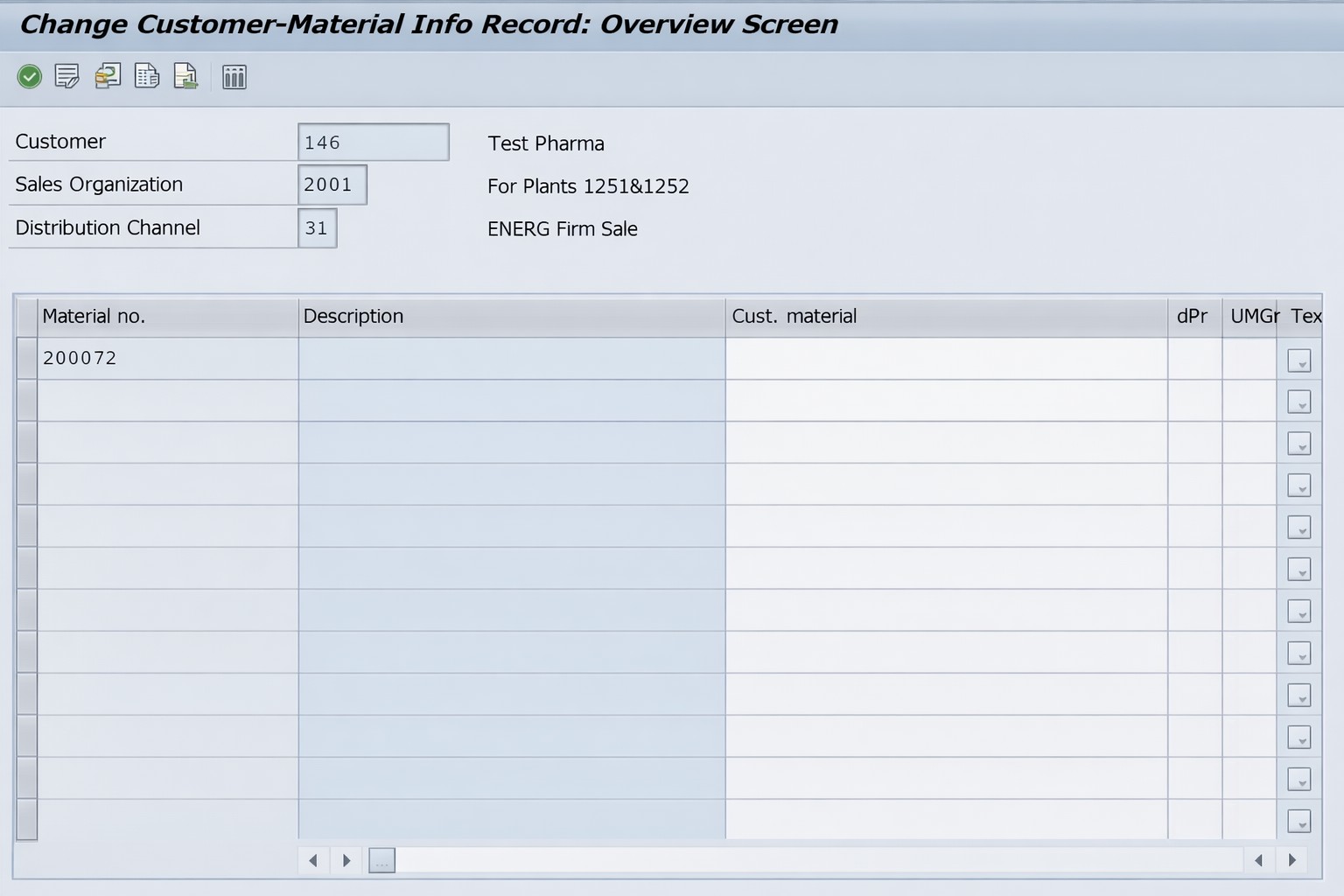
Save the customer material info record. SAP shows a message that the record was saved.
📋 Values Used in This Tutorial at a Glance
The table below summarizes every value from the steps above, so you can compare it with your own screen before you save.
| Item | Value Used | Note |
|---|---|---|
| Transaction | VD51 | Create customer-material info record |
| Customer number | 146 | Use your own customer |
| Sales organization | 2001 | Must match the customer and material |
| Distribution channel | 31 | Must match the customer and material |
| Material number | 20072 | As shown in the original screenshot |
| Final action | Save | Creates the record |
📝 Typical Information Stored in a CMIR
The exact screen differs between releases, but a customer-material info record normally holds the following kinds of information.
| Information | Meaning | Why It Matters |
|---|---|---|
| Material | Your own material number. | Identifies the product in your system. |
| Customer material number | The number the customer uses for the same product. | Lets orders be entered with the customer's number. |
| Customer material description | The name the customer uses. | Can appear on documents for the customer. |
| Plant and delivery data | Delivery plant, tolerances and partial delivery rules. | Controls how the product is delivered to this customer. |
| Packaging or labeling notes | Customer-specific packing and labeling needs. | Helps the warehouse follow the customer's wishes. |
Agree with the sales team which fields are needed, and fill them in the same way for every customer, so the data is consistent.
🔄 CMIR Compared with Other Info Records
| Record | Links | Module | Transaction |
|---|---|---|---|
| Customer-material info record | Customer and material | Sales and Distribution | VD51 |
| Purchasing info record | Vendor and material | Materials Management | ME11 |
| Material master | Material only | Both | MM01 |
The sales tutorial path in this guide uses the customer-material record. Do not confuse it with the purchasing info record, which is used when you buy from a vendor.
📝 Customer and Material Master Basics for CMIR
A customer-material record depends on two other master records. The customer master holds the customer's name, address, sales area data, payment terms and partner functions. The material master holds your product's description, units, plant data and sales views. The CMIR sits between them and can only exist when both are complete for the sales area in use.
Before creating the record, open the customer with XD03 and check that the sales area data exists for sales organization 2001 and distribution channel 31. Then open the material with MM03 and check the sales organization views. A few minutes spent here prevent the most common error message, which says that the customer or the material is not defined for the sales area.
It also helps to confirm the unit of measure. If your company stores a product in pieces and the customer orders in boxes, agree the conversion with the product team, so the same quantity means the same thing in every document.
📦 Customer-Specific Delivery and Packing Wishes
The example in this guide mentions that customers may ask for specific packaging or labeling. The CMIR is a convenient place to record such wishes, because they belong to the combination of one customer and one product. For example, one customer may want each carton labeled with their own part number, while another wants a particular quantity per pallet.
The warehouse team reads these notes when preparing the delivery. If the wishes are written in the record, the team no longer has to search old emails, and a new employee follows the same rules as an experienced one. Keep the text short and clear, and review it with the customer once a year, because requirements change.
Where the standard fields are not enough, agree with your SAP team whether a text field or a custom field is the better place. Avoid storing the same information in several places, because duplicates always drift apart.
📊 Who Maintains Customer Material Records
| Role | Responsibility |
|---|---|
| Sales operations | Create and update records when customers send new part numbers. |
| Master data team | Check for duplicates and keep the format consistent. |
| Warehouse lead | Confirm packing and labeling notes. |
| Functional consultant | Support uploads and fix configuration issues. |
| Key user | Test sample orders after major changes. |
Writing down these responsibilities avoids the common situation where everyone assumes someone else maintains the records, and nobody does.
✅ Testing Plan After Creating a CMIR
| Test | Expected Result |
|---|---|
| Display the record with VD53 | Customer, sales area and material appear as entered. |
| Create a sales order with the customer's number | SAP finds your material and fills the item. |
| Check the description on the item | The customer's description is proposed. |
| Enter an unknown customer number | SAP does not find a material and shows a message. |
| Create the delivery and invoice | The documents carry the customer data as expected. |
Run these five checks after every new record or upload. They take only a few minutes, and they confirm that the whole chain, from order to invoice, works with the new data.
📅 Setting Up a New Customer: A Simple Routine
| Step | Action | Owner |
|---|---|---|
| 1 | Create and release the customer master with sales area data. | Master data team |
| 2 | Confirm which materials the customer will order. | Sales operations |
| 3 | Collect the customer's part numbers and descriptions. | Sales operations |
| 4 | Create CMIR records with VD51 or an upload. | Sales operations |
| 5 | Test a sales order and check the document flow. | Key user |
| 6 | Record the setup in the customer file. | Master data team |
Following the same six steps for every new customer avoids missing records, and the first order arrives into a system that is already ready for it.
📄 Effect on Delivery Notes, Invoices and Reports
Once the record exists, the customer's own number can travel through the whole sales process. Delivery notes can show it so the receiving clerk at the customer's warehouse recognizes the goods at once. Invoices can show it so the customer's accounts payable team can match the invoice to the purchase order without asking questions. This is a small detail, but it saves time on both sides and reduces payment delays caused by documents that cannot be matched.
The records are also useful for reporting. Sales managers can list which products a customer buys and how the customer names them, and they can spot customers whose records are missing or outdated. When a customer changes its part numbering, the old records can be updated in one pass, and the history of earlier orders stays intact.
Treat the CMIR as a living record. Review it whenever a customer contract is renewed, add new materials as they are introduced, and remove numbers that are no longer used. A tidy record keeps order entry fast and keeps the data trustworthy for everyone who relies on it.
📦 How the CMIR Is Used in a Sales Order
Once the record is saved, open VA01 and create a sales order for customer 146 in sales organization 2001. In the item, the user can enter the customer's own material number instead of your material number. SAP looks up the customer-material record, finds your material and fills the item. The customer's description is also proposed. If no record exists, SAP cannot translate the number, and the user must enter your material number by hand. This is the main benefit of the record: the order is entered quickly, and the same material is found every time.
💼 Real-World Scenario: Setting Up Customer 146 at Learn Pharma, Pune
At Learn Pharma in Pune, sales coordinator Pooja Patil noticed that customer 146 always sent orders with their own part numbers. Each order needed a manual check, and twice the wrong material was entered.
She opened VD51, entered customer 146, sales organization 2001 and distribution channel 31, selected the material and saved the record. Her colleague Rohan Kulkarni tested a new sales order by entering the customer's number, and SAP found the right material at once.
Finance lead Sameer Joshi noticed that invoices now showed the customer's own number, which made payment matching easier for the customer. Pooja added the steps to her work instruction, so new records were created in the same way.
❗ Common Mistakes When Creating a CMIR
- Creating the record for a customer or material that is not extended to the sales area.
- Typing the customer's material number with a different format than the customer uses.
- Creating two records for the same customer and material with different data.
- Entering the wrong sales organization or distribution channel.
- Forgetting to maintain the record before the first order arrives.
- Never reviewing old records, so outdated numbers stay in the system.
🔧 Troubleshooting: When the Record Does Not Work
| Symptom | Likely Cause | What to Check |
|---|---|---|
| Material not found for the customer. | The material is not extended to the sales area. | Check the sales data of the material with MM03. |
| Customer not accepted. | The customer is not extended to the sales area. | Check the sales area data of the customer with XD03. |
| Order does not propose the customer number. | No record exists for this customer and material. | Check the record with VD53. |
| Wrong material found. | Two records use the same customer number. | Search for duplicate customer material numbers. |
| Cannot save the record. | Missing authorization or missing data. | Read the message and check the required fields. |
✅ Best Practices for Customer Material Info Records
- Create the record when the customer is set up, not when the first order arrives.
- Keep one record per customer and material, and update it instead of adding another.
- Use the customer's exact number and description, including spaces and dashes.
- Review records when a customer changes its part numbering.
- Use a standard upload tool for many records, and test with a small file first.
- Document who may create and change records.
🔄 Creating Many Records at Once
Entering records one by one is fine for a handful of materials. For a customer with hundreds of part numbers, a mass upload is faster and less error-prone. Many companies use the Legacy System Migration Workbench for this kind of task. You can read more in the LSMW import guide. Always test the upload with a few records, check them with VD53 and only then load the full file.
📱 This Process in SAP S/4HANA
Customer-material information remains available in SAP S/4HANA, although screens and Fiori apps can differ from the classic examples used here. Confirm the exact steps in your own release before you train users. The business principle does not change: the record links the customer's number to your material and speeds up order entry.
🎓 Interview-Style Questions and Answers
Q: What is a CMIR?
A record that links a customer to a material and stores the customer's own number and description.
Q: Which transactions are used?
VD51 to create, VD52 to change and VD53 to display.
Q: Why is it useful?
It simplifies order processing, reduces errors and keeps customer-specific data in one place.
Q: What must exist before creating it?
The customer and the material must be extended to the sales area.
Q: How does it differ from a purchasing info record?
The CMIR is for sales and customers, the purchasing info record is for procurement and vendors.
📚 Quick Glossary of Terms Used in This Guide
- CMIR: Customer Material Info Record, the link between a customer and a material.
- Sales Organization: The unit responsible for selling products.
- Distribution Channel: The way products reach the customer, such as direct sales.
- Customer Material Number: The number the customer uses for your product.
- Master Data: Long-lived records, such as customers and materials.
- Sales Area: The combination of sales organization, distribution channel and division.
🎯 Conclusion
A Customer Material Info Record connects your products to the way your customers talk about them. Open VD51, enter customer 146, sales organization 2001 and distribution channel 31, select the material and save. Then test it in a sales order and keep the record clean over time. If you run into any errors while following along, feel free to send a screenshot to pramod@learntosap.com for help.