SAP ME41: How to Create a Request for Quotation (RFQ) – Step-by-Step
Request for Quotation (RFQ) is a crucial document in the procurement process. It is used by organizations to solicit price quotations or proposals from potential suppliers for the procurement of goods or services. The RFQ is sent to multiple suppliers, and they respond with their quotations detailing the prices, terms, and conditions for the requested goods or services. This guide walks you through the Step-by-Step Process to Create an RFQ using transaction ME41. If you encounter any errors while following along, feel free to send a screenshot to pramod@learntosap.com, and I will help you resolve the issue.
✅ What is ME41 TCode in SAP MM?
Request for Quotation (RFQ) is a crucial document in the procurement process. It is used by organizations to solicit price quotations or proposals from potential suppliers for the procurement of goods or services. The RFQ is sent to multiple suppliers, and they respond with their quotations detailing the prices, terms, and conditions for the requested goods or services. The RFQ process involves creating, managing, and tracking RFQ documents electronically within the SAP system. This module allows you to efficiently manage the procurement process from initiating the RFQ, sending it to suppliers, receiving their quotations, evaluating the offers, and ultimately selecting the most suitable supplier based on factors like price, quality, delivery terms, and other relevant criteria.
It helps to understand upfront why the RFQ sits where it does in SAP's procurement cycle. Unlike a Purchase Requisition, which is purely internal, or a Purchase Order, which is a binding commitment, the RFQ is neither - it is an invitation to bid. This distinction matters because it changes how carefully the header data, item details, and deadline dates need to be entered: everything on the RFQ is what vendors will actually see and respond to, so accuracy here directly shapes the quality of the quotations that come back.
Related Transaction Codes
| Transaction | Purpose |
|---|---|
| ME41 | Creating Request for Quotation. |
| ME42 | Modify Request for Quotation. |
| ME43 | Display Request for Quotation. |
📋 The RFQ Process, End to End
Creation of the RFQ: A buyer creates a Request for Quotation in ME41, specifying the material or service required, quantity, delivery date, and the deadline by which vendors must respond with pricing.
Vendor Selection and Distribution: The buyer selects one or more vendor addresses so the same RFQ can be sent out to multiple potential suppliers at once, allowing prices and terms to be compared fairly.
Vendor Response (Quotation Entry): Each invited vendor submits a quotation with their proposed price, delivery terms, and conditions. These quotations are recorded in SAP using transaction ME47, one per responding vendor, all linked back to the same RFQ or collection number.
Price Comparison: Once quotations have been received, the buyer compares them side by side - typically using the price comparison list (ME49) - weighing price against delivery time, quality history, and other relevant criteria.
Vendor Selection and Rejection: The buyer selects the winning quotation and formally rejects the others, which also lets unsuccessful vendors know the outcome.
Conversion to Purchase Order or Contract: The selected quotation is then converted into a Purchase Order (ME21N) or, for a longer-term commitment, an outline agreement such as a Contract (ME31K).
🔧 Steps to Create RFQ in SAP Using ME41
Go To: Logistics → Materials Management → Purchasing → RFQ/Quotation → Create, or run transaction ME41 directly.
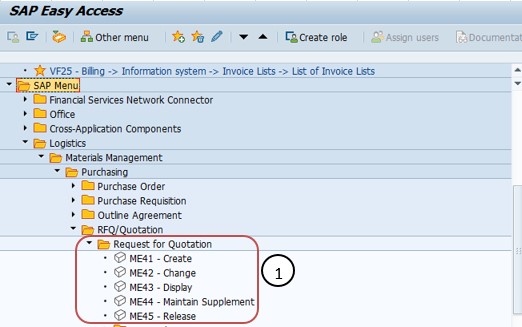
Go to Tcode ME41. Run transaction ME41 to open the Request for Quotation creation screen. This is the starting point for inviting one or more vendors to bid on a material or service requirement.
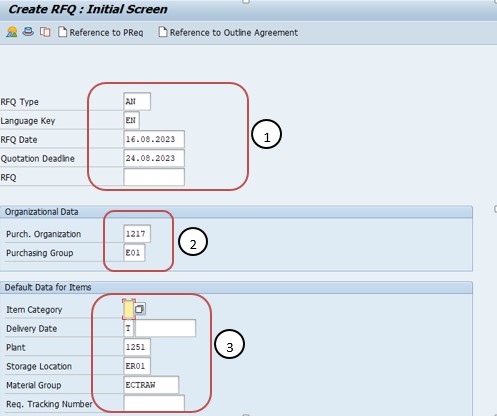
RFQ Type - AN (you can choose a different RFQ type). Select the RFQ document type; AN is the standard type used for most inquiries, though other types may exist for special procurement scenarios.
Language Key - EN (English). Set the language the RFQ document will be printed or transmitted in, which should generally match the language the vendor operates in.
RFQ Date - 16.08.2023 (enter your own quotation start date). This marks the date the RFQ is being issued.
Quotation Deadline - 24.08.2023 (enter your own quotation end date). This is the cutoff by which vendors must submit their quotations to be considered.
Purchasing Organization - 1217. The organizational unit within the company responsible for procurement activity on this RFQ.
Purchasing Group - E01 - Raw Material. The buyer or buying team responsible for handling this specific RFQ.
Item Category - Use Standard. Defines how the requested line item will be handled; Standard covers typical stock and non-stock material procurement.
Delivery Date - T (day format). The date by which the material or service should be delivered if the vendor is selected.
Plant - 1251. The receiving location that will use or stock the material once delivered.
Storage Location - ER01. The specific storage area within the plant where the material should be booked in upon receipt.
Material Group - ECTRAW. Groups the material for reporting and analysis purposes, useful when comparing spend across similar categories.
Enter Collection Number, Deadline Date, Validity Period, and Target Value.
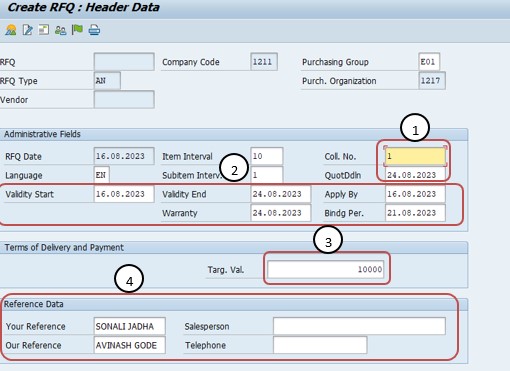
Collection No - 1. The collection number is a unique identifier assigned to each RFQ, useful for grouping related quotations together.
Deadline Date - 24.08.2023. The deadline date in an RFQ is the cutoff point for suppliers to submit their bids.
Validity Start and End - 16.08.2023 to 24.08.2023. Defines the window during which the RFQ, and any quotations submitted against it, remain valid.
Target Value - 10000. The target value is the estimated or desired value of the procurement effort, giving vendors and buyers a reference point during evaluation.
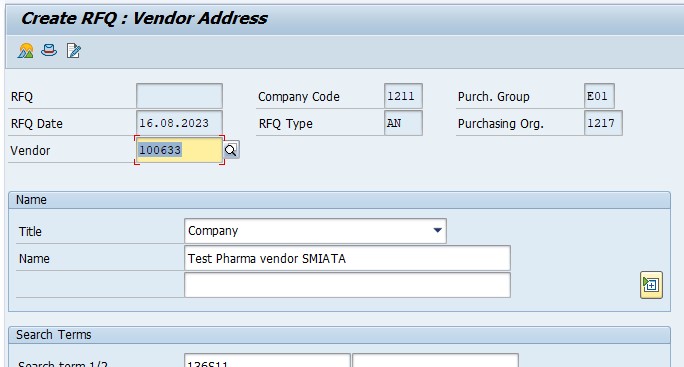
Select Vendor Address. Choose the address of each vendor who should receive the RFQ, so the same requirement can be quoted by multiple suppliers at once.
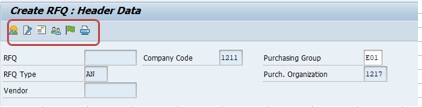
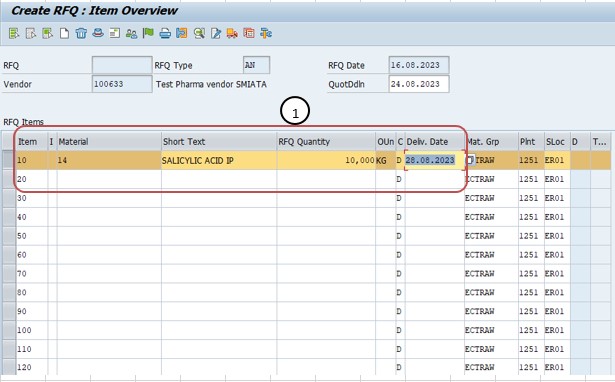
Enter Material No, Qty, Delivery Date, and Save. Fill in the item-level details - the material number, the quantity being requested, and the delivery date expected if the vendor's quotation is accepted - then save the RFQ. The collection number plays an important role here, as it serves as a unique identifier for the RFQ that ties all subsequent vendor quotations back to the same requirement.
📋 Key RFQ Fields at a Glance
A quick reference for the main fields captured when creating a Request for Quotation in ME41.
| Field | What It Captures |
|---|---|
| RFQ Type | AN (Standard) or another RFQ type configured for special sourcing scenarios. |
| Language Key | The language the RFQ document is printed or transmitted in, matched to the vendor. |
| RFQ Date / Quotation Deadline | The date the RFQ is issued and the cutoff by which vendors must respond. |
| Purchasing Organization / Group | The organizational unit and buyer or buying team responsible for the RFQ. |
| Item Category | Defines how the requested line item is handled - typically Standard for regular material or service procurement. |
| Plant / Storage Location | The receiving location and storage area where the material would be booked in if delivered. |
| Material Group | Groups the material for reporting and spend analysis across similar categories. |
| Collection Number | A unique identifier tying the RFQ and all vendor quotations against it together. |
| Target Value | The estimated or desired value of the procurement effort, used as a reference during evaluation. |
| Vendor Address | The supplier(s) invited to submit a quotation against the RFQ. |
| Material Number / Quantity / Delivery Date | The item-level details defining exactly what is being requested and by when. |
📋 Related SAP Transactions
| Transaction | Purpose |
|---|---|
| ME41 | Create a new Request for Quotation. |
| ME42 | Change / modify an existing Request for Quotation. |
| ME43 | Display a Request for Quotation without allowing changes. |
| ME47 | Enter or maintain vendor quotations received against an RFQ. |
| ME49 | Compare vendor quotations side by side using the price comparison list. |
| ME21N | Create a Purchase Order, often based on the winning quotation. |
| ME31K | Create a Contract, an alternative outcome for a longer-term sourcing decision from an RFQ. |
❗ Common Mistakes When Creating an RFQ
- Setting a quotation deadline that is unrealistically short for vendors to prepare a properly costed response, leading to rushed or padded quotations.
- Leaving the material group, plant, or storage location inconsistent with how similar procurement is normally categorized, making later spend analysis harder.
- Sending the RFQ to too few vendors, which undermines the entire purpose of soliciting competitive quotations in the first place.
- Entering a target value that is not grounded in any market or historical reference, which can distort how quotations are evaluated against it.
- Forgetting to record the collection number properly, making it harder to group and compare quotations received against the same requirement.
- Mismatched item category or delivery date between what the requesting department actually needs and what is stated on the RFQ, leading to quotations that don't reflect the real requirement.
- Not following up with invited vendors as the deadline approaches, resulting in an incomplete set of quotations to compare.
✅ Best Practices for RFQ Creation
- Give vendors a realistic quotation deadline based on the complexity of the requirement, rather than an aggressive date that discourages a careful response.
- Invite a sufficient number of qualified vendors so the resulting quotations genuinely allow price and terms to be compared.
- Set a target value based on historical pricing or market research wherever possible, so it serves as a meaningful reference during evaluation.
- Keep material number, quantity, delivery date, plant, and storage location consistent with the actual internal requirement, ideally traceable back to a Purchase Requisition.
- Use the collection number consistently to group all quotations received against the same RFQ for easier comparison later.
- Follow up with invited vendors ahead of the deadline to confirm they intend to respond, reducing the risk of an incomplete comparison.
- Document the basis for the eventual vendor selection - price, delivery terms, quality history - so the decision is defensible during any later audit or review.
📈 How RFQ Data Powers Downstream Sourcing Decisions
The Request for Quotation's influence extends across the entire sourcing decision, which is exactly why getting the initial ME41 creation right pays off well beyond the creation screen itself. The RFQ's material, quantity, and delivery date define exactly what every invited vendor is quoting against, its collection number ties every vendor's response together for a clean comparison, and its quotation deadline determines how much time buyers have to evaluate offers before a sourcing decision has to be made.
Because the eventual Purchase Order or Contract is built on whichever quotation wins, an inconsistency at the RFQ stage - a vague delivery date, a mismatched material number, an unrealistic deadline that discourages serious bids - is one of the more common root causes behind a sourcing decision that later turns out to be based on incomplete or non-comparable information, rather than a problem with the Purchase Order or Contract configuration in isolation.
✅ Validating the RFQ Before Sending It to Vendors
Once an RFQ is entered, it's worth running through a short validation checklist before it goes out to suppliers. Display the RFQ (ME43) and confirm the material, quantity, delivery date, plant, and storage location were all saved correctly. Confirm the quotation deadline and validity period give vendors enough time to respond properly. Check that every vendor address intended to receive the RFQ has actually been added. Finally, confirm the target value and material group are consistent with how the requirement will be evaluated once quotations come in.
Skipping this validation step is one of the more common reasons an RFQ has to be reissued or amended after vendors have already started preparing their responses - usually a missing vendor, an unrealistic deadline, or an item detail that does not match what the requesting department actually needs.
🎓 Interview-Style Questions and Answers
Q: What is a Request for Quotation, and why does an organization use one?
A Request for Quotation is a document sent to potential suppliers to solicit price quotations or proposals for goods or services. Organizations use it to test the market and compare multiple vendors on price, quality, and delivery terms before committing to a Purchase Order or Contract.
Q: What is the collection number, and why is it useful?
The collection number is a unique identifier assigned to an RFQ that ties together every vendor quotation submitted against it, making it possible to compare responses to the same requirement side by side.
Q: What is the difference between ME41, ME42, and ME43?
ME41 creates a new Request for Quotation, ME42 changes an existing RFQ, and ME43 displays an RFQ without allowing any changes.
Q: What happens after quotations are received against an RFQ?
Vendor quotations are entered using ME47, compared using the price comparison list (ME49), and the winning quotation is typically converted into a Purchase Order or, for longer-term arrangements, a Contract.
📚 Quick Glossary of Terms Used in This Guide
- Request for Quotation (RFQ): A document sent to potential suppliers to solicit price quotations or proposals for goods or services.
- Collection Number: A unique identifier assigned to an RFQ, used to group and track quotations received from different vendors against the same requirement.
- Target Value: The estimated or desired value of the procurement effort, used as a reference point during quotation evaluation.
- Quotation Deadline: The cutoff date by which invited vendors must submit their quotations to be considered.
- Price Comparison List: A tool (ME49) used to compare vendor quotations received against an RFQ side by side.
- Item Category: A field defining how a requested line item on the RFQ is processed, typically Standard for regular material or service procurement.
📝 Governance for RFQ Creation
Because an RFQ is the point where an organization first invites external competition for a requirement, most companies maintain a documented governance process around which purchasing groups may issue RFQs, how many vendors must be invited for different value thresholds, and how long the quotation deadline should be for different categories of spend. This is particularly important in larger organizations where procurement wants confidence that sourcing decisions are being made on a genuinely competitive basis, rather than defaulting to whichever vendor happens to be easiest to reach.
Data quality governance matters here for the same reason it does for other purchasing documents: an RFQ issued quickly, with a vague delivery date, too few invited vendors, or an unrealistic deadline, tends to produce quotations that are hard to compare fairly - which weakens the entire justification for having gone through a competitive sourcing process at all. Establishing a clear RFQ checklist, tailored to how your organization typically sources different material groups, keeps RFQ quality consistent across a large buying team over time.
💼 Real-World Scenario: Sourcing a New Raw Material Supplier
Buyer Anita Shah at Learn Pharmaceuticals needed to identify a new supplier for a raw material after the existing vendor's contract was due to expire. Rather than simply renewing with the incumbent, purchasing manager Rajesh Pawar suggested she issue a Request for Quotation to test whether better pricing or terms were available in the market.
Anita entered transaction ME41, selected RFQ type AN, set the language key to EN, and entered an RFQ date along with a two-week quotation deadline to give vendors enough time to prepare a properly costed response. She entered the purchasing organization, purchasing group, item category, delivery date, plant, storage location, and material group, then assigned a collection number and set a target value based on what the organization had paid historically for similar volumes.
She selected the addresses of three qualified vendors, including the incumbent supplier, entered the material number, quantity, and delivery date at the item level, and saved the RFQ. As quotations came in through ME47, Anita used the price comparison list (ME49) to evaluate them against price, delivery lead time, and quality history, ultimately selecting a new vendor who offered better pricing without compromising on delivery reliability, and converted the winning quotation into a new long-term Contract.
📱 This Configuration in SAP S/4HANA
Transaction ME41 and the underlying RFQ creation process work largely the same way in SAP S/4HANA as in classic ECC, since the RFQ remains a core Materials Management document type. What has changed in S/4HANA is the availability of Fiori apps such as "Manage RFQs" and improved quotation comparison analytics, which give buyers a more modern, list-based way to track which vendors have responded and compare quotations without leaving a single screen. Many S/4HANA implementations continue to use ME41 for detailed or complex RFQ creation, while Fiori-based apps are increasingly favored for monitoring RFQ status and running quotation comparisons across the buying team.
🎯 Conclusion
Creating a Request for Quotation in ME41 is the step where SAP procurement first opens a requirement up to competition among potential suppliers, and getting it right shapes how useful the resulting quotations actually are. Selecting the correct RFQ type, entering accurate item details and a realistic quotation deadline, assigning a proper collection number and target value, and inviting a genuinely competitive set of vendors are what separate an RFQ that produces comparable, actionable quotations from one that generates confusion or an incomplete sourcing decision. Keep this guide handy the next time your organization needs to solicit quotations from suppliers for materials or services.