How to Assign Sales Office to Sales Area in SAP SD (OVXM Tcode Tutorial)
Assigning sales offices to sales areas is a fundamental configuration step in SAP SD. It facilitates geographical alignment, customer proximity, tailored sales strategies, and efficient reporting. This guide walks through transaction OVXM, explains what the assignment actually enables once it's live, and covers what needs to already exist beforehand - a defined sales office and a built sales area - before this step can even be attempted. If you run into any errors while following along, feel free to send a screenshot to pramod@learntosap.com for help.
✅ Why Assign a Sales Office to a Sales Area in SAP SD?
Assigning sales offices to sales areas is a fundamental configuration step in SAP SD. It facilitates geographical alignment, customer proximity, tailored sales strategies, and efficient reporting. In this blog post, we've explored the importance of this assignment and provided a step-by-step guide using transaction OVXM.
A sales office on its own only represents a regional branch or office - it says nothing yet about which sales area, that is, which sales organization, distribution channel, and division combination, it is actually permitted to sell through. OVXM is the step that supplies that missing link. Without it, a sales office that has already been carefully defined with its own address and description in OVX1 remains invisible on the sales order header, no matter how correctly it was set up.
This assignment is also what allows a single regional office to genuinely reflect how a business actually operates on the ground. A branch in Pune might sell through more than one distribution channel, or handle more than one division, and OVXM is what lets that same sales office be linked to each relevant sales area separately, rather than forcing the business to create duplicate office records just to cover different selling combinations.
📋 Where This Assignment Fits in the SD Organizational Structure
This assignment sits at the point where two already-independent parts of the SD enterprise structure meet - the sales office, defined earlier in OVX1, and the sales area, built by combining sales organization, distribution channel, and division. Seeing how OVXM relates to what comes before it makes clear why this step always comes last in the sequence.
| Organizational Unit | Role | Typical Transaction |
|---|---|---|
| Sales Organization | The top-level SD unit legally responsible for selling and distributing goods. | OVX5 |
| Distribution Channel | Describes how goods reach the customer - wholesale, retail, or direct sales. | OVXI |
| Division | Groups materials or products by product line or business unit. | OVXB |
| Sales Area | The combination of sales organization, distribution channel, and division actually used on sales documents. | OVXG |
| Sales Office | Represents a regional branch or office; defined independently before this assignment. | OVX1 |
| Sales Office → Sales Area | Makes the sales office selectable on documents created for that sales area; created here. | OVXM |
Because a sales area itself needs sales organization, distribution channel, and division already linked together before it exists, and a sales office needs its own OVX1 record before it exists, OVXM is genuinely the last step in the chain - there is nothing left to configure underneath it before a sales office becomes fully usable on live sales documents.
🔧 Assign Sales Office to Sales Area in SAP SD: Step-by-Step OVXM Tutorial
This is a short, purely relational transaction - both the sales office and the sales area already exist as separate configuration entries, and OVXM simply links the two together.
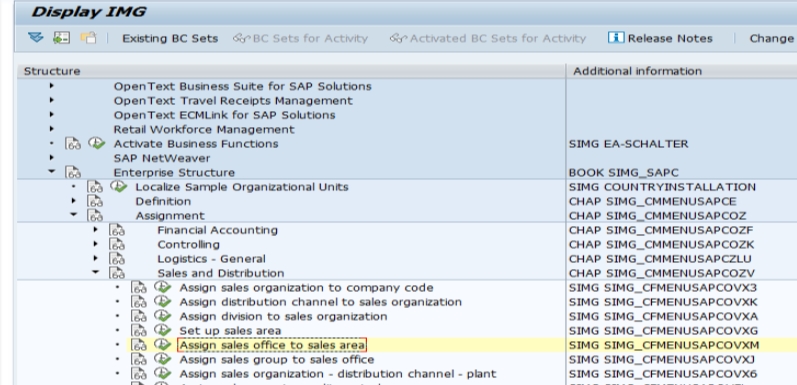
Run transaction OVXM directly, or follow the IMG path: SPRO → Enterprise Structure → Assignment → Sales and Distribution → Assign Sales Office to Sales Area.
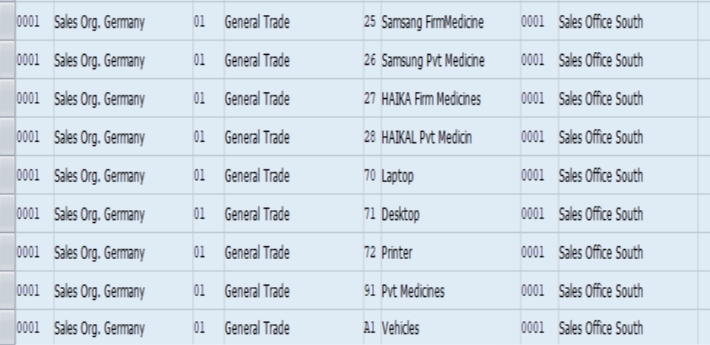
Click New Entries and assign the sales office to the relevant sales area - selecting the correct sales organization, distribution channel, and division combination alongside the sales office code.
Select Save. The system will usually prompt for a transport request if the system is configured to require one, which is standard practice for enterprise structure changes so they can be tracked and migrated through the landscape (Development → Quality → Production) in a controlled way.
📋 What Needs to Already Exist Before Using OVXM
Because OVXM is purely an assignment step, it depends entirely on two pieces of configuration already being in place. Skipping ahead to OVXM before either one is ready is one of the more common reasons this transaction produces confusing errors for consultants working through the enterprise structure for the first time.
- The sales office must already be defined using transaction OVX1, including its code, description, and address details.
- The sales area must already be built using transaction OVXG, combining a sales organization, distribution channel, and division that are all valid together.
- The distribution channel and division used in that sales area must already be individually assigned to the sales organization, since a sales area cannot be built from an invalid combination in the first place.
With all three pieces confirmed, OVXM becomes the short, final step that ties everything together - which is exactly why it is usually the very last enterprise structure activity completed for a new sales office, rather than one of the earlier ones.
💼 Real-World Scenario: Making a New Regional Office Fully Usable
Pooja Mishra, an SAP SD consultant at Learn Pharmaceuticals in Pune, had already completed most of the enterprise structure setup for a new regional branch - the sales office itself was defined in OVX1 with its full address, and the sales area it needed to sell through had already been built in OVXG. Sales manager Sonali Patil was confused when order-entry users still couldn't see the new office on the sales order screen, assuming the OVX1 step alone should have been enough.
Working with functional consultant Priya Sundar, Pooja explained that one link was still missing - the sales office had never actually been assigned to the sales area in OVXM. He used the transaction to add the missing entry, connecting the new sales office to the correct sales organization, distribution channel, and division combination. Business analyst Anita Shah then asked whether the same office would also need to sell through a second distribution channel the business had recently added, and Pooja confirmed that a second OVXM entry, linking the same sales office to the second sales area, would be needed for that combination too.
Once both entries were saved, order-entry users at Learn Pharmaceuticals could finally select the new sales office on live sales orders across both selling combinations - confirming that OVXM, while genuinely the last step in the enterprise structure chain, is also the one step that actually determines whether all the earlier configuration work becomes usable at all.
❗ Common Mistakes When Assigning Sales Office to Sales Area
- Assuming that defining a sales office in OVX1 is enough on its own, without realizing OVXM is still required before the office is selectable on a sales order.
- Attempting the OVXM assignment before the sales area has been fully built in OVXG, which results in an invalid combination error.
- Creating only one OVXM entry for a sales office that genuinely needs to sell through multiple sales areas, leaving some valid combinations unusable.
- Assigning a sales office to a sales area it has no real business reason to sell through, which clutters reporting with combinations that are never actually used.
- Confusing this assignment with the separate "Assign Division to Sales Organization" or "Assign Sales Office to Sales Area" steps for other organizational units, since several similarly named IMG activities exist near each other in the enterprise structure assignment node.
- Making this assignment directly in a production client instead of testing it in a sandbox or development client first.
✅ Best Practices for This Assignment
- Confirm both the sales office and the sales area already exist and are correctly configured before attempting the OVXM entry.
- List out every sales area combination a given sales office genuinely needs to sell through before starting, rather than adding entries reactively as gaps are discovered.
- Document every sales office to sales area assignment in a configuration workbook so the mapping is auditable during testing and go-live.
- Test a sample sales order immediately after each OVXM entry to confirm the sales office actually appears as selectable for that sales area.
- Coordinate this step with whoever completed the sales office and sales area configuration, since it's often done by a different team member or at a different point in the project timeline.
- Move enterprise structure changes like this through a transport request and test them in the Quality system before they reach Production, the same as any other configuration change.
📈 How This Assignment Supports Regional Sales Reporting
Once a sales office is correctly assigned to one or more sales areas, it becomes fully usable in exactly the way regional sales reporting depends on - every sales order, delivery, and billing document created under that combination carries the sales office value, letting management slice performance by branch or region without any additional development. This is the same reporting capability that the sales office's own OVX1 record promised, but it only becomes real once OVXM completes the chain.
This also matters for how a business models geographical alignment and customer proximity in the system. A regional office that genuinely serves customers across more than one distribution channel or product line needs each relevant sales area linked through its own OVXM entry, so that customer master records and sales documents in every one of those combinations correctly reflect which physical branch is responsible. Skipping any of these combinations leaves a gap where a valid business scenario has no matching sales office on the order, forcing users to either leave the field blank or select an office that doesn't actually reflect reality.
✅ Validating the Assignment Before Go-Live
Once the OVXM entries are saved, it's worth running through a short validation checklist before considering the sales office genuinely ready for end users. Create a test sales order (VA01) against each sales area the office was assigned to, and confirm the sales office appears and can be selected in the header organizational data. Save the order and confirm the value is stored correctly by displaying it (VA03) and checking the organizational data tab. Run a basic sales report filtered by the sales office to confirm it's picked up correctly for that combination. If the office needed to be assigned to multiple sales areas, repeat this check for each one individually, since a working assignment for one sales area says nothing about whether a second, separate combination was completed correctly.
Skipping this validation step is one of the more common reasons a sales office still doesn't appear where end users expect it after go-live - usually a missing OVXM entry for one specific sales area combination, easy to overlook when a sales office needs to serve several combinations rather than just one.
📱 This Configuration in SAP S/4HANA
Transaction OVXM and the underlying concept of assigning a sales office to a sales area work the same way in SAP S/4HANA as in classic ECC, since this assignment remains a foundational SD organizational link unaffected by the Universal Journal or the simplified data model. The prerequisites - a defined sales office and a built sales area - and the sequence of steps leading up to OVXM are also unchanged. What differs in S/4HANA is mainly on the analytics side: embedded analytics and Fiori reporting apps expose sales office as a standard dimension in many pre-built sales analytics apps in the Fiori launchpad, which means the payoff for completing every relevant OVXM combination cleanly is larger than it was in classic ECC, since regional performance dashboards can now be built almost entirely from standard content rather than custom ABAP reports.
📋 Related SAP Transactions
| Transaction | Purpose |
|---|---|
| OVXM | Assign sales office to sales area. |
| OVX1 | Define and maintain sales offices. |
| OVXG | Set up a sales area by combining sales organization, distribution channel, and division. |
| OVX5 | Define, copy, delete, and check sales organizations. |
| OVXA | Assign division to sales organization. |
| VA01 / VA03 | Create or display a sales order, including its sales office field. |
🎓 Interview-Style Questions and Answers
Q: Why does a sales office still need OVXM if it was already created in OVX1?
Because OVX1 only defines the sales office itself as a standalone organizational unit - it does not connect that office to any sales area. OVXM is the required link that makes the office selectable on a sales document created against a specific sales organization, distribution channel, and division combination.
Q: Can the same sales office be assigned to more than one sales area?
Yes. A single sales office can be linked to multiple sales areas, which is common when a regional branch sells through more than one distribution channel or handles more than one division.
Q: What has to exist before an OVXM entry can be created?
Both the sales office, defined in OVX1, and the sales area, built in OVXG from a valid sales organization, distribution channel, and division combination, must already exist before OVXM can link them together.
Q: What is the practical symptom of a missing OVXM entry?
The sales office will not appear as a selectable value on the sales order header for that sales area, even though the office itself exists correctly in the system and looks fully configured when displayed in OVX1.
📚 Quick Glossary of Terms Used in This Guide
- Sales Office: An organizational element representing a specific geographical location, region, or branch office responsible for sales activities.
- Sales Area: The combination of sales organization, distribution channel, and division actually referenced on sales documents.
- Geographical Alignment: Matching sales offices to the customers and regions they realistically serve, reflected in the system through the OVXM assignment.
- VKBUR: The table field on the sales order (VBAK) that stores the selected sales office value.
- Customer Proximity: The business benefit of routing sales activity through the regional office closest to a given customer, enabled once the correct sales office to sales area assignment exists.
- Transport Request: The mechanism used to move enterprise structure changes like this assignment through Development, Quality, and Production systems in a controlled way.
📝 Governance for Sales Office to Sales Area Assignments
Because a sales office can genuinely be assigned to several sales areas, it's worth deciding early who is responsible for keeping that list current as the business changes - new distribution channels launch, new divisions are added, or a regional office takes on a new product line. Most SD teams track this in the same configuration workbook used for the sales office and sales area setup themselves, recording exactly which sales area combinations each office has been assigned to and why.
Governance matters here for the same reason it does throughout the enterprise structure: an office with sales area assignments that no longer match how the business actually operates - either missing a combination it should have, or retaining one it no longer needs - produces reporting and order-entry friction that's often only noticed well after the fact. Reviewing this mapping periodically, particularly whenever a new distribution channel or division is introduced, keeps the assignment genuinely reflective of the business rather than a static snapshot from the original implementation.
🎯 Conclusion
Assigning a sales office to a sales area in OVXM is a short transaction on the surface, but it is genuinely the final, decisive step that determines whether all the earlier enterprise structure work - defining the sales office, building the sales area - actually becomes usable to end users. Confirming both prerequisites are already in place, covering every relevant sales area combination a given office needs to sell through, and validating the result with a test sales order are what separate a sales office that looks correctly configured from one that actually works in daily order processing. Keep this guide handy the next time your project brings a new regional office online, or extends an existing one into a new distribution channel or product line.