How to Assign Sales Organization to Company Code in SAP (OVX3 Tcode Tutorial)
Assigning a sales organization to a company code is a critical configuration step in SAP SD. It establishes a seamless connection between sales and finance, ensuring accurate revenue recognition, data segmentation, and compliance with legal and tax regulations. This guide walks through transaction OVX3, explains why this single assignment matters so much for the SD-FI integration, and covers what to check afterward before the sales organization is genuinely ready for live billing. If you run into any errors while following along, feel free to send a screenshot to pramod@learntosap.com for help.
✅ What Is a Sales Organization in SAP, and Why Assign It to a Company Code?
The SAP Sales and Distribution (SD) module plays a critical role in managing a company's sales processes. One of the key steps in SAP SD configuration is the assignment of a sales organization to a company code. Assigning a sales organization to a company code is a critical configuration step in SAP SD. It establishes a seamless connection between sales and finance, ensuring accurate revenue recognition, data segmentation, and compliance with legal and tax regulations.
Put simply, a sales organization is the SD-side unit responsible for selling and distributing goods, while a company code is the FI-side legal entity that produces financial statements. Neither module can complete a sales cycle in isolation: a customer order gets created in SD, but the invoice that results from it eventually has to post revenue, tax, and receivables into a real set of books. The OVX3 assignment is what tells SAP which set of books - which company code - a given sales organization's billing documents should post into.
Because this assignment is a strict one-to-one relationship in SAP - each sales organization points to exactly one company code - it is one of the earliest and most consequential decisions made in an SD enterprise structure design, and it is usually locked down early in a project precisely because so much downstream configuration and reporting assumes it will not change.
📋 Where This Assignment Fits in the SD-FI Integration
The sales organization to company code assignment is the foundational link in the wider SD-FI integration. Seeing how it relates to the units on either side of it - sales organization on the SD side, company code on the FI side - makes clear why this single OVX3 entry has such an outsized effect on whether billing documents can post at all.
| Organizational Unit | Module | Role | Typical Transaction |
|---|---|---|---|
| Company Code | FI | The legal entity for which financial statements are produced. | OX02 |
| Sales Organization | SD | The top-level SD unit responsible for selling and distributing goods. | OVX5 |
| Sales Org → Company Code | SD-FI Link | The assignment that routes billing revenue to the correct company code; created here. | OVX3 |
| Plant → Company Code | MM-FI Link | A parallel assignment linking each plant to a company code for inventory valuation. | OX18 |
| Sales Area | SD | The combination of sales organization, distribution channel, and division referenced on sales documents. | OVXG |
Because a sales order can be created without this assignment in place, teams sometimes don't notice a missing link until the order reaches billing - which is exactly why this assignment is usually one of the very first things confirmed in any new SD implementation or when a new sales organization is added to an existing landscape.
🔧 Step-by-Step: How to Use Transaction Code OVX3
Unlike defining a brand-new organizational unit, this configuration step is purely an assignment - the sales organization and company code both already exist, and OVX3 simply links the two together.
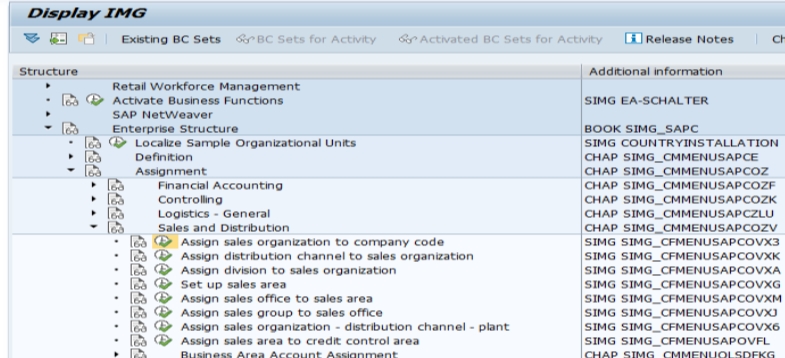
Run transaction OVX3 directly, or follow the IMG path: SPRO → Enterprise Structure → Assignment → Sales and Distribution → Assign Sales Organization to Company Code.
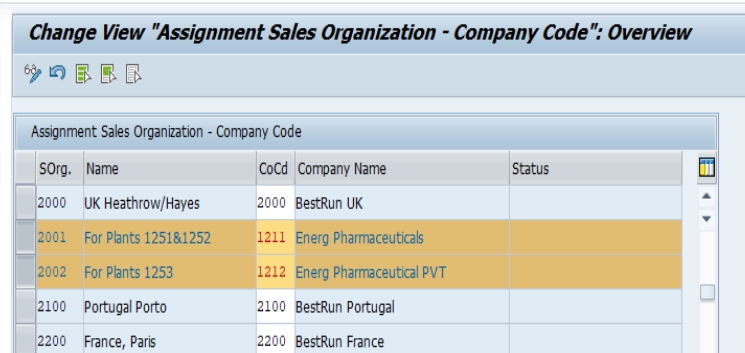
On the resulting overview screen, locate each sales organization row and enter the company code it should post revenue against. In this example, sales organization 2001 is assigned to company code 1211, and sales organization 2002 is assigned to company code 1212.
Select Save. The system will usually prompt for a transport request if the system is configured to require one, which is standard practice for enterprise structure changes so they can be tracked and migrated through the landscape (Development → Quality → Production) in a controlled way.
📋 What This Assignment Actually Controls
It's easy to look at OVX3 as a two-minute configuration step and underestimate what it actually governs once it's live. The company code linked to a sales organization determines which set of books revenue, cost of goods sold, and accounts receivable post to when a billing document is released. It also plays into tax determination and legal reporting, since company code is frequently tied to a specific country and its associated tax regime, and into intercompany billing scenarios, where goods are sold by one sales organization but delivered by a plant belonging to a different company code.
Because this assignment sits so close to the accounting side of the business, it is one of the SD configuration areas most likely to be reviewed jointly by SD and FI consultants during blueprint, rather than owned by the SD team alone. Getting it wrong doesn't just produce a technical error - it can mean revenue lands in the wrong legal entity's books, which is the kind of mistake that is expensive and slow to unwind once real transactions have already posted against it.
💼 Real-World Scenario: Two Sales Organizations, Two Company Codes
Pooja Patil, an SAP SD consultant at Learn Pharmaceuticals, was brought in as the business expanded into a second legal entity to support a newly acquired product line, while keeping the original business running under its existing company code. Sales manager Rajesh Pawar explained that the new sales organization, 2002, needed its billing to post cleanly into the new entity's books under company code 1212, completely separate from the existing sales organization 2001, which continued to post into company code 1211 as it always had.
Working with FI consultant Priya Mishra, Pooja used OVX3 to confirm sales organization 2001 remained correctly assigned to company code 1211, then added the new entry linking sales organization 2002 to company code 1212. Business analyst Anita Shah flagged that this single assignment would determine which entity's financial statements picked up revenue from the new product line, so the team tested it carefully in a sandbox client - creating a sample order and running it all the way through to billing - before confirming the same setup in production.
Once live, sales orders created against sales organization 2002 billed correctly into company code 1212, and Suresh's finance team could see clean, separated revenue between the two legal entities from the very first reporting period - confirming that the OVX3 entry, small as it looked in the configuration screen, was the single control point that made the entire dual-entity structure work correctly end to end.
📋 What to Confirm Alongside This Assignment
Assigning sales organization to company code rarely happens in complete isolation. A few closely related items are worth confirming at the same time, since they are frequently reviewed together during the same configuration session:
- Plant to company code assignment (transaction OX18), so that inventory valuation for goods sold by this sales organization is consistent with the financial entity receiving the revenue.
- Sales area setup (transaction OVXG), since a sales organization needs a complete sales area, not just a company code link, before it can be used on a live sales order.
- Account determination configuration, which relies on the company code to decide which general ledger accounts a billing document should post to.
- Tax determination settings, since company code often drives which tax procedure and jurisdiction rules apply to billing documents from this sales organization.
None of these are strictly part of the OVX3 transaction itself, but a sales organization with a correct company code assignment and nothing else configured around it will still fail at various points in the order-to-cash cycle, which is why experienced consultants treat this step as one part of a small cluster of related assignments rather than a standalone task.
❗ Common Mistakes When Assigning Sales Organization to Company Code
- Leaving a newly created sales organization unassigned, which allows sales orders to be created but blocks the sales cycle the moment a user tries to release a billing document to accounting.
- Assigning a sales organization to the wrong company code, which can silently post revenue into the wrong legal entity's books until finance notices a reconciliation discrepancy.
- Assuming a sales organization can be linked to more than one company code, when the relationship is strictly one-to-one in SAP.
- Changing the company code assignment for a sales organization that already has live transactions, without fully understanding the impact on historical reporting and reconciliation.
- Treating this as a purely SD configuration decision instead of reviewing it jointly with the FI team, given how directly it affects financial posting.
- Making this change directly in a production client instead of testing the full order-to-billing cycle in a sandbox or development client first.
✅ Best Practices for This Assignment
- Confirm the correct company code with the FI team before making the assignment, rather than assuming it based on the sales organization's region or naming alone.
- Complete this assignment as one of the earliest configuration steps for any new sales organization, since so much downstream configuration - account determination, tax determination, sales area setup - depends on it.
- Document every sales organization to company code pairing in a configuration workbook so the mapping is auditable during testing and go-live.
- Test the full order-to-billing cycle in a sandbox or development client after making the assignment, not just the OVX3 entry itself.
- Treat any change to an existing, live sales organization's company code assignment as a high-risk change requiring FI sign-off, not a routine configuration update.
- Move enterprise structure changes like this through a transport request and test them in the Quality system before they reach Production, the same as any other configuration change.
📈 How This Assignment Drives Revenue Recognition and Reporting
Revenue recognition, at its core, requires the system to know unambiguously which legal entity's books a given sale belongs to, and the sales organization to company code assignment is exactly what supplies that answer for every billing document generated under a given sales organization. Once assigned, standard SD-FI integration takes over: released billing documents automatically create accounting documents in the correct company code, feeding general ledger, accounts receivable, and, where relevant, controlling area reporting without any manual intervention.
This also matters for compliance and tax reporting. Company codes are frequently tied to specific countries or tax jurisdictions, so the sales organization's company code assignment indirectly determines which statutory reporting requirements and tax procedures apply to its sales activity. A business operating in multiple countries typically maintains a distinct sales organization per major market for exactly this reason - each one cleanly assigned to the company code representing that market's legal entity, keeping tax and statutory reporting correctly separated from day one.
✅ Validating the Assignment Before Go-Live
Because this assignment only becomes visible as a problem at the billing step, it's worth running a short validation checklist rather than assuming the OVX3 entry alone is sufficient. Create a test sales order (VA01) under the sales organization in question and process it through delivery and billing (VF01) to confirm the billing document is generated successfully. Display the resulting accounting document (VF03, then the accounting tab) and confirm it posted to the expected company code. Check that tax is calculated correctly on the billing document, since tax procedure often depends on company code. If intercompany billing is relevant, confirm goods movements between plants belonging to different company codes trigger the correct intercompany billing process rather than a standard billing document.
Running this test end-to-end, rather than stopping at the OVX3 save confirmation, is what actually proves the assignment works - a sales organization can look perfectly configured in OVX3 and still fail at billing release if a related setting, like account determination, was never completed for the new company code combination.
📱 This Configuration in SAP S/4HANA
Transaction OVX3 and the underlying one-to-one relationship between sales organization and company code remain unchanged in SAP S/4HANA, since this assignment is a foundational element of the SD-FI integration unaffected by the Universal Journal or the simplified data model. What has changed in S/4HANA is mainly how quickly the impact of this assignment becomes visible: with the Universal Journal unifying FI and CO postings into a single source of truth, a misassigned sales organization surfaces in real-time financial reporting almost immediately, rather than only appearing in a delayed reconciliation report, which raises the practical importance of getting this assignment right from day one.
📋 Related SAP Transactions
| Transaction | Purpose |
|---|---|
| OVX3 | Assign sales organization to company code. |
| OVX5 | Define, copy, delete, and check sales organizations. |
| OX02 | Define, copy, delete, and check company codes. |
| OX18 | Assign plant to company code. |
| OVXG | Set up a sales area by combining sales organization, distribution channel, and division. |
| VF01 / VF03 | Create or display a billing document, including its resulting accounting entry. |
🎓 Interview-Style Questions and Answers
Q: Why is the sales organization to company code assignment considered one of the most critical steps in SD configuration?
Because it is the single link that determines which legal entity's financial books receive revenue from a sales organization's billing documents - almost every downstream SD-FI process, including account determination and tax calculation, depends on it being correct.
Q: Can a sales organization be assigned to more than one company code?
No, the relationship is strictly one-to-one. A sales organization must be assigned to exactly one company code, though a single company code can have multiple sales organizations assigned to it.
Q: What is the practical risk of assigning a sales organization to the wrong company code?
Revenue, receivables, and tax postings from that sales organization's billing documents would flow into the wrong legal entity's books, which is difficult and time-consuming to correct once real transactions have already posted against the incorrect assignment.
Q: Why does this configuration step typically involve both SD and FI consultants?
Because while OVX3 is technically an SD transaction, its outcome directly affects financial posting, tax determination, and statutory reporting, all of which are FI concerns - reviewing it jointly reduces the risk of a mismatch between how SD and FI expect the assignment to work.
📚 Quick Glossary of Terms Used in This Guide
- Sales Organization: The top-level SD organizational unit responsible for selling and distributing goods.
- Company Code: The FI-level legal entity for which a complete set of financial statements is produced.
- Billing Document: The SD document that, once released, generates the accounting entry posting revenue to the assigned company code.
- Account Determination: Configuration that decides which general ledger accounts a billing document posts to, dependent on company code.
- Intercompany Billing: A billing process used when the selling sales organization and the delivering plant belong to different company codes.
- Transport Request: The mechanism used to move enterprise structure changes like this assignment through Development, Quality, and Production systems in a controlled way.
📝 Governance for Sales Organization to Company Code Assignments
Because this is a strict one-to-one assignment with direct financial consequences, most organizations treat it as a governed, documented decision rather than a routine configuration entry. The mapping - which sales organization posts to which company code, and why - is typically recorded in a configuration workbook maintained jointly by SD and FI teams, since either side may need to reference it when troubleshooting a billing or reporting discrepancy months or years after go-live.
Change control matters here even more than for most enterprise structure settings. Because live sales organizations accumulate real transaction history against their assigned company code, reassigning an existing sales organization to a different company code is a change that can affect historical reporting, reconciliation, and even statutory filings - which is why most landscapes require explicit FI and often audit sign-off before such a change is made, rather than allowing it to be treated as a simple configuration update.
🎯 Conclusion
Assigning a sales organization to a company code in OVX3 looks like a two-field entry on the surface, but it is genuinely one of the most consequential links in the entire SD-FI integration - the single control point that determines whose books a sales organization's revenue lands in. Confirming the correct company code with the FI team, testing the full order-to-billing cycle before go-live, and documenting the mapping clearly are what separate a clean, reliable enterprise structure from one that surfaces confusing reconciliation issues months later. Keep this guide handy the next time your project brings a new sales organization online, whether for a new legal entity, a new country rollout, or an acquired business being integrated into the existing landscape.