How to Create Bank in SAP – FI01 TCode Step-by-Step Guide
A bank master record is the entry in SAP's bank directory that every vendor, customer and house bank refers to. This guide shows how to create one with transaction FI01, using bank country IN, bank key BKID00, the bank name, the SWIFT/BIC code and the original screenshots. It explains the fields, the bank key and SWIFT/BIC, the difference between a bank master record and a house bank, a real scenario, common mistakes, troubleshooting and best practices. If you encounter any errors in SAP, send a screenshot to pramod@learntosap.com and I will help you resolve the issue.
✅ What Is FI01 in SAP? Step-by-Step Process to Create House Bank
Create Bank: A Step-by-Step Guide
Creating banks using SAP FICO's FI01 transaction is a crucial step in financial management. Banks are integral for managing payments, cash management, and reconciliations. By following the easy steps outlined in this blog, organizations can efficiently set up and manage banks in their SAP FICO system, contributing to streamlined financial operations and accurate financial reporting.
In simple words, before SAP can pay a vendor or receive money from a customer, it needs to know which banks are involved. FI01 creates the bank in the system's directory. This guide follows the original screenshots step by step and then explains the fields, the difference between a bank and a house bank, and the checks that keep the bank directory clean.
📝 What Is a Bank Master Record?
A bank master record is an entry in SAP's bank directory. It holds the basic identity of a bank: the country, the bank key, the name, the address and the SWIFT/BIC code. Once the record exists, it can be used in many places. A vendor master record can refer to it for the vendor's bank details, a customer record can refer to it for direct debits, and a house bank can be built from it for your own accounts.
Because many records point to the same bank entry, one correct bank record is better than many slightly different ones. A good bank directory saves effort in payments and avoids rejected transfers.
🔄 Bank Master Record Compared with a House Bank
| Point | Bank Master Record | House Bank |
|---|---|---|
| What it is | An entry for any bank in the directory. | A bank where your company holds accounts. |
| Created with | FI01 | FI12 |
| Contains | Country, key, name, address, SWIFT/BIC. | Bank accounts and their G/L accounts. |
| Used for | Vendor, customer and house bank data. | Payment program and bank accounting. |
| Needs first | Nothing. | A bank master record. |
The heading in this guide says Create House Bank, but FI01 creates the bank master record. The house bank is the next step, and it uses the record you create here.
📝 Bank Master Transactions at a Glance
Go to Tcode FI01
| Transaction | Purpose |
|---|---|
| FI01 | Create a bank master record (used in this guide). |
| FI02 | Change a bank master record. |
| FI03 | Display a bank master record. |
| FI12 | Maintain house banks and bank accounts. |
| FS00 | Create the G/L account for a bank account. |
| FBZP | Maintain the payment program configuration. |
🔧 What You Need Before You Create a Bank
- The bank's official details: the exact name, address and codes.
- The bank country, here IN, and the bank key rule for that country.
- The SWIFT/BIC code, from the bank's documents.
- A check for duplicates, so the bank does not already exist in the directory.
- Authorization to create bank master records.
If the bank already exists with a slightly different name, use the existing record. Creating a second record causes confusion in payments and reports.
🔧 Step-by-Step: Create a Bank with FI01
Go to Tcode FI01
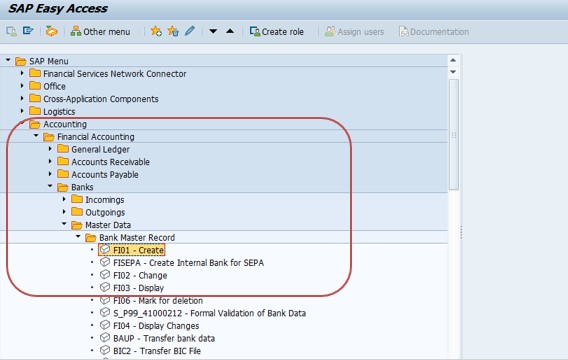
Follow Path: Accounting → Financial Accounting → Banks → Master Data → Bank Master Record → FI01 – Create.
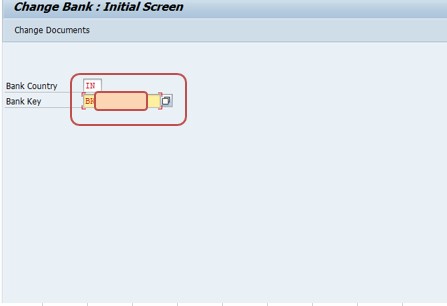
Select the bank country. Bank Country: IN.
Select the bank key. Bank Key: BKID00.
Select the bank name. Bank Name: Bank Of.
Select the SWIFT/BIC. SWIFT/BIC: 400011111.
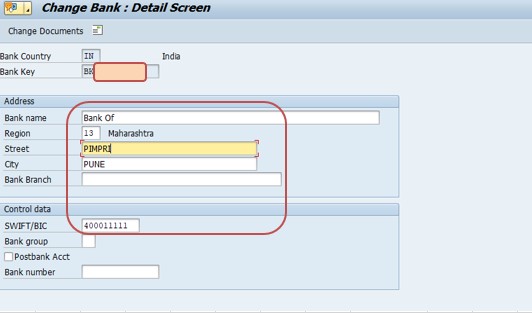
Select the Save button. SAP shows a message that the bank was created.
📋 Values Used in This Tutorial at a Glance
The table below summarizes every value from the steps above, so you can compare it with your own screen before you save.
| Field | Value Used | Note |
|---|---|---|
| Transaction | FI01 | Create bank master record |
| Bank country | IN | Country of the bank |
| Bank key | BKID00 | Identifies the bank in the country |
| Bank name | Bank Of | Use the full official name |
| SWIFT/BIC | 400011111 | Check against the bank's documents |
| Final action | Save | Creates the bank master record |
💡 The Fields of the Bank Master Record Explained
| Field | Meaning | Why It Matters |
|---|---|---|
| Bank country | The country in which the bank is located. | The bank key is unique within the country. |
| Bank key | A key that identifies the bank or branch. | Used when vendors and customers refer to the bank. |
| Bank name | The official name of the bank. | Appears on payment documents and reports. |
| Region, street, city | The address of the bank. | Helps identify the right branch. |
| SWIFT/BIC | The international bank code. | Needed for cross-border payments. |
| Bank group | An optional group of banks. | Helps with reporting and payment rules. |
Field names and layout differ slightly between releases, so compare with your own screen before you save.
🔑 Choosing the Bank Key
The bank key is the most important field, because everything else refers to it. In many countries the bank key follows a national standard, such as a bank code or a branch code. In India, the key is often based on the IFSC code, which identifies the bank and the branch. In this guide the bank key is BKID00.
Decide the rule before creating many banks, and write it in the work instruction. A consistent key makes it easy to search for banks and to avoid duplicates. If one person uses the IFSC code and another uses a made-up key, the directory fills with near-duplicates that nobody can tell apart.
🌐 SWIFT/BIC Explained
The SWIFT/BIC code identifies a bank internationally. It is used for payments between countries, where the receiving bank must be recognized by the sending bank. A SWIFT/BIC code usually has a fixed structure that includes letters for the bank and the country, followed by a location code and, optionally, a branch code.
Because a wrong code can send a payment to the wrong place or cause it to be rejected, always copy the code from the bank's official documents. The value in the original example, 400011111, is only digits, so check it carefully against what the bank has given you. If your company does not make international payments, the field may be optional, but filling it correctly is still good practice.
📦 From Bank Master Record to House Bank
Creating the bank master record is the first step. To pay vendors and receive money, the company usually also sets up a house bank with FI12. The house bank uses the bank master record, adds your own bank accounts and links each account to a G/L account created with FS00. The payment program in FBZP then uses the house bank to decide from which account to pay.
| Step | What Happens | Transaction |
|---|---|---|
| 1 | The external bank is created in the directory. | FI01 |
| 2 | The house bank and its accounts are set up. | FI12 |
| 3 | The G/L accounts for the bank accounts are created. | FS00 |
| 4 | The payment program uses the house bank. | FBZP |
Each step depends on the one before it. If the bank master record is wrong, every later step inherits the error.
💼 Real-World Scenario: Adding a Bank at Learn Pharma, Pune
At Learn Pharma in Pune, the company opened a new account with a bank that was not yet in the SAP directory. Treasury executive Pooja Patil asked master data lead Sameer Joshi to create it. Sameer checked the directory with FI03 and confirmed that the bank did not exist.
Functional consultant Neha Deshmukh opened FI01, entered bank country IN, the bank key BKID00, the bank name and the SWIFT/BIC code from the bank's letter, and saved. She then checked the new record and told Pooja that it was ready for the house bank setup.
Pooja created the house bank with FI12, and the first vendor payment went out from the new account. Neha added the rule for bank keys to the master data guide, so every future bank would be created in the same way.
🔄 How Bank Records Connect to Vendors and Customers
The bank master record does not hold any account numbers. Account numbers are stored where the bank is used. A vendor master record has a bank details section with the bank country, the bank key chosen from the directory, the account number and the account holder. A customer record can hold the same kind of data for direct debits. This design means that a change in a bank's name or address is made once, in the directory, and every vendor and customer that uses the bank sees the update.
It also explains why a wrong bank record causes so many problems. A single mistake in the directory affects every vendor and customer that refers to it, and the payment program may then send money to the wrong place or have it rejected. Careful creation and regular review of bank records is therefore good protection for all payments.
🌐 Country Formats: IFSC, IBAN and Others
| Country Type | Typical Identifier | Note |
|---|---|---|
| India | IFSC code for the bank and branch. | Often used as or to build the bank key. |
| Europe | IBAN and BIC. | The account number is part of the IBAN. |
| United States | Routing number. | Used as the bank key in many systems. |
| Other countries | Local bank or branch codes. | Check the country's standard. |
Each country has its own identifiers, and SAP lets you adapt the bank key to the local standard. Ask the treasury team which identifier the banks in your country use, and follow it consistently.
🔒 Protecting Bank Data
- Limit access. Only a small group should create and change bank records.
- Check against documents. Always compare entries with the bank's official letter.
- Use dual control. A second person should review new or changed records.
- Log changes. Review the change log for banks and vendor bank details every month.
- Confirm changes with the bank or vendor. Use a trusted channel, never an email that asks for a change.
- Remove unused records. Mark banks that are no longer in use.
Bank data is one of the most sensitive pieces of master data. Wrong or manipulated details can send money to the wrong person, and the controls above are inexpensive and effective.
📅 A Simple Routine for Adding a Bank
| Step | Action | Owner |
|---|---|---|
| 1 | Receive the bank's official details in writing. | Treasury |
| 2 | Search the directory for an existing entry. | Master data team |
| 3 | Create the bank with FI01. | Functional consultant |
| 4 | Have a second person check the record against the documents. | Finance lead |
| 5 | Create the house bank or link vendors as needed. | Treasury |
| 6 | File the documents with the master data request. | Master data team |
Following the same six steps for every new bank keeps the directory clean and the payments safe.
📅 Yearly Review of the Bank Directory
| Check | Done When |
|---|---|
| Duplicates | No bank appears twice with different keys. |
| Unused entries | Banks not used by any record are marked. |
| Codes | SWIFT/BIC and bank keys match the bank's documents. |
| Addresses | Names and addresses are up to date. |
| Access | Only the right people can change bank records. |
A short yearly review finds small problems before they cause rejected payments, and it keeps the bank directory reliable for every vendor and customer.
❗ Common Mistakes When Creating a Bank
- Creating a bank that already exists, so the directory has duplicates.
- Using an incomplete or shortened bank name.
- Typing a wrong bank key or SWIFT/BIC code.
- Mixing up the bank master record and the house bank.
- Using a different key rule for every new bank.
- Forgetting to check the details against the bank's official documents.
🔧 Troubleshooting: When the Bank Does Not Work
| Symptom | Likely Cause | What to Check |
|---|---|---|
| Bank already exists. | The bank key is already in the directory. | Search with FI03 before creating. |
| Bank not offered in vendor master. | The bank key or country is wrong. | Check the bank country and key. |
| Payment rejected by the bank. | Wrong SWIFT/BIC or account details. | Check the codes against the bank's documents. |
| House bank cannot be created. | The bank master record does not exist. | Create the record with FI01 first. |
| Cannot save the bank. | Missing authorization or a required field. | Read the message and check the required fields. |
✅ Best Practices for the Bank Directory
- Search for the bank before creating it.
- Use the bank's official name and codes from its documents.
- Follow one bank key rule per country and write it in the work instruction.
- Limit who can create and change bank master records.
- Review the directory once a year and mark unused entries.
- Keep a copy of the bank's letter with the master data request.
📊 Who Maintains the Bank Directory
| Role | Responsibility |
|---|---|
| Master data lead | Creates banks and approves changes. |
| Treasury | Provides the official bank details. |
| Accounts payable | Reports wrong or missing banks. |
| Internal audit | Reviews changes to bank data. |
| Functional consultant | Supports uploads and configuration. |
Bank data is sensitive, because wrong details can send money to the wrong place. Writing down who owns it avoids the situation where everyone changes entries and nobody checks them.
🔄 Creating Many Banks at Once
Entering banks one by one is fine for a handful of records. For many banks, for example when a country's bank directory is loaded, a mass upload is faster. Many companies use the Legacy System Migration Workbench for such loads. You can read more in the LSMW import guide. Always test with a few records, check them with FI03 and only then load the full file.
📱 Banks in SAP S/4HANA
In SAP S/4HANA, banks are still maintained in a bank directory, although screens, Fiori apps and the link to business partners can differ from the classic FI01 used here. Confirm the exact steps in your own release before you train users. The business principle does not change: the bank is created once with a country, a key, a name and a code, and then used wherever bank data is needed.
🎓 Interview-Style Questions and Answers
Q: What is FI01 used for?
To create a bank master record in SAP.
Q: What fields are mandatory in this guide?
Bank country, bank key and bank name, with the SWIFT/BIC code entered as well.
Q: What is the difference between a bank master record and a house bank?
The bank master record describes any bank. The house bank is a bank where the company has accounts.
Q: Which transaction creates a house bank?
FI12.
Q: Why check for duplicates?
Duplicate banks confuse payments and reports.
📚 Quick Glossary of Terms Used in This Guide
- Bank Master Record: An entry in the bank directory.
- Bank Key: A key that identifies a bank within a country.
- SWIFT/BIC: An international bank identification code.
- House Bank: A bank where the company holds accounts.
- Bank Directory: The list of all banks known to the system.
- Master Data: Long-lived records such as banks, vendors and customers.
🎯 Conclusion
Creating a bank with FI01 is a small step that supports every payment the company makes. Open the transaction, enter bank country IN, bank key BKID00, the bank name and the SWIFT/BIC code, and save. Then check the record and continue with the house bank. If you encounter any errors in SAP, send a screenshot to pramod@learntosap.com and I will help you resolve the issue.