SAP F-28: Customer Incoming Payment Process Explained with Steps & Screenshots
A customer incoming payment records money received and clears the invoices it settles. This guide shows how to post one with transaction F-28, using company code 9000, bank account 1000011, amount 3422.00 and the original screenshots. It explains open items, posting keys, document and posting dates, payment details, clearing, partial payments and residual items, with a real scenario, common mistakes, troubleshooting and month-end checks. If you run into any errors while following along, feel free to send a screenshot to pramod@learntosap.com for help.
✅ How to Post Incoming Payments in SAP F-28
Create Customer Incoming Payment: A Step-by-Step Guide
Efficiently managing customer incoming payments is crucial for any organization to maintain healthy cash flow and financial stability. SAP FICO (Financial Accounting and Controlling) offers a powerful toolset to streamline this process, and one of the key transaction codes for managing incoming payments is F-28. In this blog, we will walk you through the steps to use F-28 effectively to process customer incoming payments in SAP FICO.
In simple words, a customer sent money, and the bank received it. F-28 records that event in two places at the same time: it increases the bank balance and it reduces what the customer owes. This guide follows the original screenshots step by step and then explains the entries, the fields and the checks that keep the customer account clean.
📝 What Is a Customer Incoming Payment?
A customer incoming payment is the posting that records money received from a customer. It has two sides. The bank (or cash) account is debited, because the company now has more money, and the customer account is credited, because the customer owes less. When the payment is linked to specific invoices, SAP also clears those invoices, so they no longer appear as open.
Clean clearing matters for every part of the business. Sales sees which customers have paid, collections sees who still owes money, and finance sees the correct bank balance and customer balances. A payment that is posted but not matched to an invoice leaves the invoice open and the customer looking as if they owe money they have already paid.
💰 Accounting Entries Behind F-28
The table shows the typical effect of an incoming payment. The exact accounts depend on your chart of accounts and your bank accounts.
| Line | Account | Debit / Credit | Meaning |
|---|---|---|---|
| 1 | Bank account (here 1000011) | Debit | Money received increases the bank balance. |
| 2 | Customer account | Credit | The customer's open balance is reduced. |
| 3 | Cleared invoice | Cleared | The open item is marked as paid. |
Because the posting touches both finance and receivables, an error in either account shows up in several reports. That is why the guide ends with checks on the net assigned amount and on the document.
📋 Where F-28 Fits in the Order-to-Cash Cycle
Incoming payment is the last step of the sales cycle. The table shows the stages before it.
| Stage | What Happens | Document / Transaction |
|---|---|---|
| Sales order | The customer's order is entered. | VA01 |
| Delivery | Goods are delivered. | VL01N |
| Invoice | The customer is billed. | VF01 |
| Incoming payment | The money is received and the invoice is cleared. | F-28 |
| Reporting | Open items and balances are reviewed. | FBL5N |
If you have followed the sales tutorials, the invoice created there is exactly the open item that F-28 clears here.
📝 Incoming Payment Transactions at a Glance
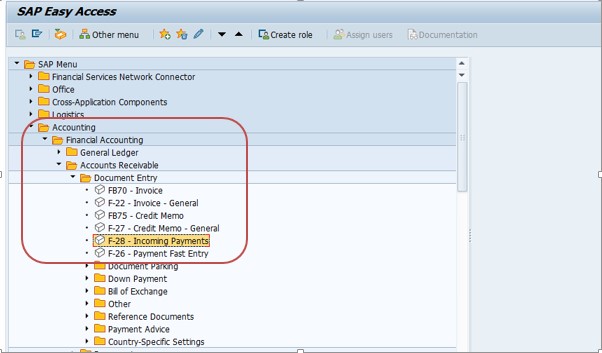
Go to Tcode F-28
| Transaction | Purpose |
|---|---|
| F-28 | Post customer incoming payment and clear open items (used in this guide). |
| F-26 | Post incoming payment using a fast entry screen. |
| F-32 | Clear a customer account manually. |
| FBL5N | Display customer line items. |
| FB03 | Display an accounting document. |
| FF67 | Process a manual bank statement. |
🔧 What You Need Before You Post the Payment
- An open invoice for the customer, so there is something to clear.
- The company code, here 9000, and the posting period open for posting.
- The bank account, here 1000011, created in the chart of accounts.
- The payment details from the bank statement: date, amount and reference.
- Authorization to post incoming payments.
If one of these is missing, the posting may stop with an error message, or the invoice may stay open after posting.
🔧 Step-by-Step: Post a Customer Incoming Payment with F-28
F-28 SAP Tutorial for Beginners Step by Step
Go to Tcode F-28. Follow the path: ACCOUNTING → FINANCIAL ACCOUNTING → ACCOUNTS RECEIVABLE → F-28 (INCOMING PAYMENT).
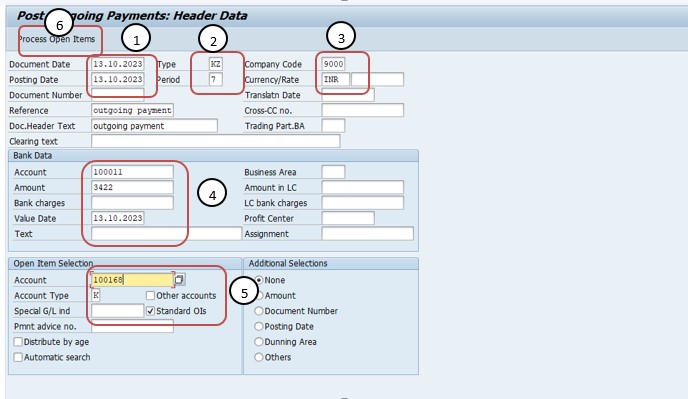
Select the transaction F-28. Select the document date: 13.10.23. Select the posting date: 13.10.23.
Select the type and period. Type: KZ. Period: 7.
Select the company code and the currency. Company Code: 9000. Currency: INR.
Select the bank data. Account: 1000011. Amount: 3422.00 (which invoice you want to select). Value Date: 13.10.23.
Select the open item selection. Account: 100168 (name). Account Type: K.
Select the button Process Open Items.
💡 Open Items
Open items are transactions that have not been cleared from the customer's account. These could include invoices, credit memos, and other financial transactions.
The list shown after you press Process Open Items is made of exactly these items. Each line has a document number, a date, an amount and a reference. Your job is to tell SAP which of them the payment settles.
🔑 Posting Key
A posting key is a two-digit code that specifies the type of accounting entry. In F-28, the posting key "01" is used for customer debit entries (incoming payments), and "21" is used for customer credit entries (clearing items).
📅 Document Date and Posting Date
Enter the document date, which is the date of the incoming payment, and the posting date. The posting date may differ from the document date and is the date on which the transaction is recorded in the system.
In this guide both dates are 13.10.23, and the period is 7. The posting date decides the period, so make sure the period is open. If you post into a closed period, SAP stops with a message, and a controller must open the period or you must use another date.
💳 Payment Details
Fill in the payment details, including the payment method, bank details, and amount received.
The amount should match the bank statement exactly. Typing 3422.00 instead of 3242.00 is one of the most common mistakes, and it is difficult to see afterwards because the document looks perfectly normal. Compare the amount with the statement before you continue.
✅ Clear Open Items
If this payment is intended to clear specific open items in the customer's account, enter the respective invoice or document numbers in the clearing items section.
SAP shows the open items for the account you selected. Select the invoices that the customer paid, and watch the assigned amount change. When the assigned amount equals the payment, the difference is zero and the document can be posted. If the customer paid more or less, SAP shows a difference that you must handle, as described in the next section.
💾 Save and Post
After filling in all the required information, click Save to post the incoming payment. The system will generate a document number for the transaction, which you can use for reference.
🔄 Partial Payment: Step by Step
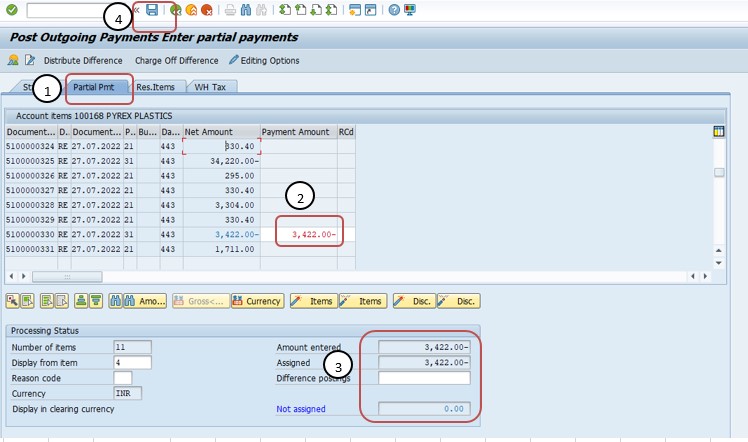
Follow Steps
Select the Partial Payment button.
Select the payment amount. Payment Amount: 3422.
Check Net Assigned. The difference must be zero before you save.
Select the Save button. SAP shows the document number of the posting.
📊 Partial Payment and Residual Items
A customer does not always pay the full invoice. When the amount received is smaller than the open item, SAP offers two common ways to handle the difference. A partial payment keeps the original invoice open and posts the payment against it. A residual item clears the original invoice and creates a new open item for the remaining amount.
| Method | What Happens | Best For |
|---|---|---|
| Partial payment | The invoice stays open, and the payment is linked to it. | Customers who pay in several instalments. |
| Residual item | The invoice is cleared, and a new item shows the rest. | Cases where a short payment is final or disputed. |
Choose the method with the collections team, because it changes how the open items look in reports and statements. In this guide the partial payment button is used, and the net assigned amount is checked before saving.
📋 Values Used in This Tutorial at a Glance
The table below summarizes every value from the steps above, so you can compare it with your own screen before you post.
| Field | Value Used | Note |
|---|---|---|
| Transaction | F-28 | Incoming payment |
| Document date | 13.10.23 | Date of the payment |
| Posting date | 13.10.23 | Decides the period |
| Type / Period | KZ / 7 | Compare with your configuration |
| Company code | 9000 | Use your own company code |
| Currency | INR | Currency of the payment |
| Bank account | 1000011 | The account that receives the money |
| Amount | 3422.00 | Must match the bank statement |
| Value date | 13.10.23 | Date the money is available |
| Open item account | 100168 | Account type K as in the original |
| Final action | Save | Creates the document |
💼 Real-World Scenario: Posting a Customer Payment at Learn Pharma, Pune
At Learn Pharma in Pune, the bank statement showed a payment of 3,422.00 rupees from a customer. Accounts receivable executive Pooja Patil opened F-28, entered the document date and the posting date, the company code 9000, the currency and the bank account, and typed the amount from the statement.
She selected the customer account, pressed Process Open Items and chose the invoice that matched the amount. The net assigned field showed zero, so she saved the document. Finance lead Sameer Joshi checked the entry with FB03 and confirmed that the bank account was debited and the customer account was credited.
The next day, sales manager Rohan Kulkarni saw that the invoice no longer appeared in the open item list for the customer. Pooja added the steps to her work instruction, so a new colleague could post the next payment in the same way.
💰 Overpayments and Payments Without a Clear Invoice
Not every payment matches an invoice. A customer may pay more than the invoice, pay without a reference, or pay for several invoices with one transfer. When the amount received is higher than the selected items, SAP shows a difference. You can post the difference as a payment on account, which leaves a credit on the customer account until the next invoice, or send it back to the customer. Never force the difference to zero by selecting the wrong invoice.
When a payment has no reference, contact the customer or check the bank statement text before posting. A payment left on account without an explanation grows into a long list of unmatched items, and cleaning it up at year end is slow and expensive. A simple rule, such as solving every unassigned payment within a week, keeps the customer accounts reliable.
🏦 Value Date, Posting Date and the Bank Statement
The value date is the day the money is available in the bank account, and it can differ from the document date and the posting date. In this guide all three are 13.10.23, which is the simplest case. In daily work, a payment may arrive on the 30th and be posted on the 1st of the next month, which moves it into another period.
Agree a rule with the finance team about which date to use. Many companies post on the day of the bank statement, so the bank account in SAP matches the statement day by day. This makes the monthly bank reconciliation fast, because any difference points to a specific day and a specific payment.
📝 Reference and Text Conventions
The reference and text fields look minor, but they save a lot of time later. Use the invoice number or the bank reference in the reference field, and a short description in the text field. When someone searches the customer line items weeks later, a clear reference tells them immediately which payment settled which invoice.
Write the convention in the work instruction and apply it to every posting. A few extra seconds at posting time prevent long searches during audits, and they help new colleagues understand old documents without asking the person who posted them.
❗ Common Mistakes When Posting Incoming Payments
- Typing an amount that does not match the bank statement.
- Selecting the wrong customer or account type.
- Posting into a closed period, or with a posting date in the wrong month.
- Leaving the net assigned amount different from zero.
- Clearing the wrong invoice, so the right one stays open.
- Posting the same payment twice because the first posting was not noticed.
🔧 Troubleshooting: When the Payment Does Not Post
| Symptom | Likely Cause | What to Check |
|---|---|---|
| Posting period is closed. | The period is not open for the posting date. | Check the open periods or use a valid date. |
| No open items appear. | Wrong account, company code or account type. | Check the account, company code and account type. |
| Cannot save the document. | The difference is not zero. | Check the net assigned amount. |
| Bank account not accepted. | The account does not exist in the company code. | Check the account with FS00. |
| Invoice stays open after posting. | It was not selected for clearing. | Display the line items and clear manually if needed. |
✅ Best Practices for Incoming Payments
- Post payments the same day they appear on the bank statement.
- Always match the amount with the statement before saving.
- Clear invoices at the time of posting, and avoid leaving unassigned payments.
- Review open items and unassigned payments at month end.
- Use a clear naming of reference and text so documents can be found later.
- Limit who can post to bank accounts and review the postings regularly.
📅 Month-End Checks for Incoming Payments
| Check | Done When |
|---|---|
| Bank reconciliation | The bank account balance matches the statement. |
| Unassigned payments | No payment is left on account without a reason. |
| Open items | Old invoices are reviewed with the collections team. |
| Posting periods | All payments are in the correct period. |
| Documentation | Corrections and reasons are written down. |
A short checklist at month end finds small problems before they turn into audit findings, and it keeps the customer balances reliable.
📱 Incoming Payments in SAP S/4HANA
Customer payments remain a core process in SAP S/4HANA, although screens, Fiori apps and some transaction codes can differ from the classic examples used here. Confirm the exact steps in your own release before you train users. The business principle does not change: the money received is recorded, and the matching invoices are cleared.
🎓 Interview-Style Questions and Answers
Q: What is F-28 used for?
To post customer incoming payments and clear open items.
Q: What does an incoming payment do in accounting?
It debits the bank account and credits the customer account.
Q: What are open items?
Transactions that have not been cleared from the customer's account, such as invoices and credit memos.
Q: What does net assigned mean?
The difference between the payment and the selected items, which must be zero to post.
Q: How do you handle a short payment?
With a partial payment or a residual item.
📚 Quick Glossary of Terms Used in This Guide
- Incoming Payment: Money received from a customer.
- Open Item: A transaction that has not been cleared.
- Posting Key: A two-digit code that controls the type of accounting entry.
- Value Date: The date the money is available in the bank account.
- Net Assigned: The difference between the payment and the selected items.
- Residual Item: A new open item for the part of an invoice that remains unpaid.
🎯 Conclusion
Posting a customer incoming payment with F-28 keeps cash flow visible and customer accounts accurate. Open the transaction, enter the dates, the company code 9000, the currency, the bank account and the amount, select the open items, check that the net assigned amount is zero, and save. Then verify the document and review open items at month end. If you run into any errors while following along, feel free to send a screenshot to pramod@learntosap.com for help.