How to Create Credit Memo Request in SAP SD (VA01) – Step-by-Step Guide
A Credit Memo Request (CMR) is the controlled way to give a customer a credit in SAP SD, for example after a billing error, a return or a complaint. This guide shows how to create one with transaction VA01, using Create with Reference, the Credit Memo Request order type, sales organization 2001, distribution channel 31, division 31, order 20210 and the billing block from the original screenshots. It explains the reasons for a credit memo request, how it differs from a debit memo request, how billing turns it into a credit memo, common mistakes and troubleshooting. If you run into any errors while following along, feel free to send a screenshot to pramod@learntosap.com for help.
✅ How to Create a Credit Memo Request in SAP SD and Why Use It
Credit Memo Request in SAP SD: Step-by-Step Guide
Credit Memo Request stands out as a crucial tool for resolving disputes, correcting billing errors, and ensuring customer satisfaction. A Credit Memo Request (CMR) in SAP SD is a document used to request a credit or refund for a customer due to various reasons. It does not change the customer account by itself. It is a sales document that is reviewed and then billed, and the resulting credit memo is what reduces the amount the customer owes.
In simple words, the company has charged a customer too much, or has agreed to give something back, and needs a controlled way to do it. The request records the reason, links to the original order and gives a manager the chance to approve the credit before any money moves. This guide shows how to create a credit memo request with VA01 using the original screenshots, and then explains billing, approval and common pitfalls.
💡 Why Use a Credit Memo Request? Common Reasons
A Credit Memo Request is used for various reasons, such as:
- Billing Errors: Incorrect pricing, quantity, or tax calculations.
- Product Returns: Customer dissatisfaction or damaged goods returned.
- Promotions and Discounts: Retroactively applying discounts or rebates.
- Sales Credits: Adjusting invoices to reflect changes in sales conditions.
- Customer Complaints: Addressing customer grievances promptly.
All of these have one thing in common: the customer should pay less than the invoice shows. If the customer should pay more, the correct document is a debit memo request, described in the debit memo request guide.
📋 Credit Memo Request and Debit Memo Request Compared
| Point | Credit Memo Request | Debit Memo Request |
|---|---|---|
| Effect on the customer | Reduces the amount owed. | Increases the amount owed. |
| Typical reason | Overcharge, return, complaint, retroactive discount. | Undercharged price or quantity, extra cost. |
| Order type (standard) | Credit Memo Request (CR). | Debit Memo Request (DR). |
| Billing result | Credit memo. | Debit memo. |
| Created with | VA01 | VA01 |
The standard order type keys can differ in your system, so confirm them before you train users.
📋 Where the Credit Memo Request Fits in Order-to-Cash
The request is a correction step that sits after billing. The table shows the stages around it.
| Stage | What Happens | Document / Transaction |
|---|---|---|
| Sales order | The original order is entered. | VA01 |
| Delivery | Goods are delivered. | VL01N |
| Invoice | The customer is billed, possibly too much. | VF01 |
| Credit memo request | The credit is requested with reference to the order. | VA01 |
| Credit memo | The request is billed and the account is reduced. | VF01 |
Because the request refers to the original order, the history of the sale stays together in the document flow.
📝 Credit Memo Transactions at a Glance
Tcode for Credit Memo Request – Go to Tcode VA01
| Transaction | Purpose |
|---|---|
| VA01 | Create credit memo request. |
| VA02 | Change the request, for example to release a billing block. |
| VA03 | Display the request and its document flow. |
| VF04 | Process the billing due list. |
| VF01 | Create the credit memo from the request. |
| FB03 | Display the accounting document. |
🔧 What You Need Before You Create the Request
- An existing sales order to refer to, here order number 20210.
- The sales area, here sales organization 2001, distribution channel 31 and division 31.
- A clear reason for the credit, agreed with sales or finance.
- Authorization to create the credit memo request order type.
- Evidence, such as a return note or a price agreement, if your company requires it.
Without a clear reason and evidence, the request is hard to approve, and it may be rejected during review.
🔧 Step-by-Step: Create a Credit Memo Request with VA01
Create Credit Memo Request – VA01
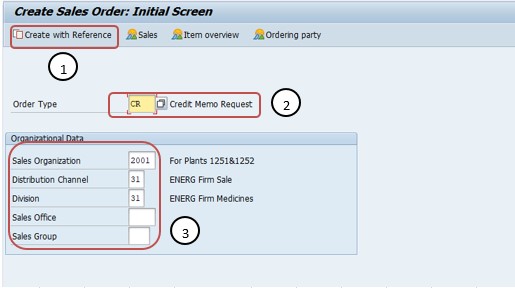
Select Create with Reference. This copies the data of an existing document into the request.
Select the order type. Order Type: Credit Memo Request.
Select the sales area. Sales Organization: 2001. Distribution Channel: 31. Division: 31.
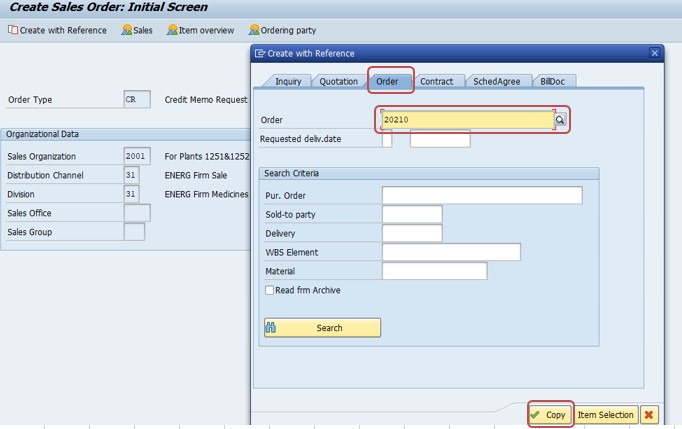
Select the reference order. Order No: 20210. Then select Copy.
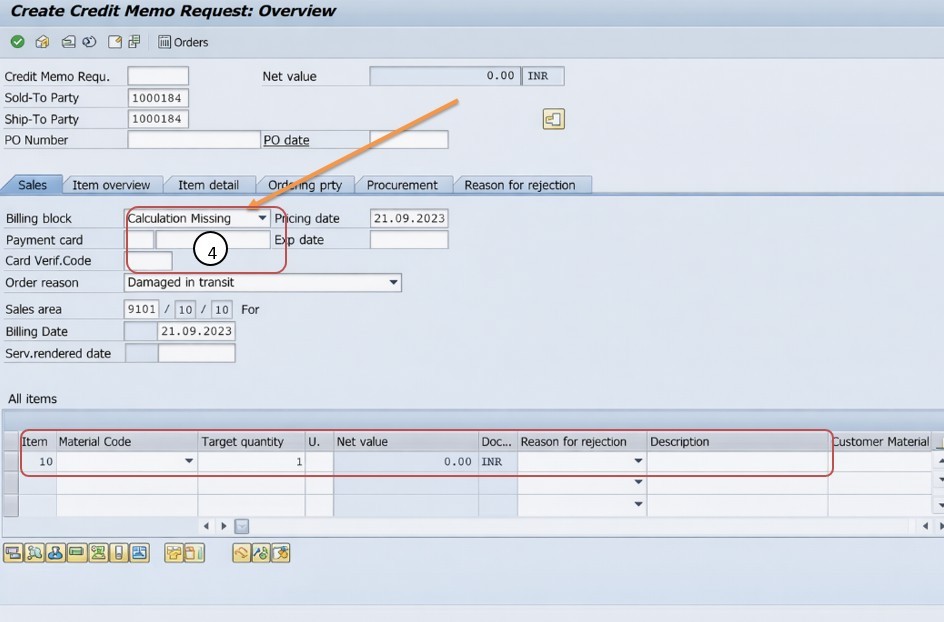
Select the billing block. Billing Block: Calculation Missing.
Save the credit memo request. SAP shows a message with the number of the new request.
📋 Values Used in This Tutorial at a Glance
The table below summarizes every value from the steps above, so you can compare it with your own screen before you save.
| Item | Value Used | Note |
|---|---|---|
| Transaction | VA01 | Create sales document |
| Method | Create with Reference | Copies data from an existing order |
| Order type | Credit Memo Request | Standard key is usually CR |
| Sales organization | 2001 | Use your own sales organization |
| Distribution channel | 31 | Use your own channel |
| Division | 31 | Use your own division |
| Reference order | 20210 | The order being credited |
| Billing block | Calculation Missing | Holds the request until the amount is reviewed |
| Final action | Save | Creates the request |
⛔ Why a Billing Block Is Set on the Request
In this guide the request is saved with the billing block Calculation Missing. A billing block stops the request from being billed until someone has reviewed it. This is an important control for credits, because a wrong credit memo gives money back to a customer and is much harder to recover than to prevent.
The typical routine is that sales creates the request, the pricing or finance team checks the amounts and the reason, and then the block is released with VA02. Only after that does the request appear in the billing due list for VF04 or VF01. If the block is never released, the request stays open, and the customer never receives the credit. A weekly list of requests with open blocks keeps this from happening.
💰 From Request to Credit Memo
After the block is released, the request is billed. In VF01 the user selects the request number and saves, and SAP creates a credit memo with a billing document number. In a standard setup the system also creates an accounting document that credits the customer account and debits the revenue, so the amount the customer owes is reduced by the credited amount. The document flow of the original order then shows the order, the delivery, the invoice, the request and the credit memo in one chain.
Check the result with FB03, and confirm the amount, the tax and the customer account. The exact accounting entries depend on your configuration, so confirm them with your finance team before using the process in production.
📦 Credit Memo Request and Product Returns
One of the reasons in this guide is product returns. When goods come back, many companies use a returns order, which brings the goods back into stock and can lead to a credit. Others create the credit memo request directly, for example when the customer keeps a damaged item and receives a partial refund. The right choice depends on whether the goods physically return.
If goods return, the warehouse must receive them and the stock must be updated. If only money returns, no stock movement is needed. Agree the rule with sales, the warehouse and finance, and write it into the work instruction, so a request is never used to hide a stock problem and a returns order is never used when no goods are coming back.
💼 Real-World Scenario: Crediting an Overcharge at Learn Pharma, Pune
At Learn Pharma in Pune, a customer complained that order 20210 had been invoiced at a higher price than agreed. Sales manager Rohan Kulkarni checked the contract and confirmed that the customer was right.
Finance executive Pooja Patil opened VA01, chose Create with Reference, selected the order type Credit Memo Request, entered sales organization 2001, distribution channel 31 and division 31, and copied order 20210. She set the billing block Calculation Missing and saved the request.
Finance lead Sameer Joshi checked the amounts, released the block with VA02, and Pooja created the credit memo with VF01. The customer received the corrected amount, and Pooja noted the steps in her work instruction.
💰 Pricing and Partial Credits
When you create the request with reference to order 20210, SAP copies the items and, depending on the copy control settings, the prices. A credit is often partial. The customer may have been overcharged on only one item, or only by a few percent. In that case the request should carry only the amount to be credited, not the full order value.
The billing block in this guide gives the pricing team a chance to check this. They can compare the request with the original invoice, adjust the quantity or the conditions and then release the block. Agree the method in advance and write it into the work instruction, because mixed methods are the most common source of wrong credits.
Taxes follow the same logic. If the credit reduces the taxable amount, the tax in the credit memo reduces with it. Confirm the tax result with your tax team the first time you use a new type of credit.
📊 Tracking Open Requests
| Question | Where to Look |
|---|---|
| Which requests still have a billing block? | The list of sales documents, filtered by billing block. |
| Which requests are ready for billing? | The billing due list with VF04. |
| Which credit memos were created this month? | The billing document list, filtered by billing type. |
| Which customers receive many credits? | A report on credit memos by customer. |
Many credits for the same customer or product point to a root cause, such as a wrong price in the master data. Fix the cause once, and the number of requests falls.
📞 Communicating with the Customer
A credit memo is good news for the customer, but it still needs clear communication. Before or when the document is sent, the account manager should explain what is being credited and why, and refer to the original invoice number, the order number and the reason. A short note prevents confusion, especially when the credit is partial or is offset against a later invoice.
Keep copies of the original invoice, the request and the credit memo together in the customer file, and name them in a consistent way so they can be found quickly. If the customer later questions the amount, anyone in the team can show the complete trail in a few minutes. A fast, friendly handling of a complaint often turns a dissatisfied customer into a loyal one.
📊 Accounting and Tax Impact of a Credit
A credit memo reduces both the receivable and the revenue. In a standard setup, the customer account is credited and the revenue account, and where relevant the tax account, are debited. The customer's open items show the credit, and it can be offset against an unpaid invoice or paid out, depending on the company's rules.
Because credits reduce revenue, finance teams watch them closely at month end. A sudden rise in credits can signal quality problems, pricing mistakes or disputes that need attention. Reviewing the credits by reason code, if your company uses them, helps managers see which problems are the most expensive and fix them at the source.
Always confirm the accounting treatment with your finance and tax teams, because the exact entries depend on your configuration and on local tax rules.
📝 Documentation and Audit Trail
Credits are sensitive documents, and auditors usually look at them closely. Make sure that every credit memo request has a reason in the document text, a reference to the original order and a named approver. Keep screenshots of the key steps, such as the order type, the reference and the billing block, in your project documentation.
It also helps to review all credit memos once a quarter. The review should check that each one has an approved request, that the amounts match the explanation and that no request was billed twice. A short quarterly check finds small problems before they grow, and it shows the auditors that the process is under control. Share the results with the sales and finance leads, so that both teams see the same numbers.
❗ Common Mistakes When Creating a Credit Memo Request
- Using a credit memo request when a debit memo request is needed, so the customer owes less instead of more.
- Creating the request without a reference, so the original data is not copied.
- Forgetting to release the billing block, so the request is never billed.
- Entering the wrong sales area, so the reference order is not found.
- Not recording the reason for the credit.
- Billing the request twice, which credits the customer twice.
🔧 Troubleshooting: When the Request Does Not Work
| Symptom | Likely Cause | What to Check |
|---|---|---|
| Reference order not found. | Wrong sales area or order number. | Check the order in VA03 and the sales area. |
| Order type not available. | No authorization or order type missing. | Check authorization and the order type configuration. |
| Request is not in the billing due list. | A billing block is still set. | Release the block with VA02. |
| Credit memo not created. | Pricing or account determination problem. | Read the message and check pricing and accounts. |
| Amount is wrong. | Prices were copied from the order unchanged. | Review the pricing screen of the request. |
✅ Best Practices for Credit Memo Requests
- Write the reason for the credit in the document text.
- Use a billing block so that every request is reviewed before billing.
- Set approval limits, so large credits need a manager's approval.
- Keep a list of open requests and release or reject them quickly.
- Review the customer account after billing.
- Train the team to tell credit memos and debit memos apart.
✅ A Simple Approval Routine for Credits
| Step | Action | Owner |
|---|---|---|
| 1 | Receive the complaint or return and check the evidence. | Customer service |
| 2 | Create the request with reference to the order. | Sales operations |
| 3 | Review amounts, tax and the reason text. | Pricing team |
| 4 | Release the billing block. | Finance lead |
| 5 | Create the credit memo. | Billing clerk |
| 6 | Inform the customer and file the documents. | Customer service |
A routine like this keeps credits traceable. Anyone who looks at the document flow later can see who created the request, who approved it and when it was billed.
📱 This Process in SAP S/4HANA
Credit memo requests remain available in SAP S/4HANA, although screens and Fiori apps can differ from the classic examples used here. Confirm the exact steps in your own release before you train users. The business principle does not change: a controlled request is created, reviewed and then billed.
🎓 Interview-Style Questions and Answers
Q: What is a credit memo request?
A sales document used to give a customer a credit, which is billed later as a credit memo.
Q: Which transaction creates it?
VA01, with the order type Credit Memo Request.
Q: What does Create with Reference do?
It copies data from an existing document, such as order 20210, into the new request.
Q: Why set a billing block?
It stops the request from being billed until it has been reviewed.
Q: How does a credit memo differ from a debit memo?
A credit memo reduces the amount the customer owes, and a debit memo increases it.
📚 Quick Glossary of Terms Used in This Guide
- Credit Memo Request (CMR): A sales document that requests a credit for the customer.
- Credit Memo: The billing document created from the request.
- Debit Memo Request: The opposite document, used to increase the customer's balance.
- Billing Block: A block that stops a document from being billed.
- Create with Reference: A function that copies data from an existing document.
- Document Flow: The chain of documents linked to a sales order.
🎯 Conclusion
A credit memo request gives your company a controlled way to put things right when a customer has been charged too much. Open VA01, choose Create with Reference, select the order type Credit Memo Request, enter sales organization 2001, distribution channel 31 and division 31, copy order 20210, set the billing block and save. Then release the block and bill the request. If you run into any errors while following along, feel free to send a screenshot to pramod@learntosap.com for help.