How to Define a Warehouse Number in SAP WM
Warehouse number is the top-level organizational unit in SAP Warehouse Management, representing an entire physical warehouse or distribution center - everything from storage types and storage sections down to individual storage bins lives underneath it. This guide walks through the Define, Copy, Delete, Check Warehouse Number activity end to end, explains why warehouse numbers are almost always copied rather than built from scratch, and covers the plant and storage location assignment needed afterward before the new warehouse can actually be used. If you run into any errors while following along, feel free to send a screenshot to pramod@learntosap.com for help.
✅ What Is a Warehouse Number in SAP WM?
A warehouse number in SAP WM (Warehouse Management) is an organizational unit used to represent a complex physical storage facility - a distribution center, a large finished-goods warehouse, or any location where inventory needs to be managed down to the level of individual storage bins rather than just a single flat storage location quantity. It is the highest-level element in the WM enterprise structure, sitting above storage type, storage section, storage bin, and picking area.
Structuring inventory this way gives a business a genuinely detailed, bin-level view of where stock physically sits, rather than just knowing how much of a material exists somewhere inside a storage location. Warehouse workers can be directed to an exact bin for putaway or picking, and system-directed strategies can automatically decide where new stock should go and where existing stock should be picked from, based on rules configured underneath the warehouse number.
A warehouse number is never used on its own; it must be linked to one or more plant and storage location combinations so that Inventory Management (MM-IM) and Warehouse Management stay synchronized, and it typically carries a rich set of dependent configuration - storage types, storage sections, door and staging area definitions, and more - that together define how the physical warehouse actually operates.
📋 Where Warehouse Number Fits in the Logistics Execution Structure
Warehouse number sits at the top of the WM-specific portion of the broader Logistics Execution structure, linked across to plant and storage location on the Materials Management side. Seeing how it relates to the units above and below it makes the assignment step later in this guide much easier to follow.
| Organizational Unit | Role | Typical Transaction |
|---|---|---|
| Plant | The MM-level location where materials are managed and valuated; the starting point for the WM link. | OX10 |
| Storage Location | A subdivision of a plant used to differentiate stock; assigned to a warehouse number. | OX09 |
| Warehouse Number | The top-level WM unit representing a complex physical warehouse; created here. | EC09 |
| Storage Type | A physical or organizational subdivision of a warehouse, such as bulk storage or high-rack storage. | OMS2 |
| Storage Bin | The most granular WM unit - the exact physical slot where a quant of material is placed. | LS01N |
Because Inventory Management movements need to know whether a given plant/storage location is WM-managed, defining the warehouse number in the Define, Copy, Delete, Check Warehouse Number activity is only the first of several configuration steps for a genuinely new warehouse. It is, however, a required first step, since the plant/storage location assignment and storage type setup that follow both depend on the warehouse number already existing.
🔧 Step-by-Step: Defining a Warehouse Number
Unlike many SD organizational elements, a warehouse number is almost always created by copying an existing reference warehouse rather than as a blank new entry, because a real warehouse depends on a large amount of dependent configuration - storage types, storage sections, and more - that would otherwise need to be built from scratch. The steps below follow the copy approach, which is the standard, recommended method.
Run transaction EC09 directly, or follow the IMG path: SPRO → Enterprise Structure → Definition → Logistics Execution → Define, Copy, Delete, Check Warehouse Number.
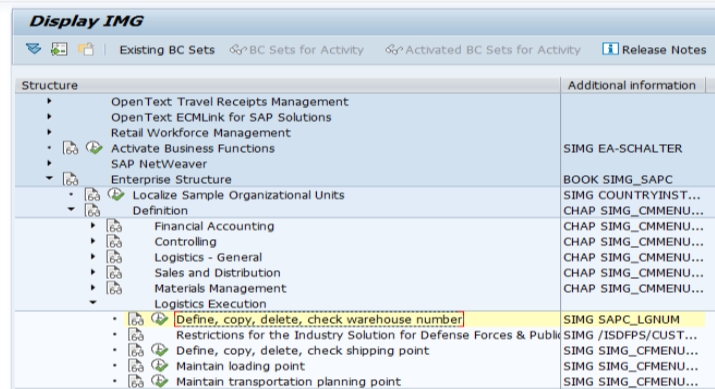
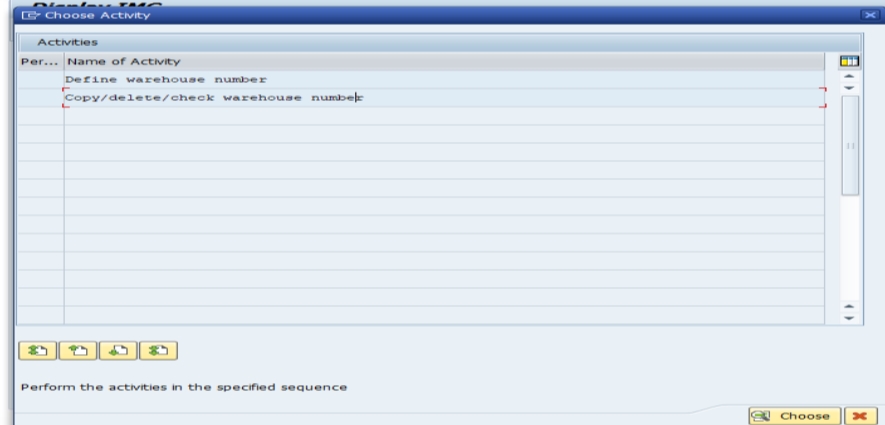
From the activity list, select Copy, Delete, Check Warehouse Number. This activity lets you build a new warehouse number from an existing reference rather than creating one field by field.
Click the Copy button and enter the source (reference) warehouse number along with the new target warehouse number you want to create - for example copying warehouse WH1 to a new warehouse WH6. Choose a reference warehouse whose storage type and storage section structure is genuinely close to what the new warehouse needs.
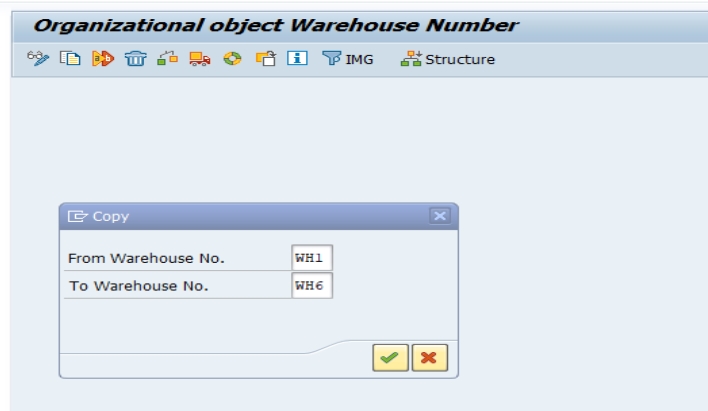
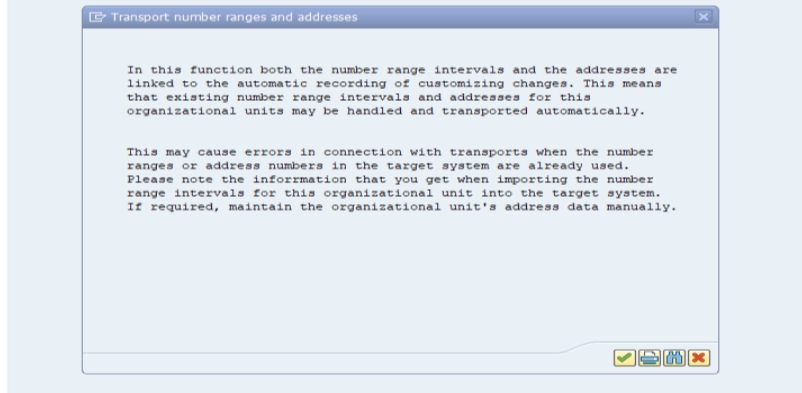
Confirm the system prompt by selecting Yes when asked whether dependent entries - such as storage types, storage sections, and related WM configuration - should also be copied across to the new warehouse number.
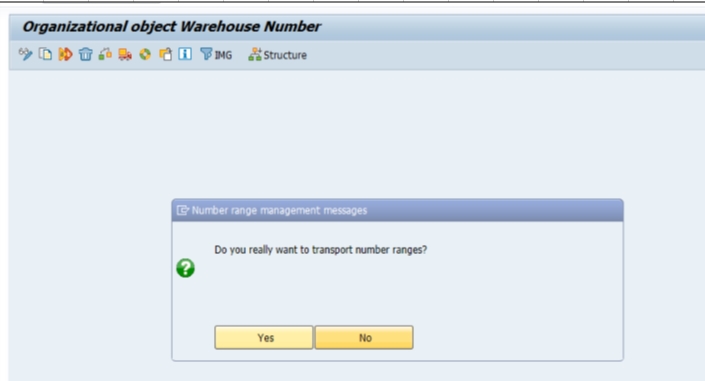
Save the entry. If prompted, enter or select a transport request, since this is transportable IMG configuration. At this point the warehouse number exists, complete with copied dependent configuration, but is not yet linked to any plant or storage location.
Navigate to SPRO → Enterprise Structure → Assignment → Logistics Execution → Assign Warehouse Number to Plant/Storage Location, and link the new warehouse number to the relevant plant and storage location combination so Inventory Management movements know the location is WM-managed.
🔍 What Actually Happens Behind the Scenes
Creating a warehouse number writes a new entry to table T300, which stores the basic warehouse number data such as the warehouse number code, description, and a handful of control indicators. When the copy function is used, the system also copies related customizing entries across a wide range of dependent tables governing storage types, storage sections, and other structural WM settings, saving substantial manual configuration effort compared to building each dependent object individually.
The plant/storage location assignment is stored separately, in table T320, which links a plant and storage location combination to a specific warehouse number. This is the table Inventory Management checks to decide whether a goods movement against a given plant/storage location needs to trigger WM-relevant processing, such as generating a transfer order.
It's worth being clear that copying a reference warehouse number does not automatically assign the new warehouse to any plant or storage location, and it does not automatically activate the warehouse for live transactions. Those are separate steps, described below, and none of them happen automatically just because the warehouse number record itself was created.
📋 What to Configure Next After Defining a Warehouse Number
Defining the warehouse number is an early step, not the final one. Before goods movements can actually be processed against the new warehouse, further steps are required:
- Assign the warehouse number to a plant and storage location, so Inventory Management knows the location is WM-managed and can trigger transfer order creation.
- Review and adjust copied storage types, confirming the copied structure genuinely matches the new warehouse's physical layout rather than just inheriting the reference warehouse's configuration unchanged.
- Create storage bins for the relevant storage types, either manually or using a bin creation program, since a warehouse number with storage types but no bins still can't receive stock at bin level.
- Define or review putaway and picking strategies for the new warehouse, confirming they fit the new location's actual operating pattern rather than assuming the reference warehouse's strategies apply unchanged.
Only after these steps are complete can warehouse staff actually process goods receipts, putaway, and picking against the new warehouse number. A warehouse number that exists in EC09 but has not yet been assigned to a plant/storage location will simply not be triggered by any inventory movement, rather than producing a clear error message pointing back to the missing configuration.
📋 Warehouse Number, Storage Location, and Storage Type - How They Differ
Warehouse number is frequently confused with storage location and storage type, since all three sound like they might describe "where" stock physically is. The distinction matters because they belong to different modules and different levels of granularity. Warehouse number is a WM-specific unit representing an entire physical facility, and it is assigned to one or more plant/storage location combinations from the MM side.
Storage location, by contrast, is an MM-level organizational unit - a simpler subdivision of a plant used to differentiate stock even in plants that don't use WM at all. Many plants have storage locations without any warehouse number behind them; the warehouse number link only exists where bin-level management is actually needed. Storage type is different again - it's a subdivision within a warehouse number, such as bulk storage, high-rack storage, or a fixed-bin area, each typically configured with its own putaway and picking strategy.
A single warehouse number can serve multiple storage locations, and a single storage location is assigned to exactly one warehouse number - the relationship between the two is one WM warehouse to potentially several MM storage locations, not a strict one-to-one pairing in every case.
💼 Real-World Scenario: Standing Up a New Distribution Center
Pradnya Pawar, an SAP WM consultant supporting a national distribution company headquartered in Pune, was asked to configure a new warehouse number for a distribution center the business had just opened outside Nagpur. Rather than building the warehouse structure from scratch, Pradnya identified an existing warehouse, WH1, whose storage type layout - bulk storage, high-rack storage, and a small fixed-bin area for fast-moving items - closely matched what the new facility needed.
Using the Copy, Delete, Check Warehouse Number activity, Pradnya copied WH1 to a new warehouse number WH6, confirming that dependent entries such as storage types and storage sections should also be copied. Anand Rathi, the operations manager who would be running the new distribution center, asked whether the new warehouse was ready to receive stock immediately after the copy completed. Pradnya explained that the warehouse number still needed to be assigned to the new facility's plant and storage location, and that the copied storage type structure needed a careful review, since the Nagpur facility had a larger high-rack storage area than WH1 and would need additional storage bins created to match.
After completing the plant/storage location assignment, adjusting the storage type capacities, and generating storage bins for the expanded high-rack area, Pradnya asked Anand 's team to process a test goods receipt and confirm the resulting transfer order proposed a sensible putaway bin. Only once that test transaction completed cleanly did Pradnya confirm the new warehouse was genuinely ready for the Nagpur team to begin live operations - a reminder that copying the warehouse number was just the starting point of a multi-step rollout, not a complete configuration on its own.
❗ Common Mistakes When Defining a Warehouse Number
- Choosing a reference warehouse for the copy that doesn't genuinely resemble the new facility's physical layout, creating extra rework later.
- Declining to copy dependent entries during the copy step, leaving the new warehouse number with no storage type or storage section structure at all.
- Forgetting to assign the new warehouse number to a plant and storage location, leaving it technically defined but never triggered by any inventory movement.
- Assuming a copied warehouse number is ready for live transactions without reviewing whether storage bins actually exist for the copied storage types.
- Leaving putaway and picking strategies unchanged after a copy, even when the new warehouse's operating pattern genuinely differs from the reference warehouse.
- Treating warehouse number configuration as a purely technical exercise rather than involving the actual warehouse operations team who understand the physical layout.
✅ Best Practices for Warehouse Number Setup
- Pick a reference warehouse for copying whose storage type structure is genuinely close to the new facility, not just whichever warehouse number happens to be convenient.
- Always confirm dependent entries should be copied, then review and prune what doesn't actually apply, rather than declining the copy and rebuilding everything manually.
- Treat the plant/storage location assignment as a required next step, not an optional follow-up.
- Involve the warehouse operations team early, since they understand the physical layout far better than a configuration-only view of the system can convey.
- Plan storage bin creation as part of the same rollout, rather than treating it as an afterthought once the warehouse number itself is "done."
- Document the warehouse-number-to-facility mapping outside SAP as well, so new team members don't have to reverse-engineer what each code represents.
- Test a full goods receipt and putaway cycle in a sandbox or development client before migrating the configuration to production.
📦 How Warehouse Number Supports Storage Types and Putaway Strategies
The real operational value of a warehouse number comes from what's configured underneath it. Storage types - bulk storage, high-rack storage, fixed-bin areas, and similar subdivisions - are defined per warehouse number and typically carry their own putaway and picking strategies, letting the system automatically propose sensible bins for incoming stock rather than requiring warehouse staff to decide manually every time.
Because these strategies are configured at the storage type level within a specific warehouse number, copying a reference warehouse is valuable precisely because it carries this strategy configuration across automatically - building strategy logic for bulk storage, near-fixed-bin, and high-rack areas from scratch for every new warehouse would be a significant undertaking on its own.
Warehouse number is also relevant to cycle counting and physical inventory processes in WM, since inventory counts, differences, and adjustments are all scoped to a specific warehouse number and its underlying storage bins, giving warehouse managers a clean, bin-level view of stock accuracy for their own facility.
🔒 Authorization Considerations for a New Warehouse Number
Because warehouse number governs which transfer orders, putaway confirmations, and picking activities a user can process, many organizations restrict which users can work with a given warehouse using standard WM authorization objects checked by warehouse number, alongside storage type and movement type where relevant. This is especially important when a newly opened facility should only be accessible to its own on-site team, rather than the entire company's warehouse staff.
A common oversight after standing up a new warehouse number is assuming existing WM users can immediately work with it. If security roles are built around explicit warehouse number values rather than a wildcard, the new warehouse needs to be added to the relevant roles before the local team can actually process transfer orders against it - otherwise the rollout stalls on authorization errors unrelated to the warehouse configuration itself.
Loop in the security or Basis team as soon as a new warehouse is planned, so role updates can be tested alongside the storage type and bin build rather than becoming a late-stage blocker right before go-live.
🔧 Troubleshooting Common Warehouse Number Errors
"Warehouse number does not exist" during transfer order creation
This means the warehouse code hasn't been created yet, or exists in one client but hasn't been transported to the client being used. Confirm the entry exists in table T300 for the relevant client.
Goods movement doesn't trigger a transfer order
Almost always means the plant/storage location combination was never assigned to the warehouse number. Revisit the assignment step covered earlier in this guide and check table T320.
No storage bins available for putaway after a copy
Copying dependent entries carries over storage type and storage section configuration, but it does not automatically generate storage bins. Bins need to be created separately, either manually or with a bin creation program.
Putaway or picking strategy behaves unexpectedly in the new warehouse
Check whether the copied strategy configuration actually fits the new warehouse's real capacity and layout, since a strategy copied unchanged from a differently sized reference warehouse can propose bins that don't reflect real available space.
Changes not visible in QA or Production
As with any enterprise structure change, confirm the transport was released and imported; warehouse number configuration is client-independent but still requires a transport to move between systems.
🏢 How Different Industries Typically Structure Warehouse Numbers
Because a warehouse number is meant to reflect a real, physical facility, the right structure looks quite different across industries:
- National distributors and FMCG: Warehouse numbers typically map one-to-one with regional distribution centers, each with its own bulk, high-rack, and fast-picking storage type mix.
- Discrete manufacturers: Warehouse numbers often separate raw material storage from finished goods storage, even within the same physical site, to keep inbound and outbound processes cleanly divided.
- Retail and e-commerce fulfillment: Warehouse numbers frequently emphasize fast-picking storage types and dense bin structures, since throughput and pick efficiency matter more than raw storage capacity.
- Cold chain and pharmaceutical distribution: Warehouse numbers may be split by temperature zone within the same physical building, with each zone modeled as a distinct storage type or even a separate warehouse number depending on regulatory tracking needs.
As with other organizational elements, there's no single correct structure prescribed by SAP - the important design principle is that the warehouse number and its storage types genuinely reflect how the physical facility operates, rather than an abstraction that looks tidy in configuration but doesn't match the warehouse floor.
📋 Warehouse Number Rollout Checklist
- Confirm the business genuinely needs a new warehouse number, rather than an additional storage type within an existing warehouse.
- Identify a reference warehouse whose structure genuinely resembles the new facility.
- Copy the reference warehouse number using the Copy, Delete, Check Warehouse Number activity, including dependent entries.
- Assign the new warehouse number to the correct plant and storage location combination.
- Review and adjust copied storage types to match the new facility's actual capacity and layout.
- Create storage bins for each relevant storage type.
- Update authorization roles so the local warehouse team can actually process transactions for the new warehouse.
- Run a test goods receipt, putaway, and picking cycle before considering the warehouse ready for live operations.
📈 How Warehouse Number Powers Inventory Accuracy and Reporting
Beyond enabling bin-level putaway and picking, warehouse number is one of the primary fields used for inventory accuracy and cycle counting reporting, since WM reports and standard transactions readily filter and group by warehouse number and storage type without additional development. This gives operations managers a genuinely granular view of where discrepancies occur, down to a specific storage type or even a specific bin.
This reporting value only holds up if storage bin data is kept current and cycle counts are actually performed on schedule. A warehouse where bin contents drift out of sync with the system - through unrecorded manual moves or skipped counts - produces reporting that looks precise but is quietly unreliable, undermining exactly the bin-level visibility that WM is meant to provide in the first place.
📊 Sample KPIs and Dashboards Built Around Warehouse Number
- Inventory accuracy by warehouse and storage type: Compares system-recorded quantities against physical counts, isolated to a specific warehouse number.
- Transfer order throughput by warehouse: Tracks how quickly putaway and picking transfer orders are confirmed, useful for spotting bottlenecks at a specific facility.
- Bin utilization by storage type: Helps warehouse managers understand how close a given storage type is to capacity, informing decisions about expansion or reslotting.
- Cycle count completion rate by warehouse: Measures how consistently scheduled inventory counts are actually being performed across each facility.
As with any organizational-unit-based reporting, the numbers are only as trustworthy as the underlying master data - a warehouse number with stale bin records or storage types that were copied but never properly capacity-checked will quietly undermine every dashboard built on top of it.
📱 This Configuration in SAP S/4HANA
Classic SAP WM, including the EC09 warehouse number definition activity described in this guide, remains available in SAP S/4HANA in a compatibility mode, and many existing implementations continue to run on it. However, SAP's strategic direction for warehouse management going forward is SAP EWM (Extended Warehouse Management), either embedded in S/4HANA or run as a decentralized system, which offers materially more advanced capabilities for slotting, labor management, and yard management. Organizations planning a new warehouse rollout on S/4HANA should evaluate early on whether to configure it in classic WM or migrate the design directly to embedded EWM, since the two use different configuration models and the migration path is a meaningful project in its own right, not a simple switch.
📋 Related SAP Transactions
| Transaction | Purpose |
|---|---|
| EC09 | Define, copy, delete, and check warehouse numbers. |
| OMS2 | Define storage types within a warehouse number. |
| LS01N | Create a storage bin manually. |
| OX09 | Define, copy, delete, and check storage locations. |
| OX10 | Define, copy, delete, and check plants. |
| LT01 / LT03 | Create a transfer order manually, or automatically from a reference document. |
🎓 Interview-Style Questions and Answers
Q: Why is a warehouse number usually created by copying an existing one instead of building it field by field?
Because a functioning warehouse number depends on substantial dependent configuration - storage types, storage sections, strategies - that would be time-consuming to build manually. Copying an existing warehouse carries this structure across automatically, which can then be reviewed and adjusted rather than built from nothing.
Q: What table stores the basic warehouse number record?
Table T300 stores the warehouse number code, description, and core control indicators. The plant/storage location assignment that links the warehouse into the MM side is stored separately, in table T320.
Q: Does copying a warehouse number automatically assign it to a plant?
No. Copying only creates the warehouse number and its dependent configuration. It must be separately assigned to a plant and storage location combination through the Assign Warehouse Number to Plant/Storage Location activity before Inventory Management movements recognize it as WM-managed.
Q: How does warehouse number relate to storage location, given both seem to describe "where" stock is?
Storage location is an MM-level unit that can exist with or without WM behind it, while warehouse number is a WM-specific unit representing bin-level management of a physical facility. A storage location is linked to a warehouse number specifically where bin-level detail is actually needed.
Q: What's the practical risk of declining to copy dependent entries when creating a new warehouse number?
The new warehouse number is created but has no storage types, storage sections, or strategy configuration underneath it, meaning essentially all of the real operational configuration - the part that actually determines how putaway and picking behave - would need to be built manually from scratch.
📚 Quick Glossary of Terms Used in This Guide
- Warehouse Number: The top-level WM organizational unit representing a complex physical warehouse or distribution center.
- Storage Type: A physical or organizational subdivision of a warehouse number, such as bulk storage or high-rack storage.
- Storage Bin: The most granular WM unit - the exact physical slot within a storage type where a quant of material is placed.
- Transfer Order: The WM document that instructs warehouse staff to move stock between bins, typically generated from a goods movement or delivery.
- T300 / T320: The SAP tables that store the warehouse number master record and the plant/storage location assignment, respectively.
- SAP EWM: Extended Warehouse Management, SAP's more advanced successor warehouse application, separate from classic WM.
📝 Naming and Governance for New Warehouse Numbers
Warehouse number codes are 3 characters in SAP, the same length as sales group codes, which puts a premium on choosing an abbreviation scheme early - a facility prefix plus a short sequence, for example - so codes stay meaningful as the network of warehouses grows. Even so, the code alone rarely communicates enough on its own without an internal reference document describing which physical facility each warehouse number represents.
Governance matters here for similar reasons as with other organizational elements. Because a new warehouse number typically implies a genuine physical facility - real racking, real staff, and often a significant capital investment - many organizations require a documented business case and sign-off from operations leadership before a new warehouse number is created, confirming that the facility genuinely needs its own warehouse number rather than being modeled as an additional storage type within an existing one. Deciding this early is usually what keeps an organization's WM structure clean and meaningful over time, rather than accumulating overlapping or redundant warehouse entries.
🎯 Conclusion
Defining a warehouse number is a comparatively quick activity thanks to the copy function, but because it represents a genuine physical facility with real racking, real staff, and real stock, getting the reference warehouse choice, the plant/storage location assignment, and the storage bin build right has a direct, visible impact on how smoothly the new facility actually operates from day one. The follow-up steps - assigning the warehouse to a plant and storage location, reviewing copied storage types, and creating storage bins - are not optional extras but required steps before the new warehouse delivers the bin-level control the business actually asked for. Keep this guide handy the next time your project needs to stand up a new distribution center or warehouse in SAP.