How to Define a Sales Group in SAP SD (OVX4)
Sales group represents a team of salespeople - new business, key accounts, renewals, or any other way a business splits up its sales force - and it is the organizational unit that sits directly underneath sales office in the SD structure. This guide walks through transaction OVX4 end to end, explains what sales group actually controls once it is live, and covers the sales office assignment and customer master updates needed afterward before the new group can genuinely be used for order processing and reporting. If you run into any errors while following along, feel free to send a screenshot to pramod@learntosap.com for help.
✅ What Is a Sales Group in SAP SD?
Sales group in SAP SD is an organizational element used to group salespeople into teams based on shared responsibility - a set of customers, a product line, a sales channel, or simply how a regional office chooses to split its workload internally. Unlike sales office, which represents a physical or organizational location, sales group represents people: the team actually doing the selling.
Grouping salespeople this way gives a business a clean way to measure and manage performance at the team level: a sales manager can pull backlog, order volume, and revenue figures for their own group without filtering through every other team in the office, and commission or incentive calculations that depend on team assignment have a stable, reportable field to reference rather than relying on informal spreadsheets maintained outside SAP.
Sales group is almost never used entirely on its own; it is typically assigned underneath a sales office, so that the combination of sales office and sales group reflects both where a team is based and which team within that office is responsible for a given customer or transaction. A sales group can, in principle, also be referenced directly on a sales document without going through a sales office relationship, but in most real implementations the office-then-group hierarchy is what drives reporting and territory design.
📋 Where Sales Group Fits in the SD Organizational Structure
Sales group sits at the bottom of the broader SD organizational structure - underneath sales office, which itself sits underneath sales area. Seeing how it relates to the units above it makes the assignment step later in this guide much easier to follow.
| Organizational Unit | Role | Typical Transaction |
|---|---|---|
| Sales Organization | The top-level SD unit responsible for selling and distributing goods. | OVX5 |
| Distribution Channel | Describes how goods reach the customer - for example wholesale, retail, or direct sales. | OVXI |
| Sales Area | The combination of sales organization and distribution channel that a sales office is assigned to. | OVXG |
| Sales Office | Represents a physical or organizational sales location; sales groups are assigned underneath it. | OVX1 |
| Sales Group | Represents a team of salespeople, assigned underneath a sales office; created here. | OVX4 |
Because sales documents ultimately reference sales organization, distribution channel, division, sales office, and sales group together, defining the sales group in OVX4 is one of the later steps in a genuinely new regional or team rollout - it typically depends on the relevant sales office already existing, so that the group has somewhere meaningful to be assigned underneath.
🔧 Step-by-Step: Defining a Sales Group Using OVX4
Sales group is one of the simplest organizational elements to create in SD, since the record itself carries very little dependent configuration - no address, no complex assignment logic beyond linking it to a sales office. Even so, naming and assignment still deserve care, since a sloppy sales group structure is one of the more common sources of messy salesperson-level reporting later on.
Run transaction OVX4 directly, or follow the IMG path: SPRO → Enterprise Structure → Definition → Sales and Distribution → Maintain Sales Group.
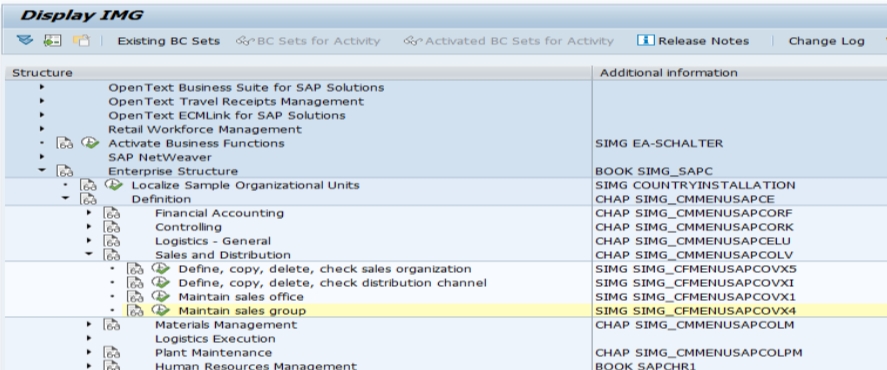
From the activity list, select Maintain Sales Group, then click New Entries to open a blank record for the new group.
Enter the new Sales Group code (3 characters) and a clear, business-meaningful description - for example the team's actual function, such as "Key Accounts" or "New Business", rather than a generic label that will be hard to interpret a year later.
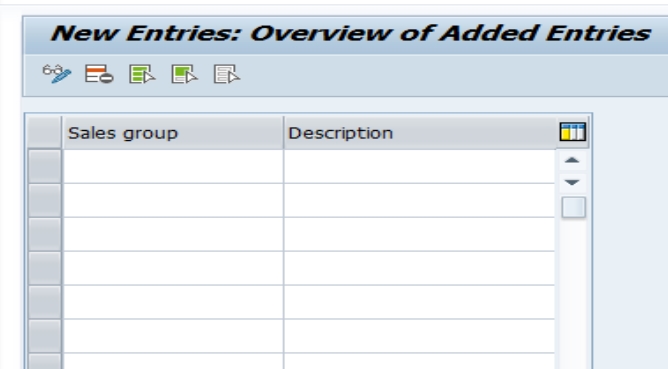
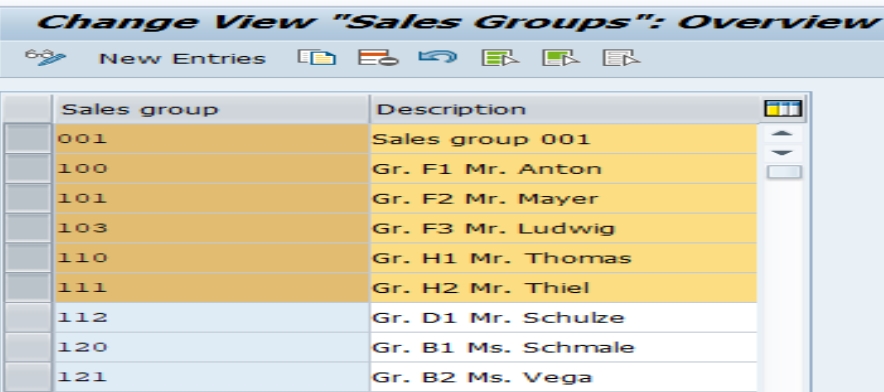
Save the entry. If prompted, enter or select a transport request, since this is transportable IMG configuration. At this point the sales group exists in the system but is not yet linked to any sales office, meaning it isn't functionally usable on a real sales document yet.
Assign the new sales group underneath the relevant sales office. This is typically done as part of the customer master or sales area assignment rather than a separate dedicated IMG activity, since sales group does not require its own address or independent sales area link the way sales office does - its practical "assignment" happens through where it's referenced on customer masters and sales documents.
Extend the relevant customer master records with the new sales office and sales group combination, and create a test sales order to confirm the new group appears correctly and that reporting picks it up as expected.
🔍 What Actually Happens Behind the Scenes
Creating a sales group in OVX4 writes a new entry to table TVKGR, which stores the sales group code and description. Unlike sales office, there is no associated address record and no link into central address management, since a sales group is a team designation rather than a physical location that needs its own correspondence address.
Technically, the sales group field VKGRP appears on the sales document header (table VBAK) alongside sales office, sales organization, distribution channel, and division. This is why sales group can be filtered and reported on independently even though it's conceptually "underneath" sales office - the field exists in its own right on every relevant document and master record, rather than being derived automatically from the sales office value.
It's worth being clear that creating the sales group record in OVX4 does not automatically place it underneath any particular sales office, and it does not automatically appear on any customer master record. Those relationships are established separately, through customer master maintenance and sales document entry, not through any automatic inheritance triggered by saving the OVX4 record itself.
📋 What to Configure Next After OVX4
Defining the sales group is a quick step, but it isn't the final one. Before sales documents can actually reference the new group meaningfully, further steps are typically required:
- Confirm the parent sales office already exists, since sales group is designed to operate underneath a sales office rather than as a standalone element.
- Extend customer master records with the correct sales office and sales group combination, so the new group is actually referenced when orders are created for those customers.
- Update partner determination or output routing if internal notifications, approvals, or commission calculations need to reference the new sales group.
- Brief the sales team on the new group code and description, particularly if salespeople themselves select the group manually when creating sales documents.
Only after these steps are complete does the new sales group start contributing meaningful, trustworthy figures to team-level reporting. A sales group that exists in OVX4 but has never been referenced on a customer master or sales document simply won't appear anywhere in day-to-day reporting, since there is no data pointing to it yet.
📋 Sales Group, Sales Office, and Sales Organization - How They Differ
Sales group is frequently confused with sales office and sales organization, since all three can sound like they describe "who" is responsible for a sale. The distinction matters because they are maintained independently and serve different purposes. Sales group is a team of people - new business, key accounts, renewals - typically assigned underneath a sales office and referenced directly on sales documents through the field VKGRP.
Sales office, by contrast, is a physical or organizational location rather than a team; it is defined separately in OVX1 and usually carries its own address for correspondence, with one or more sales groups operating from within it. Sales organization is different again - it's the top-level SD unit legally and organizationally responsible for selling and distributing goods, combined with distribution channel and division to form the sales area that a sales office is ultimately assigned to.
A single sales office can have several sales groups underneath it, and in some implementations the same sales group description might even be reused conceptually across different offices (though as a distinct code each time) - the three concepts are independent dimensions that combine together on a sales document, not a strict single hierarchy with only one valid path through it.
💼 Real-World Scenario: Splitting a Sales Office Into Two Teams
Pradnya Pawar, an SAP SD consultant supporting a national distribution company headquartered in Pune, was asked to restructure the existing Kolkata sales office after the business decided to separate its key account customers from its general new-business pipeline. Until then, both types of customers had been handled by a single, undifferentiated sales group, and the regional sales manager had no clean way to see key account performance separately from new business performance.
Pradnya created two new sales groups in OVX4 - "Key Accounts - East" and "New Business - East" - with clear, descriptive names rather than reusing the old generic group code. Anand Rathi, the regional sales manager, asked whether existing customer master records would automatically split between the two groups once the new codes were created. Pradnya explained that OVX4 only creates the group itself; every existing customer master record still needed to be reviewed and manually updated with the correct new sales group value, since SAP does not infer which team a customer belongs to on its own.
Working with Anand 's team, Pradnya identified which customers belonged in which group, updated the customer master records in a coordinated batch rather than gradually, and asked the team to create a handful of test sales orders against each new group to confirm reporting picked up the change correctly. Only once both new groups showed clean, separated figures in the standard sales reports did Pradnya consider the restructuring complete - a reminder that the OVX4 record itself is only the starting point, with the real work happening in the customer master rollout that follows it.
❗ Common Mistakes When Defining a Sales Group
- Using vague or generic descriptions like "Group A" or "Team 1", which become meaningless once the business has more than a handful of sales groups.
- Creating a new sales group without first confirming whether an existing group could reasonably cover the same team, leading to unnecessary fragmentation.
- Forgetting that customer master records must be manually updated after a sales group is created or changed - the new group does not retroactively apply to existing customers.
- Treating sales group as a substitute for sales office when what's actually needed is a new physical location, rather than a new team within an existing one.
- Not communicating new sales group codes to the sales team, resulting in salespeople manually selecting the wrong group on sales documents.
- Building the sales group structure around org-chart politics rather than how customers and territories are genuinely divided, producing reporting that doesn't reflect real sales activity.
✅ Best Practices for Sales Group Setup
- Give every sales group a description that clearly states its function, not just an abbreviation only the original project team understands.
- Choose a 3-character coding scheme early - for example a functional prefix plus a short suffix - so codes stay meaningful as the structure grows.
- Confirm the correct sales office already exists and is assigned to the right sales area before creating sales groups intended to sit underneath it.
- Plan customer master updates as a coordinated activity when a sales group structure changes, rather than migrating customers gradually.
- Coordinate sales group design with sales office design together, since the two are almost always planned and rolled out as a pair.
- Document the group-to-team mapping outside SAP as well, so new team members don't have to reverse-engineer what each code represents.
- Test reporting after any sales group change, confirming a sample sales order shows correctly under the new group before rolling the change out broadly.
💰 How Sales Group Supports Commission, Pricing, and Territory Reporting
Sales group is one of the most commonly used fields for salesperson- and team-level performance tracking, precisely because it maps directly onto how sales leadership already thinks about their teams. Commission calculations, whether handled inside SAP or in an external system fed by SAP data, frequently key off the sales group field to determine which team - and by extension which incentive plan - a given order or invoice belongs to.
Some organizations also use sales group as an access field in specific pricing condition tables, particularly where certain teams are authorized to apply different discount tiers or promotional pricing than others. As with any pricing configuration, this only works if condition records are actually maintained referencing sales group; creating the group in OVX4 makes this possible but does not create the pricing differentiation on its own.
Sales group is also commonly used in partner determination and workflow routing, allowing approval requirements or internal notifications to be driven off which team a document belongs to - for example routing large key-account discounts to a different approver than standard new-business orders, without requiring a fully manual routing process for every order.
🔒 Authorization Considerations for a New Sales Group
Because sales group feeds into reporting and, in some organizations, commission calculation, many businesses restrict which users can view or process documents for a given group using standard SD authorization objects checked by sales organization, sales office, and sales group together. This is especially relevant when a new group represents a newly formed team that should only be visible to its own manager and members, rather than the entire sales organization.
A common oversight after creating a new sales group is assuming existing users can immediately work with it. If security roles are built around explicit sales group values rather than a wildcard, the new group needs to be added to the relevant roles before the team can actually process or even view documents assigned to it - otherwise the rollout stalls on authorization errors unrelated to the OVX4 configuration itself.
Loop in the security or Basis team as soon as a sales group restructuring is planned, so role updates can be tested alongside the customer master rollout rather than becoming a late-stage blocker right before the team's go-live date.
🔧 Troubleshooting Common OVX4 Errors
"Sales group does not exist" on a customer master or sales order
This means the group code hasn't been created yet, or exists in one client but hasn't been transported to the client being used. Confirm the entry exists in table TVKGR for the relevant client.
Sales group not appearing in the dropdown when creating a sales order
Check whether the sales group was actually created in OVX4 and whether the transport carrying it has been imported into the current system. Unlike sales office, sales group does not need a separate sales-area assignment step, so a missing entry almost always traces back to the OVX4 record or its transport.
Sales group field shows blank on existing customer master records after a restructuring
This is expected if old sales groups were deleted or replaced without updating the affected customer master records. Sales group values on existing records must be manually corrected; SAP does not automatically remap them.
Commission or reporting figures look wrong after adding a new sales group
Almost always traces back to customers or orders still referencing the old sales group value. Confirm the customer master rollout was completed for every affected customer, not just a subset.
Changes not visible in QA or Production
As with any enterprise structure change, confirm the transport was released and imported; OVX4 changes are client-independent configuration but still require a transport to move between systems.
🏢 How Different Industries Typically Structure Sales Groups
Because sales group is meant to reflect real teams rather than places, the right structure looks quite different across industries:
- National distributors and FMCG: Sales groups often split by customer channel, such as modern trade, general trade, and institutional sales, within a single regional office.
- Multinational manufacturers: Sales groups may represent product-line specialists operating within a single country sales office, allowing technical expertise to stay grouped even as customers span multiple industries.
- Professional services and B2B software: Sales groups frequently mirror the sales funnel itself - new business, expansion/upsell, and renewals - since these require genuinely different skill sets and incentive structures.
- Franchise and dealer networks: Sales groups may represent dealer-facing account teams versus direct corporate accounts, letting the same sales office serve both channels with clearly separated reporting.
As with sales office, there's no single correct structure prescribed by SAP - the important design principle is consistency, so that sales group boundaries map cleanly onto a single, stable way of dividing the sales force rather than mixing logics that make reporting harder to interpret over time.
📋 Sales Group Rollout Checklist
- Confirm the business genuinely needs a new team designation, rather than reusing an existing sales group.
- Confirm the parent sales office already exists and is correctly assigned to a sales area.
- Create the sales group in OVX4 with a clear, function-based description.
- Identify every customer master record that needs to reference the new group.
- Update customer master records in a coordinated batch rather than gradually.
- Update authorization roles so the relevant team can actually view and process documents for the new group.
- Brief the sales team on the new group code so it's selected correctly on manual entries.
- Run a test sales order and confirm it appears correctly in standard reporting before considering the group ready for end users.
📈 How Sales Group Powers Team-Level Sales Reporting
Beyond its supporting role in pricing and partner determination, sales group is one of the most commonly used fields for team- and salesperson-level performance reporting, precisely because it maps directly onto the functional way most sales leadership already think about their organization. Standard SD reports, along with most custom or embedded analytics reports built on sales order and billing data, support filtering and grouping by sales group without additional development.
This reporting value only holds up if the sales group field is populated consistently across relevant customer master records and sales documents. A restructuring where some customers are updated immediately and others migrated gradually produces reporting that looks unreliable during the transition, with team-level figures shifting for reasons unrelated to actual sales performance. Planning the customer master update as a coordinated activity, rather than a gradual one, avoids this and gives team managers clean numbers from the first reporting cycle after go-live.
📊 Sample KPIs and Dashboards Built Around Sales Group
- Revenue by sales group, trended over time: Lets team managers compare performance directly, since sales group maps cleanly onto how teams are actually organized.
- Win rate or conversion by sales group: Frequently used to compare new-business teams against renewal or key-account teams operating under different dynamics.
- Commission payout tracking by sales group: Combines sales group with billing data to support incentive calculations and payout audits.
- Sales group performance within a sales office: Combines sales office and sales group filters to compare teams operating from the same physical location.
As with any organizational-unit-based reporting, the numbers are only as trustworthy as the underlying master data - a sales group left unassigned on customer records, or customers pointing at the wrong group after a reorganization, will quietly undermine every dashboard and commission calculation built on top of it.
📱 This Configuration in SAP S/4HANA
Transaction OVX4 works the same way in SAP S/4HANA as in classic ECC, since sales group remains a foundational SD organizational element unaffected by the Universal Journal or the simplified data model. The downstream customer master and sales document referencing are also unchanged. What differs in S/4HANA is mainly on the analytics side: embedded analytics and Fiori apps make it considerably easier to build near-real-time team-level dashboards filtered by sales group, which raises the practical importance of getting group naming and customer master assignment right from the start, since a poorly planned structure becomes visible more quickly once it feeds directly into live team performance dashboards.
📋 Related SAP Transactions
| Transaction | Purpose |
|---|---|
| OVX4 | Define and maintain sales groups. |
| OVX1 | Define sales offices, with sales groups assigned underneath them. |
| OVX5 | Define, copy, delete, and check sales organizations. |
| OVXI | Define, copy, delete, and check distribution channels. |
| OVXG | Set up a sales area by combining sales organization, distribution channel, and division. |
| XD01 / XD02 | Create or change a customer master record, including its sales group field. |
🎓 Interview-Style Questions and Answers
Q: Why does sales group require so little configuration compared to sales office?
Because sales group represents a team rather than a physical location, it doesn't carry an address or require a dedicated sales-area assignment step. Its practical link to the organization happens through customer master and sales document references rather than through IMG-level assignment activities.
Q: What table stores the sales group record created in OVX4?
Table TVKGR stores the sales group code and description. The field VKGRP is what actually appears on the sales document header table VBAK and on customer master records.
Q: Does creating a sales group in OVX4 automatically assign it to a sales office?
No. OVX4 only creates the sales group record itself. The relationship between a sales group and a sales office is established through where the group is referenced on customer master records and sales documents, not through an automatic link created by OVX4.
Q: How is sales group different from sales office, given both seem to describe "who handles" a sale?
Sales office is a location - a branch or region - while sales group is a team of people operating from that location. The two are defined with separate transactions (OVX1 and OVX4), with sales group typically nested underneath sales office in practice.
Q: Why does a coordinated customer master rollout matter more for sales group changes than for most other master data updates?
Because sales group commonly feeds commission calculations and team-level reporting directly, updating some customers immediately and others gradually creates a period where team figures and payouts shift for reasons unrelated to actual sales performance, undermining confidence in the numbers exactly when a restructured team is being watched most closely.
📚 Quick Glossary of Terms Used in This Guide
- Sales Group: An organizational element representing a team of salespeople, such as new business, key accounts, or renewals.
- Sales Office: A physical or organizational sales location that one or more sales groups are typically assigned underneath.
- Sales Area: The combination of sales organization and distribution channel that a sales office is assigned to.
- VKGRP: The technical SAP field name for sales group, appearing on the sales document header table VBAK.
- TVKGR: The SAP database table that stores sales group codes and descriptions.
- Partner Determination: The configuration that decides which internal or external parties, such as a sales group's manager, are automatically linked to a sales document.
📝 Naming and Governance for New Sales Groups
Sales group codes are 3 characters in SAP, slightly shorter than sales office codes, which puts a premium on choosing an abbreviation scheme that will still make sense once the business has a dozen or more groups across different offices. Even so, the code alone rarely communicates enough without an internal reference document describing what each group represents and which office it typically sits under.
Governance matters here for similar reasons as with sales office. Because a sales group restructuring usually implies a genuine change to how the sales force is organized - new commission plans, new reporting lines, new customer assignments - many organizations require sign-off from sales leadership before a new group is created, confirming that the change reflects a real organizational decision rather than an ad hoc configuration request. Deciding this early is usually what keeps an organization's sales group structure clean and meaningful over time, rather than accumulating overlapping or redundant team entries that nobody remembers the original purpose of.
🎯 Conclusion
Defining a sales group in OVX4 is one of the quickest configuration steps in the SD organizational structure, but because it usually represents a genuine team with its own reporting and, often, commission implications, getting the naming and the customer master rollout right has a visible, immediate impact on both team-level performance tracking and day-to-day order processing. The follow-up steps - confirming the parent sales office, updating customer master records, and briefing the sales team - are not optional extras but required steps before the new group delivers the team structure the business actually asked for. Keep this guide handy the next time your project needs to restructure a sales team or stand up a new one in SAP SD.