How to Define distribution Channel in SAP SD (OVXI)
distribution channel defines the route a product or service takes to reach the customer - direct sales, wholesale, retail, or online - and it is one of the three organizational elements, alongside sales organization and division, that make up a sales area. This guide walks through transaction OVXI using the copy-reference method, explains what gets carried over when you copy distribution channel, and covers the plant and sales area assignments needed afterward before the new channel can actually be used. If you run into any errors while following along, feel free to send a screenshot to pramod@learntosap.com for help.
✅ What Is distribution Channel in SAP SD?
distribution channel in SAP SD is the organizational unit that defines how a company's products or services physically or commercially reach the end customer. It captures the route to market - direct sales, third-party or wholesale distribution, retail, internet sales, and similar variations - and it exists so that a single sales organization can sell the same products through several different channels, each with its own pricing, its own partner determination rules, and its own reporting.
Distribution channel sits below sales organization and alongside division in the SD organizational hierarchy. It is never used on its own; it is always combined with a sales organization and a division to form a sales area, which is the level actually referenced on customer master records, sales orders, deliveries, and billing documents. Because of this, distribution channel by itself has limited meaning - its purpose only becomes concrete once it is assigned to a sales organization and used inside a sales area.
Unlike a sales organization, which must be assigned to exactly one company code, a single distribution channel can be reused across multiple sales organizations. A company that sells the same way - for example, always through direct sales - across several regional sales organizations does not need a separate distribution channel for each region; it typically reuses one "direct sales" channel across all of them, keeping the organizational structure leaner.
📋 Where Distribution Channel Fits in the SD Organizational Structure
Distribution channel is one layer among several in the broader SD organizational structure. Seeing how it relates to sales organization and division above and below it makes the plant assignment and sales area steps later in this guide much easier to follow.
| Organizational Unit | Role | Typical Transaction |
|---|---|---|
| Sales Organization | The top-level SD unit responsible for selling and distributing goods; distribution channel is assigned to it. | OVX5 / OVXK |
| Distribution Channel | Describes how goods reach the customer - for example wholesale, retail, or direct sales; created and copied here. | OVXI |
| Division | Groups materials or services into product lines for sales and reporting purposes. | OVXB |
| Plant | The physical location goods ship from; distribution channels are assigned to the plants they can deliver through. | OX10 / OVX6 |
| Sales Area | The combination of sales organization, distribution channel, and division actually used on sales documents. | OVXG |
Because sales area is what customer master records and sales documents actually reference, defining the distribution channel in OVXI is only the first of several configuration steps for a genuinely new channel. It is, however, a required first step, since the plant assignment and sales area build that follow both depend on the distribution channel already existing.
🔧 Step-by-Step: Defining distribution Channel Using OVXI
As with most SD organizational elements, the fastest and safest way to create a new distribution channel is to copy an existing, already-configured one rather than build a blank record from scratch. Copying automatically brings along dependent configuration such as partner determination procedures and pricing procedure determination entries tied to the source channel, which otherwise have to be rebuilt manually.
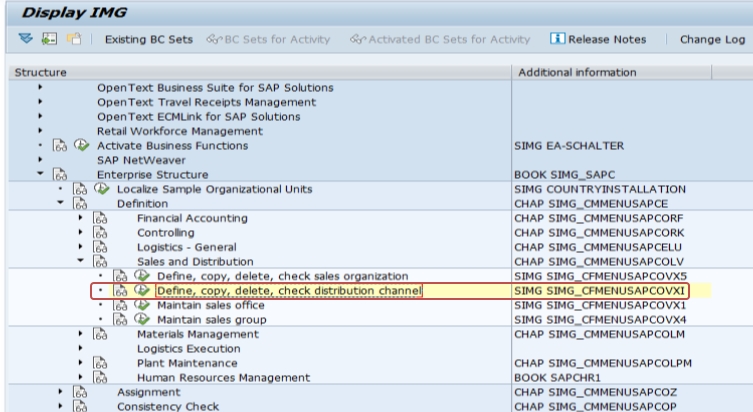
Run transaction OVXI directly, or follow the IMG path: SPRO → Enterprise Structure → Definition → Sales and Distribution → Define, Copy, Delete, Check Distribution Channel.
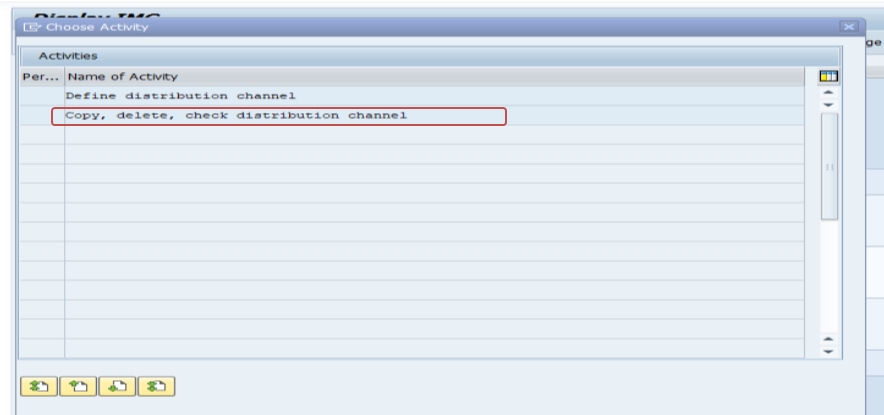
From the activity list, select Copy, Delete, Check Distribution Channel. Choosing the copy activity - rather than the plain "Define Distribution Channel" option - is what triggers SAP to duplicate the reference channel's dependent configuration automatically.
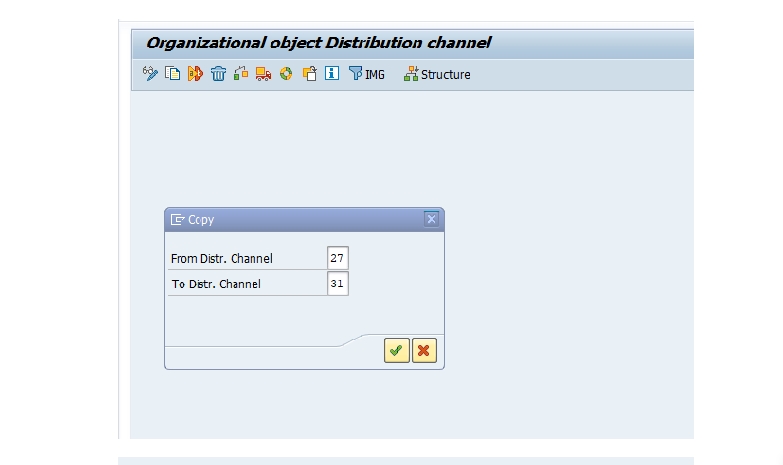
Choose the Copy function (F5) and enter the source and target distribution channels - in this example, copying from Distribution Channel 27 (an existing, already-configured channel) to the new Distribution Channel 31, intended for use across plants 1251 and 1252.
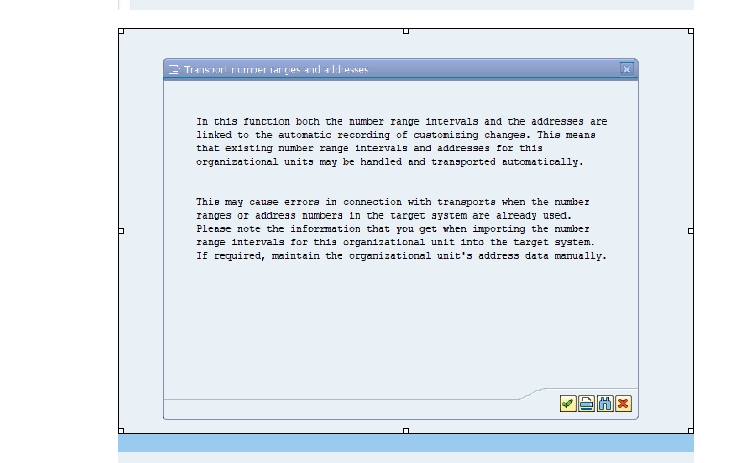
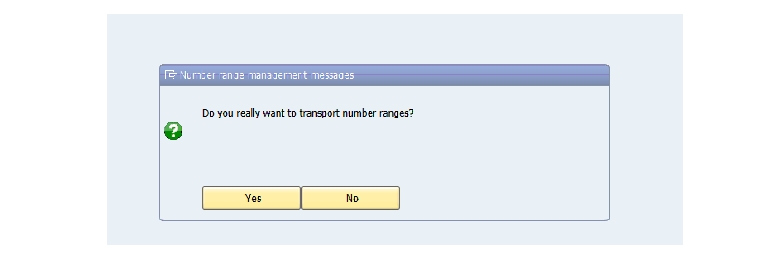
SAP prompts for confirmation before copying every dependent table linked to the source distribution channel. Select Yes on each confirmation dialog to proceed with the full copy.
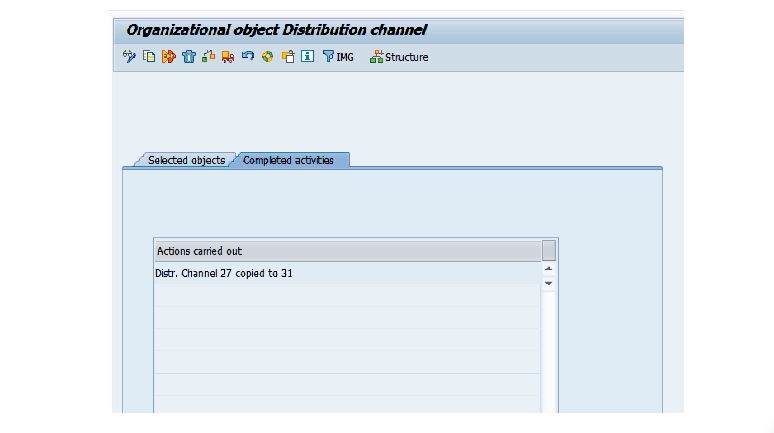
Once the copy completes, confirm the new distribution channel 31 is assigned to the intended plants - 1251 and 1252 in this example - so goods can actually be delivered through this channel from those locations. Review any channel-specific description or settings that should not simply be inherited from the reference channel.
Save the configuration. The distribution channel itself now exists in the system, though it is not yet usable on sales documents until it is assigned to a sales organization and built into a sales area, covered in the next section.
🔍 What Actually Gets Copied Behind the Scenes
The copy-reference method in OVXI is convenient for the same reason it is convenient for sales organization: distribution channel is never configured in isolation, and dozens of downstream customizing tables reference the distribution channel key directly.
When you copy distribution channel 27 to 31 and confirm both copy prompts, SAP duplicates entries such as partner determination procedures - which control which partner functions, like sold-to party or ship-to party, are relevant for documents created under this channel - along with pricing procedure determination entries that factor distribution channel into which pricing procedure applies. This is exactly why choosing a good reference channel matters: whatever partner and pricing logic the source channel uses will initially apply to the new one as well, and anything that should genuinely differ has to be adjusted deliberately after the copy finishes.
It's worth being clear that copying distribution channel does not automatically assign it to a sales organization or a division, and it does not automatically extend materials or customers to be usable under the new channel. Those are separate steps, described below, and none of them happen automatically just because the distribution channel record itself was created.
📋 What to Configure Next After OVXI
Defining the distribution channel is an early step, not the final one. Before sales documents can actually be created against distribution channel 31, further assignments are required:
- Assign the plants that deliver through this channel using the plant-to-distribution-channel assignment activity in the enterprise structure IMG, confirming which physical locations - such as 1251 and 1252 in this example - can fulfill orders through the new channel.
- Assign the distribution channel to a sales organization using transaction OVXK, since distribution channel only becomes usable once it is linked to at least one sales organization.
- Build the sales area using transaction OVXG, combining the sales organization with the new distribution channel and a division. The resulting sales area is what actually gets assigned to customer master records and referenced on sales orders, deliveries, and billing documents.
- Extend materials and customers to the new sales area where needed, since a material or customer that only exists under other sales areas will not automatically be sellable through the new distribution channel.
Only after these assignments are complete can end users select the new distribution channel when creating a sales document. distribution channel that exists in OVXI but has not yet been assigned to a sales organization or built into a sales area typically will not appear as a valid selection at all, rather than producing a clear error message pointing back to the missing configuration.
📋 Partner Determination and Pricing Tied to Distribution Channel
Two of the most consequential things distribution channel brings with it, whether copied or built manually, are its role in partner determination and its role in pricing procedure determination. Distribution channel is one of the key fields SAP uses, alongside sales organization, division, document pricing procedure, and customer pricing procedure, to decide which pricing procedure applies when a sales order is created - which means an incorrectly configured or incomplete distribution channel can cause every order created under it to price incorrectly, often without a clear error pointing back to the channel itself.
Partner determination works similarly: the distribution channel, combined with the sales document type, influences which partner functions - sold-to party, ship-to party, bill-to party, payer, and others - are proposed and required on documents created under this channel. When distribution channel is copied in OVXI, its partner determination assignments are copied along with it, which is convenient, but it also means the new channel will initially behave exactly like the reference channel in this respect unless someone deliberately reviews and adjusts it - for example, if the new channel genuinely needs a different set of required partner functions than the source channel did.
Because both of these areas are easy to configure incorrectly and hard to diagnose after the fact, it's worth testing a sample sales order against the new distribution channel specifically to confirm both partner proposal and resulting pricing look correct before considering the channel setup complete.
📦 Extending Materials and Customers to a New Distribution Channel
distribution channel that exists in configuration but has no materials or customers extended to it is effectively unusable, since a sales order needs both a valid sales area and a material or customer that is actually maintained for that sales area. Material master records carry sales-area-specific views - sales organization and distribution channel data, including things like delivering plant, pricing reference material, and item category group - that must be extended separately for each new sales area a material should be sellable under.
Customer master records work the same way: a customer maintained only under an existing distribution channel's sales area will not automatically appear as valid once a new distribution channel is created, even if the underlying general customer data is identical. This is a step that is easy to overlook after distribution channel copy, since the copy itself completes successfully and gives no indication that materials or customers still need separate extension - the gap only becomes visible the first time someone tries to create a sales order and cannot find the expected material or customer under the new sales area.
For this reason, a realistic go-live plan for a new distribution channel should include a specific step - and ideally a mass extension approach using transactions like MM17 for materials or a customer master mass maintenance tool - to extend the relevant materials and customers to the new sales area, rather than leaving it to be discovered reactively once end users start reporting that expected records are missing.
💼 Real-World Scenario: Adding a New Distribution Channel for a Second Plant Group
Pooja Mishra, an SAP SD consultant at Learn Pharmaceuticals in Pune, was asked to set up a new distribution channel so that two additional plants - 1251 and 1252 - could deliver goods through a route separate from the company's existing channel. Rather than creating the channel from a blank record, Pooja chose to copy the company's existing, well-tested distribution channel 27 into a new distribution channel 31, since 27 already had correctly configured partner determination and pricing procedure determination that the new channel could reuse as a starting point.
Rajesh Jadhav, reviewing the change request, asked why the team didn't simply reuse distribution channel 27 for the new plants instead of creating channel 31 at all. Pooja explained that the business had a genuine reason to separate them: the new plants served a different customer segment with different partner requirements and pricing agreements, which meant the two channels needed to diverge from day one rather than share configuration that would only need to be manually split apart later.
After completing the copy in OVXI and confirming both dependent-data prompts in a sandbox client, Pooja assigned distribution channel 31 to plants 1251 and 1252, then handed it to Suresh Mehta to complete the sales organization assignment in OVXK and the sales area build in OVXG. Rekha Pagar, from the customer master team, was then able to extend the relevant customers to the new sales area only once all of those follow-up steps were finished - confirming for the team that the distribution channel record created in OVXI was genuinely just the starting point, not a complete, ready-to-use configuration on its own.
❗ Common Mistakes When Defining distribution Channel
- Building a new distribution channel from a blank record instead of copying a well-configured reference, resulting in missing partner determination or pricing procedure determination that only surfaces later, during actual document creation.
- Choosing a poorly configured or mismatched reference channel just because it's convenient, rather than one whose partner and pricing logic genuinely fits the new channel's business.
- Forgetting to assign the new distribution channel to the intended plants, leaving it technically defined but unable to actually deliver goods from anywhere.
- Assuming the distribution channel is ready to use immediately after OVXI, without completing the sales organization assignment (OVXK) and sales area build (OVXG).
- Reusing an existing distribution channel for a genuinely different business scenario instead of creating a new one, when the customer segment or pricing agreements actually need to diverge.
- Copying distribution channel directly in a production client instead of testing the copy in a sandbox or development client first, making it harder to review exactly what was duplicated before it affects live data.
✅ Best Practices for Distribution Channel Setup
- Always create a new distribution channel using the copy method in OVXI rather than a blank record, so partner determination and pricing configuration are inherited automatically.
- Choose a reference distribution channel whose partner and pricing logic genuinely fit the new channel's business, not just the most convenient existing one.
- Confirm every plant that should deliver through the new channel is assigned before considering the setup complete.
- Document which distribution channel was used as the copy source, so later troubleshooting can trace configuration back to its origin.
- Treat OVXK and OVXG as required next steps, not optional follow-ups, and confirm both before releasing the distribution channel for use.
- Test the full setup in a sandbox or development client, including creating a sample sales order against the new sales area, before migrating the configuration to production.
📈 When Does a Business Actually Need a New Distribution Channel?
Not every new customer segment or sales initiative justifies a brand-new distribution channel. Because distribution channel carries its own partner determination and pricing procedure determination configuration, it is generally reserved for cases where the route to market genuinely differs - a distinct sales method such as direct versus wholesale, a channel with different required partner functions, or a business segment that needs materially different pricing agreements.
Requirements that only need a different reporting split, without a genuinely different route to market or partner logic, can often be met with a new division under the existing distribution channel instead, avoiding the overhead of duplicating partner and pricing configuration unnecessarily. Deciding this correctly before running OVXI - as Pooja and Vikram worked through in the scenario above - keeps the SD organizational structure easier for the whole team to reason about as more channels are added over time.
✅ Validating the New Distribution Channel Before Go-Live
Once OVXI, the plant assignment, OVXK, and OVXG are all complete, it's worth running through a short validation checklist before considering the distribution channel ready for end users. Confirm a representative material has been extended to the new sales area and displays correctly with the expected delivering plant. Create a test sales order using that material and a test customer maintained under the new sales area, and confirm partner functions propose as expected and pricing calculates correctly. Check that the distribution channel's assigned plants match what the business actually intends, since a channel assigned to the wrong plant will pass configuration checks but fail to deliver correctly in practice. Finally, confirm with the sales team that the channel's description and any customer-facing labeling are accurate, since these are easy to leave unedited after a straight copy from a differently named reference channel.
Skipping this validation step is one of the more common reasons a newly configured distribution channel generates a support ticket in its first week of live use - usually a missing material extension, an unexpected partner proposal, or a plant assignment that does not match what the business actually needed - all of which are far faster to catch in a short test than to trace back after go-live.
📱 This Configuration in SAP S/4HANA
Transaction OVXI and the copy-reference method for defining distribution channel work the same way in SAP S/4HANA as in classic ECC, since distribution channel remains a foundational SD organizational element unaffected by the Universal Journal or the simplified data model. The downstream assignments in OVXK and OVXG are also unchanged. What differs in S/4HANA is mainly on the Fiori side: apps related to managing sales areas and organizational structure can be used alongside the classic SPRO transactions to review or cross-check the configuration, but the underlying customizing steps described in this guide apply without modification.
📋 Related SAP Transactions
| Transaction | Purpose |
|---|---|
| OVXI | Define, copy, delete, and check distribution channels. |
| OVX5 | Define, copy, delete, and check sales organizations. |
| OVXK | Assign distribution channel to a sales organization. |
| OVXG | Set up a sales area by combining sales organization, distribution channel, and division. |
| OVXB | Define a division used within a sales area. |
| XD01 | Create a customer master record, referencing a completed sales area. |
🎓 Interview-Style Questions and Answers
Q: Why is distribution channel considered a separate organizational element from sales organization?
Because a single sales organization often needs to sell the same products through more than one route to market - for example both direct sales and wholesale - and distribution channel exists specifically to represent that difference without requiring a separate sales organization for each route.
Q: What is the advantage of using the copy method in OVXI instead of creating distribution channel manually?
Copying automatically duplicates dependent configuration such as partner determination and pricing procedure determination from the reference channel, avoiding the risk of missing one of the many settings that would otherwise need to be configured by hand.
Q: Can distribution channel created in OVXI be used immediately on a sales order?
No. It must first be assigned to the relevant plants, assigned to a sales organization in OVXK, and built into a sales area in OVXG before it can be selected on customer master records or sales documents.
Q: What two areas of configuration are copied along with distribution channel in OVXI that most often get overlooked?
Partner determination and pricing procedure determination are both tied to the distribution channel and copied along with it, but they are also the two areas most likely to need deliberate review afterward, since an incorrect or unreviewed copy in either area often does not surface as an error - it just produces the wrong partner proposal or the wrong price on a live document.
📚 Quick Glossary of Terms Used in This Guide
- Distribution Channel: The organizational unit describing how goods reach the customer, such as wholesale, retail, or direct sales.
- Sales Organization: The top-level SD organizational unit that distribution channel is assigned to.
- Division: A grouping of materials or services into product lines, combined with sales organization and distribution channel to form a sales area.
- Sales Area: The combination of sales organization, distribution channel, and division actually referenced on sales documents.
- Partner Determination: The configuration that decides which partner functions, such as sold-to or ship-to party, are proposed and required on a document.
- Copy-Reference Method: Creating a new organizational unit by duplicating an existing, already-configured one rather than starting from a blank record.
📝 Naming and Governance for New Distribution Channels
Distribution channel codes are typically two characters in SAP, which leaves little room for a self-explanatory naming scheme compared to longer-code organizational elements. Most SD teams instead maintain the mapping externally - a short internal reference document listing what each two-character code represents, such as which code means direct sales versus wholesale versus a specific regional route - since the code itself, like 27 or 31 in this guide's example, communicates nothing on its own without that context.
Governance matters here just as it does for sales organization. Because creating distribution channel by copying a reference brings that reference's partner determination and pricing procedure determination along with it, many organizations restrict who can execute OVXI in a production or development client, and require a change request documenting the business justification, the chosen copy reference, and the planned plant and sales organization assignments before configuration begins. This keeps a growing distribution channel list understandable rather than accumulating channels nobody remembers the original purpose of a year or two later.
🎯 Conclusion
Defining distribution channel in OVXI is a short transaction on the surface, but like sales organization, it sets the foundation for partner determination, pricing, and every sales document created under it. Copying from a well-configured reference channel, rather than starting from a blank record, is almost always the safer approach, and the follow-up steps - plant assignment, the sales organization link in OVXK, and the sales area build in OVXG - are not optional extras but required steps before the new channel can actually be used. Keep this guide handy the next time your project needs a new distribution channel, whether for a new route to market, a new customer segment, or a new set of delivering plants.