SAP ME49 – Price Comparison and Vendor Quotation Analysis in SAP MM
The Price Comparison (ME49) transaction code is a part of the SAP MM module and serves as a valuable tool for comparing prices from different vendors before making a purchase decision. This functionality aids procurement professionals in making informed choices, optimizing costs, and selecting the best suppliers for their organization's needs. This guide walks through transaction ME49, from purchase organization and collective RFQ entry through comparison values and the final select or reject decision. If you encounter any errors in SAP, send me a screenshot at pramod@learntosap.com, and I will help you resolve the issue.
✅ SAP ME49 – Vendor Price Comparison in Purchasing
The Price Comparison (ME49) transaction code is a part of the SAP MM module and serves as a valuable tool for comparing prices from different vendors before making a purchase decision. This functionality aids procurement professionals in making informed choices, optimizing costs, and selecting the best suppliers for their organization's needs.
Price comparison sits at a specific, important point in the procurement cycle - after RFQs (Requests for Quotation) have been sent out to multiple vendors and their quotations have been received, but before a purchase order is actually created. ME49 is where all of those vendor responses are brought together side by side, so a purchasing professional can genuinely compare like with like, rather than reviewing each vendor's offer in isolation.
This step matters more than it might first appear, since a poorly structured comparison - one that doesn't genuinely account for price, quality, delivery timing, and supplier reliability together - can lead to a purchasing decision that looks good on price alone but creates problems elsewhere in the supply chain later.
🔧 Steps to Execute ME49 for Price Comparison
Follow the path: Logistics → Materials Management → Purchasing → RFQ/Quotation → Create → ME49.
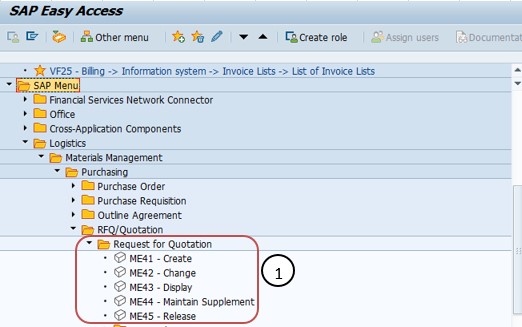
Go to transaction code ME49.
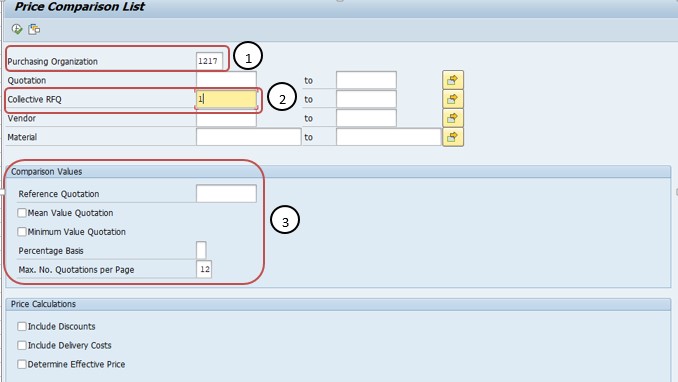
Purchase Organization - select the purchase organization, in this example 1217.
Collective RFQ No. - enter 1. The collection number is a unique identifier assigned to each RFQ, grouping all vendor responses to the same requirement together for comparison.
Comparison Values - you can select this field, though it's optional and not required:
- Mean Value Quotation - The Mean Value Quotation is a procurement approach that calculates the average price from the different quotations received for a particular material or service. This method helps organizations achieve a balanced assessment of vendor offerings and select the most reasonable price.
- Minimum Value Quotation - The Minimum Value Quotation is an approach where the system considers the lowest quotation received for a specific material or service. This method is suitable when cost savings are a critical factor.
- Percentage Basis - The Percentage Basis Quotation involves requesting vendors to quote prices based on a specified percentage discount or markup from a reference price. This approach can provide flexibility in pricing negotiations.
Click on Execute.
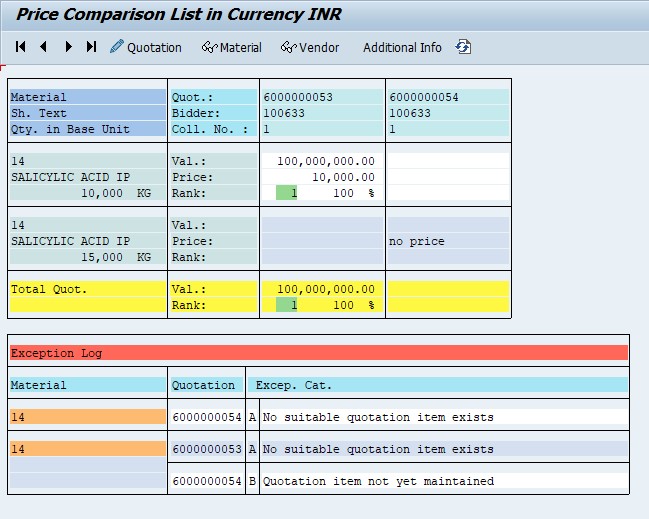
📋 Selecting or Rejecting a Quotation
Next, click on the quotation number that offers the lowest price and select it, rejecting the others.
- Selecting a Quotation: A quotation is selected when it aligns with the budget, offers competitive pricing, and meets quality and delivery expectations. Supplier credibility and past performance also play a role. Selecting a quotation marks the beginning of the procurement process with the chosen supplier.
- Rejecting a Quotation: Quotations may be rejected if the price is significantly higher than budgeted or if the supplier's reputation raises concerns. Inadequate quality, delivery delays, or unfavorable terms can also lead to rejection. However, rejection doesn't necessarily sever ties; negotiations or future collaborations might be possible.
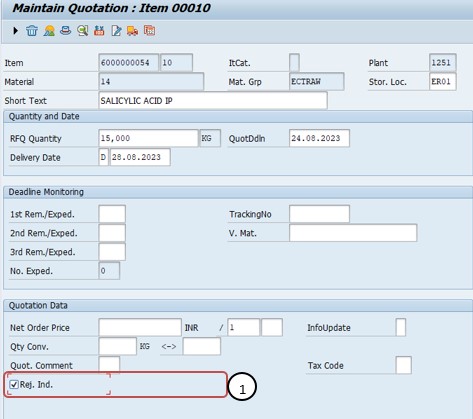
Next, locate Quotation No. 6000000054 and select the Item Details button.
Next, select Reject.
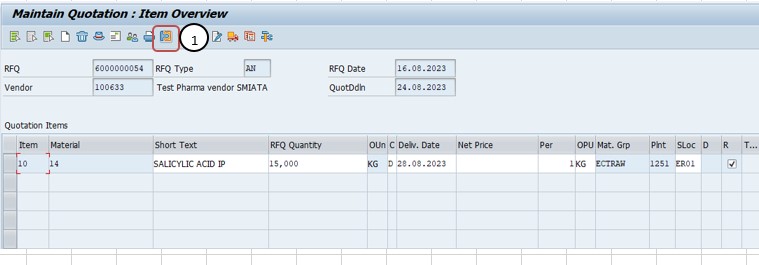
Next, select the Reject Indicator and Save.
📋 Choosing the Right Comparison Value Method
The three optional comparison value methods available in ME49 each suit a different procurement priority, and understanding when to reach for each one is what separates a mechanical price check from a genuinely informed purchasing decision.
| Method | Best Suited For | Trade-Off |
|---|---|---|
| Mean Value Quotation | Balanced, moderate-risk purchasing decisions across several comparable vendors. | May not identify the single cheapest option, but avoids overweighting an outlier quotation. |
| Minimum Value Quotation | Cost-driven purchasing where the lowest price is the deciding factor. | Doesn't inherently account for quality or delivery reliability differences between vendors. |
| Percentage Basis | Negotiated or contract-based pricing relative to an agreed reference price. | Requires a genuinely reliable reference price to be meaningful. |
None of these methods replace human judgment - they're analytical aids that surface the numbers clearly, leaving the actual select-or-reject decision to weigh price alongside quality, delivery, and supplier credibility, exactly as described in the selection criteria above.
💼 Real-World Scenario: Comparing Vendors for a Bulk Raw Material Order
Pooja Mishra, an SAP MM consultant at Learn Pharmaceuticals, supported the procurement team in evaluating three vendor quotations received against a Collective RFQ for a bulk raw material order. Purchasing manager Rajesh Sawwanted a clear, defensible comparison before committing to a supplier, since the order value was significant enough to warrant careful analysis.
Working with the purchasing team, Pooja accessed ME49, selecting purchase organization 1217 and entering the Collective RFQ number grouping all three vendor responses. He selected the Minimum Value Quotation comparison method, since cost savings were the primary driver for this particular order, and executed the comparison to see all three quotations laid out side by side.
After reviewing the comparison, the team identified the lowest-priced quotation but also flagged that one of the higher-priced vendors had a stronger track record on delivery reliability - a consideration that mattered given the raw material's role in a time-sensitive production schedule. Ultimately, the lowest-priced quotation was selected, and the remaining two, including quotation 6000000054, were marked with the Reject indicator and saved. The clear, documented comparison meant the decision could be explained and justified to finance stakeholders reviewing the purchase afterward, rather than resting on an informal, undocumented judgment call.
📋 Common Reasons Vendor Quotations Get Rejected
Beyond price alone, several recurring factors influence whether a quotation ultimately gets rejected during comparison. Recognizing these patterns helps procurement teams evaluate offers more consistently across different purchasing scenarios.
| Reason | Why It Matters |
|---|---|
| Price significantly above budget or competing offers | Even a strong vendor relationship rarely justifies a price far outside the expected or budgeted range. |
| Longer lead time than the business can accommodate | A cheaper quotation is often worthless if delivery timing doesn't meet a production or sales deadline. |
| Unfavorable payment or contract terms | Payment terms, minimum order quantities, or contract length can make an otherwise attractive price less viable. |
| Weak quality or compliance track record | A vendor's history of quality issues or missed compliance requirements can outweigh a favorable price. |
| Incomplete or unclear quotation details | A quotation missing key details makes fair comparison difficult and often gets deprioritized in favor of clearer offers. |
Weighing these factors alongside the price comparison methods covered earlier - rather than relying on price data alone - is what produces a genuinely sound purchasing decision rather than one that looks good only on a spreadsheet.
❗ Common Mistakes When Using ME49
- Selecting the wrong Collective RFQ number, comparing quotations that don't actually relate to the same requirement.
- Relying purely on a comparison value method like Minimum Value Quotation without also weighing quality, delivery, and supplier credibility.
- Selecting a winning quotation but forgetting to formally reject the others, leaving their status ambiguous in the system.
- Saving the reject indicator without genuinely reviewing the item details for each rejected quotation first.
- Treating rejection as a permanent judgment on a vendor relationship, rather than recognizing that rejected quotations can still lead to future business.
- Executing the comparison before all expected vendor quotations have actually been received, producing an incomplete picture.
✅ Best Practices for Vendor Price Comparison
- Confirm all expected vendor quotations have been received against the Collective RFQ before running the ME49 comparison.
- Choose the comparison value method - Mean, Minimum, or Percentage Basis - that genuinely fits the specific procurement priority for that purchase.
- Document the reasoning behind a selection decision, particularly when it doesn't go purely to the lowest-priced vendor, so the decision is defensible later.
- Formally select and reject every quotation reviewed, rather than leaving some in an ambiguous, undecided status.
- Maintain professional communication with rejected vendors, since today's rejected quotation may be tomorrow's winning bid on a different requirement.
- Keep purchase organization and Collective RFQ entries accurate, since a mismatch here undermines the entire comparison exercise.
📈 Where ME49 Fits in the Broader Procurement Cycle
Price comparison doesn't happen in isolation - it's one step in a longer procurement sequence that starts with identifying a purchasing need and ends with goods receipt and invoice verification. Understanding where ME49 sits in that sequence clarifies why the comparison step matters as much as it does.
| Stage | What Happens |
|---|---|
| Purchase Requisition | A business need for materials or services is identified and formally requested. |
| RFQ Creation and Sending | Requests for Quotation are sent to multiple potential vendors. |
| Quotation Receipt (ME47) | Vendors respond with their pricing and terms, maintained in the system against each RFQ. |
| Price Comparison (ME49) | Received quotations are compared, and a vendor is selected while others are rejected. |
| Purchase Order Creation | A purchase order is created referencing the selected quotation's terms. |
Because ME49 sits right before the purchase order is created, an error or a rushed decision at this stage carries directly into the actual commitment the business makes to a vendor - which is exactly why a careful, well-documented comparison here pays off throughout the rest of the procurement cycle.
📈 How Structured Price Comparison Supports Cost Optimization
Beyond the mechanics of the ME49 transaction itself, structured price comparison is one of the more direct levers a procurement organization has for genuine cost optimization. Without a formal comparison step, purchasing decisions tend to default toward whichever vendor relationship is most familiar or convenient, rather than the one that genuinely offers the best combination of price, quality, and reliability for a given requirement. Bringing every quotation into a single, side-by-side view - exactly what ME49 provides - makes it far harder for an uncompetitive offer to slip through unnoticed simply because it came from a known supplier.
This discipline compounds over time. A procurement function that consistently runs structured comparisons, documents its reasoning, and holds vendors accountable to competitive pricing tends to see measurably better outcomes across a full purchasing portfolio than one that treats each purchase as an isolated, informal negotiation. This is exactly why many organizations track ME49 usage and comparison documentation as part of their broader procurement governance and cost-control reporting.
✅ Validating the Comparison Before Proceeding
Before moving forward to create a purchase order based on a selected quotation, it's worth confirming the comparison was completed correctly. Re-display the RFQ comparison (ME49) and confirm the selected quotation shows the correct status, while rejected quotations correctly display the Reject indicator. Cross-check that the purchase organization and Collective RFQ number used match the intended procurement requirement. Confirm with the requesting department that the selected vendor and price align with what was originally budgeted or approved. Finally, if multiple stakeholders were involved in the decision, confirm the selection has been communicated and documented appropriately before the purchase order is raised.
Skipping this validation is one of the more common reasons a procurement decision needs to be revisited later - usually because a rejected quotation was never properly saved, or because the selected vendor's terms weren't fully reconciled against what was actually approved before the purchase order was created.
📱 This Configuration in SAP S/4HANA
Transaction ME49 and the underlying price comparison workflow work the same way in SAP S/4HANA as in classic ECC, since RFQ and quotation comparison remains a foundational MM purchasing process. What has evolved in S/4HANA is the availability of Fiori-based procurement apps that can present quotation comparisons in a more visual, dashboard-style format, alongside the classic ME49 transaction. Many organizations continue to rely on ME49 directly, particularly procurement teams already comfortable with the transaction-based workflow, while newer Fiori apps offer an alternative, more modern interface for the same underlying comparison logic.
📋 Related SAP Transactions
| Transaction | Purpose |
|---|---|
| ME49 | Compare vendor quotations received against a Collective RFQ. |
| ME41 | Create a Request for Quotation (RFQ). |
| ME47 | Maintain a vendor quotation received against an RFQ. |
| ME48 | Display a vendor quotation. |
| ME21N | Create a purchase order, typically referencing the selected quotation. |
| ME2M | Report on purchase orders and related purchasing documents by material. |
🎓 Interview-Style Questions and Answers
Q: What is the practical purpose of transaction ME49?
ME49 allows procurement professionals to compare vendor quotations received against a Collective RFQ side by side, supporting an informed decision about which vendor to select before a purchase order is created.
Q: What is the difference between Mean Value Quotation and Minimum Value Quotation?
Mean Value Quotation calculates the average price across received quotations for a balanced view, while Minimum Value Quotation focuses specifically on the lowest price received, useful when cost savings are the primary decision factor.
Q: What happens to a rejected quotation's status in the system?
A rejected quotation is marked with a Reject indicator once saved, formally recording that it was not selected, though this status doesn't prevent future business with that vendor on a different requirement.
Q: Does the ME49 comparison itself create a purchase order?
No. ME49 only supports the comparison and selection decision. Creating the actual purchase order referencing the selected quotation's terms is a separate, subsequent transaction.
📚 Quick Glossary of Terms Used in This Guide
- RFQ (Request for Quotation): A formal request sent to vendors asking for pricing and terms for a specific material or service.
- Collective RFQ Number: A unique identifier grouping related RFQs sent to multiple vendors for the same requirement.
- Mean Value Quotation: A comparison method calculating the average price across received quotations.
- Minimum Value Quotation: A comparison method identifying the lowest price received among quotations.
- Percentage Basis: A comparison method evaluating prices as a percentage discount or markup from a reference price.
- Reject Indicator: The system flag marking a quotation as not selected, saved as part of the ME49 process.
📝 Governance for Vendor Selection Decisions
Because price comparison decisions in ME49 often involve significant purchase values, most organizations maintain a governance process around who is authorized to make the final select-or-reject decision, particularly above certain spend thresholds. Documenting the comparison method used and the reasoning behind the final selection - especially when it doesn't go to the lowest-priced vendor - is standard practice for audit and procurement compliance purposes.
Governance also matters for vendor relationship management. Because a rejected quotation doesn't end a vendor relationship, most procurement teams maintain a consistent, professional communication process for informing unsuccessful vendors of the outcome, preserving the possibility of future business rather than treating rejection as a final, adversarial decision.
🎯 Conclusion
Transaction ME49 is a short but genuinely consequential step in the procurement cycle, bringing multiple vendor quotations together for a structured, comparable analysis before a purchasing commitment is made. Choosing the comparison method that fits the specific procurement priority, weighing price alongside quality, delivery, and supplier credibility, and formally recording both the selected and rejected quotations are what separate a defensible, well-documented purchasing decision from an informal one. Keep this guide handy the next time your procurement team needs to evaluate competing vendor quotations for a material or service.