SAP Error: "Scheduling Parameters Are Not Defined for Production Orders" – Causes and Step-by-Step Fix
A planner converts a planned order, or a shop floor clerk creates a production order in CO01, and SAP stops with a message about missing scheduling parameters. The material is fine, the routing is complete and the bill of material is in place, yet the order will not be created. The reason is not in the master data at all. It is a small configuration entry that tells SAP how to calculate dates for a given plant and order type. This guide explains what scheduling parameters are, why the system needs them, how to define them in transaction OPU3 step by step, and how to avoid the mistakes that cause the error to return. If you run into any errors while following along, feel free to send a screenshot to pramod@learntosap.com for help.
❌ The Error Message at a Glance
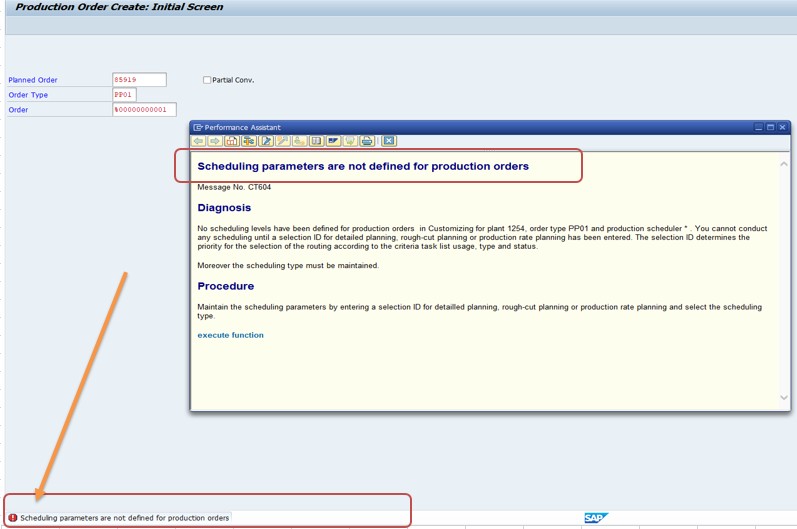
| Item | Value in This Example |
|---|---|
| Message text | Scheduling parameters are not defined for production orders |
| Module | SAP PP, shop floor control |
| Plant | 1254 |
| Order type | PP01, standard production order |
| Where to fix it | OPU3, Define Scheduling Parameters for Production Orders |
| Message type | Error: the order cannot be created until the entry exists |
The error means that SAP is missing scheduling settings for production orders for the plant or the order type in use. It appears when the system tries to calculate the dates of a new order and cannot find a matching configuration entry. The plant and order type in your own message may differ from this example, but the fix is the same.
📑 What You Will Learn in This Guide
- What the error means
- What scheduling parameters are
- Scheduling types explained
- Why the error appears
- Where you meet the error
- Diagnose the problem
- Solution: define parameters in OPU3
- Verify the fix
- Worked scheduling example
- Real-world scenario
- Master data that affects scheduling
- Common mistakes
- Troubleshooting
- How to prevent the error
- Frequently asked questions
✅ What Does "Scheduling Parameters Are Not Defined for Production Orders" Mean?
Whenever you create or change a production order, SAP calculates its dates. It needs to know when production should start, when it should finish and how long each operation takes. To do this it reads a configuration entry called the scheduling parameters, which is stored per plant, order type and production scheduler. If no matching entry exists, the system cannot decide how to schedule the order and stops with this message.
The key point is that the problem lies in Customizing and not in master data. You can have a perfect material, a correct routing and a complete bill of material, and the error will still appear. Changing the order, the material or the routing will not help, because the missing information is not there. The fix is to create the missing entry in the configuration, which is exactly what transaction OPU3 is for.
The error is common in new systems, new plants and new order types, where the master data has been loaded but nobody has yet configured how the orders should be scheduled. It also appears after a plant is copied, because the copy does not always include every production setting.
📝 What Are Scheduling Parameters in SAP PP?
Scheduling parameters are a set of rules that control how SAP schedules production orders. They are defined for each combination of plant, order type and production scheduler, and they answer questions such as: Should the system schedule forwards or backwards? Should it schedule automatically when an order is saved? How should it handle dates in the past?
| Key Field | Example | Meaning |
|---|---|---|
| Plant | 1254 | The plant for which the rule applies. |
| Order type | PP01 | The type of production order, here the standard production order. |
| Production scheduler | * | The person or group responsible for planning. The star means all schedulers. |
| Parameter | Example | Meaning |
|---|---|---|
| Scheduling type | Backward | The direction in which dates are calculated. |
| Automatic scheduling | Ticked | SAP schedules the order automatically when it is created or changed. |
A real system may show more fields, such as how to handle start dates in the past, how to adjust dates after scheduling and which reduction strategy to use. Those are refinements. The two settings in the table are the minimum needed to make the error disappear and to give SAP a clear direction.
💡 Scheduling Types Explained: Forward, Backward and Others
The scheduling type is the most important setting. It tells SAP where to start the calculation. The options below are the ones most often found in standard configuration.
| Scheduling Type | How It Works | When to Use It |
|---|---|---|
| Backward | Starts from the required finish date and calculates back to the start date. | When orders must be ready by a due date, such as a customer delivery. |
| Forward | Starts from the start date and calculates the earliest finish date. | When material is available now and you want to know when the order could be done. |
| Current date | Uses today as the starting point of the calculation. | For urgent orders or orders created late. |
| Only capacity requirements | Calculates the capacity requirements without changing the order dates. | When dates are fixed and only the load needs to be known. |
Backward scheduling is a sensible default for most make-to-stock and make-to-order scenarios, because planning usually begins with a demand date. That is why it is chosen in the example. Your company may prefer another type, and the right answer depends on how your planners work. Check the options available in your release in the dropdown of OPU3.
💡 Why Does This Error Appear? Common Causes
- No entry for the plant: the plant is new and nobody has defined scheduling parameters for it.
- No entry for the order type: the plant has entries for other order types, but not for the one you are using.
- The production scheduler does not match: an entry exists only for a specific scheduler, and the order uses another one, with no star entry as a fallback.
- A plant copy left out the entry: the plant was copied from another one, but this particular setting was not included.
- The change was not transported: the entry was created in development, but the transport has not reached the system where the error occurs.
- A new order type was created: the order type exists, but its scheduling parameters were never set up.
The error message often also prompts users to look at the material master, and the Work scheduling view of MM02 does contain a production scheduling profile. That profile is a different setting. It is worth checking, and the section on master data below explains how. But in the classic case described here, the missing piece is the plant and order type entry in OPU3.
📋 Where You Meet This Error in Daily Work
| Activity | Typical Transaction |
|---|---|
| Creating a production order with material | CO01 |
| Creating a production order without material | CO07 |
| Creating an order for a sales order | CO08 |
| Converting a planned order to a production order | MD04, CO40, CO41 |
| Rescheduling an existing order | CO02 |
The error appears at the moment the system tries to determine dates, which is why it often shows up during conversion of planned orders. In a collective conversion, one missing entry can block many orders at once, so a quick fix saves a lot of time.
🔧 Step-by-Step: Diagnose the Problem
Read the message and note the context. Which transaction were you in, which plant, and which order type? In CO01 the plant and order type are on the initial screen.
Find the production scheduler. It comes from the material master, in the MRP 1 view, and is copied into the order. Note it down, since the entry you need depends on it.
Open OPU3 in display mode and look for an entry with your plant and order type. If none exists, you have found the cause. If one exists for a different scheduler only, you need a star entry or one for your scheduler.
Compare with a working plant. If another plant creates orders without problems, open its OPU3 entry and copy its logic, after checking that it makes sense for your plant.
🔧 Solution: Define Scheduling Parameters in OPU3
Follow these steps to create the missing entry.
Run transaction OPU3 (Define Scheduling Parameters for Production Orders). It is also available in the IMG under Production, Shop Floor Control, Operations, Scheduling.
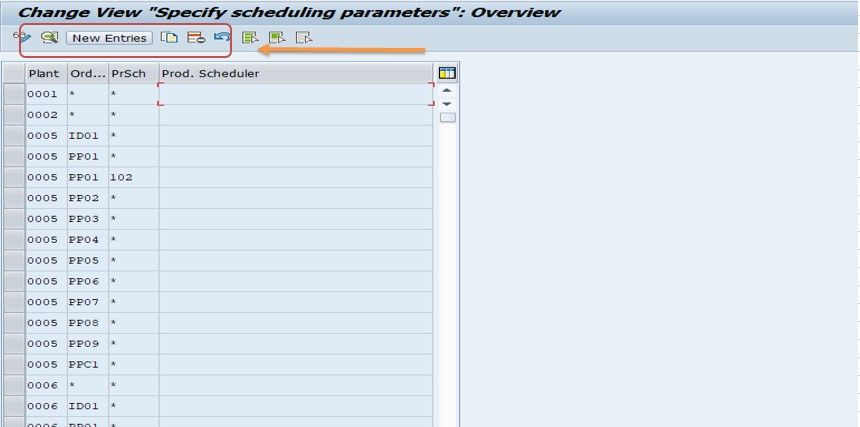
Choose the New Entries button to maintain a new line.
Enter the key fields. Select Plant 1254, Order Type PP01 (standard production order) and Production Supervisor *. The star means the entry applies to every production scheduler in that plant and order type.
Maintain the scheduling parameters. Set the Scheduling Type to Backward and tick the Automatic Scheduling checkbox.
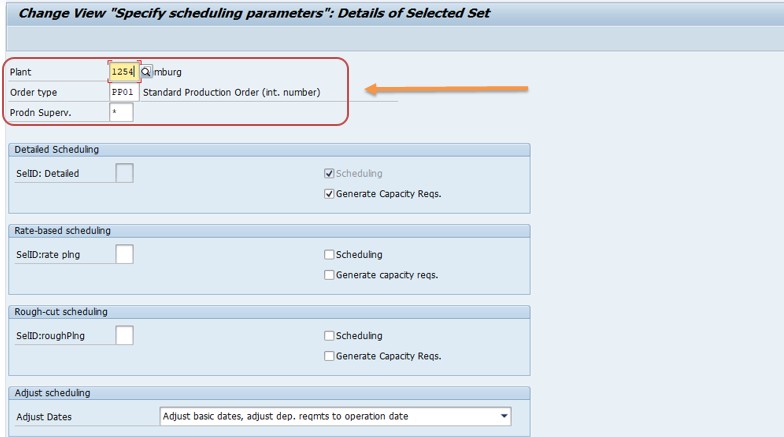
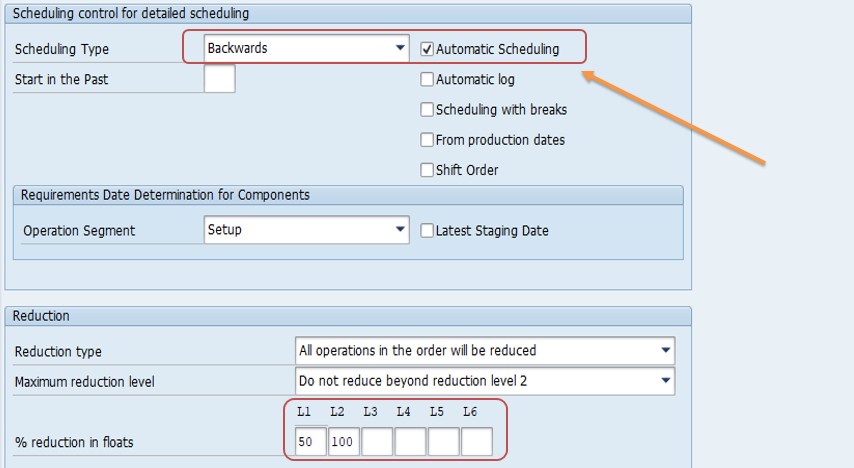
Save your entry. If SAP asks for a Customizing request, enter an existing request or create a new one with a clear description, for example "Scheduling parameters plant 1254 order type PP01".
✅ How to Verify That the Fix Worked
- Open a new session so that nothing from the failed attempt remains.
- Run CO01 and create a production order for a material in plant 1254 with order type PP01.
- Save the order. The error should no longer appear.
- Display the order with CO03 and check the basic start and finish dates.
- Open the scheduling view and confirm that the order was scheduled backward from the finish date.
- Repeat the conversion of a planned order if that was the original failing step.
If the test works in the quality system, transport the change to production. Include in the description which plant and order type are affected, so that the support team knows the reason later.
📅 Worked Example: What Backward Scheduling Does
A concrete example shows why the scheduling type matters. Assume plant 1254 works Monday to Friday and a production order for 100 pieces has a total lead time of five working days. The customer needs the goods finished on Friday 20 November 2026.
| Item | Backward | Forward |
|---|---|---|
| Starting point | Finish date, Friday 20 November | Start date, for example Monday 16 November |
| Calculated | Start date: Monday 16 November | Finish date: Friday 20 November |
| Question answered | When must we start to be ready on time? | When will we be ready if we start now? |
In the backward case SAP counts five working days back from the finish date, using the factory calendar of the plant, and arrives at Monday 16 November. If a public holiday fell in that week, the calculation would skip it and the start date would move earlier. In the forward case, SAP starts from the chosen start date and counts forward.
If the scheduling parameters were missing, SAP could do neither. With the entry in place, the dates are filled in automatically when the order is saved, as long as automatic scheduling is ticked. That is exactly the behavior planners expect.
💼 Real-World Scenario: A New Plant Goes Live with No Orders
This is an illustrative example based on a typical project. A manufacturer in Pune opened a new plant, 1254, and copied most settings from an existing plant. Master data was loaded over a weekend: materials, bills of material and routings. On Monday morning the first planner tried to create a production order with CO01 and received the message that scheduling parameters were not defined.
The SAP PP consultant opened OPU3 and found entries for the old plant, but none for 1254. She checked how the old plant was set up, discussed with the head of planning whether orders there were scheduled backward from the customer date, and created a new entry for plant 1254, order type PP01, with a star for the production scheduler, backward scheduling and automatic scheduling. She tested a sample order in the quality system, moved the transport to production and told the planner to try again.
The order was created within minutes. Afterwards the team added "scheduling parameters per plant and order type" to their go-live checklist for new plants, together with number ranges and the production scheduling profile. The same oversight never caused a delay again.
🔄 Master Data That Also Affects Scheduling
While OPU3 is the key to this error, several other settings influence how SAP schedules an order. Knowing them helps you tell a configuration problem from a data problem.
| Setting | Where It Is Maintained | Effect on Scheduling |
|---|---|---|
| Production scheduler | Material master, MRP 1 view | Selects the matching line in OPU3. |
| Production scheduling profile | Material master, Work scheduling view (defined in OPKP) | Proposes defaults such as underdelivery and overdelivery tolerances and the order type. |
| In-house production time | Material master, MRP 2 view | Used for lead time when no routing times are available. |
| Scheduling margin key | Material master, MRP 2 view | Adds float before and after production. |
| Operation times and formulas | Routing and work center | Determine the duration of each operation. |
| Factory calendar | Plant settings | Defines the working days used in the calculation. |
Think of OPU3 as the rule book, and the other settings as the data the rules work with. If the rule book is empty, nothing works. If the data is wrong, SAP schedules, but the dates are not realistic. Both need attention.
🔄 Where Should You Make the Change?
| Situation | Recommended Action |
|---|---|
| Sandbox or training system | Make the change directly and test it. |
| Project landscape with DEV, QA and PROD | Change in DEV, test in QA, then import the transport to PROD. |
| OPU3 is display-only in production | Do not look for a workaround. Raise a change request. |
| Production is blocked right now | Follow your emergency change process and document the reason. |
If the error persists in production after the fix works in quality, check that the transport has been released and imported into the right client. Also compare the plant and order type values between the systems, in case a different order type is used in production.
❗ Common Mistakes When Fixing This Error
- Changing the material or the routing, when the missing piece is configuration.
- Creating the entry for the wrong plant or the wrong order type.
- Forgetting that the production scheduler must match, or that a star entry is needed.
- Choosing a scheduling type without asking planners how they work.
- Leaving automatic scheduling off, and then wondering why dates stay empty.
- Making the change directly in production, so that it is lost at the next import.
- Not testing a complete order after the change, only checking that the entry was saved.
- Not documenting the change, so that nobody knows why the rule was set that way.
🔧 Troubleshooting: When the Fix Does Not Work
The error still appears after saving in OPU3
Check that the plant and order type in the entry are exactly those of the failing order. Then start a new session, since an open session may use old buffers.
It works for some planners but not for others
This points to the production scheduler. Compare the schedulers of the failing materials and make sure a star entry or a matching entry exists.
Works in quality but not in production
The transport may not be imported, or may be waiting in a queue. Compare the OPU3 entries in both systems.
The order is created but the dates are empty
Automatic scheduling may be off, or the routing may have no usable times. Check the entry in OPU3 and the operation data in the routing.
The dates look unrealistic
Review the factory calendar, the work center capacity and formulas, the scheduling margin key and the queue times. The parameters decide direction, not duration.
A different error appears after the fix
This is normal. The first error was hiding the next requirement, such as a missing routing, a closed period or a missing number range. Solve them one by one.
✅ How to Prevent This Error in the Future
- Add scheduling parameters to the checklist for every new plant and every new order type.
- Create a star entry for each plant and order type as a safe fallback.
- Keep a short document listing the scheduling rules per plant.
- Test order creation in the quality system before each go-live.
- Compare Customizing between plants after a copy, and fill the gaps.
- Give transports clear descriptions so that changes can be traced.
- Train key users to report the plant, the order type and the scheduler, not only a screenshot.
- Review scheduling rules once a year with the planning team.
💡 Best Practices for Scheduling Parameters
Once the error is fixed, a little discipline keeps the configuration clean. These habits come from projects where scheduling rules grew over many years and nobody remembered why each entry existed.
Start simple and refine later
Begin with one star entry per plant and order type, with a clear scheduling type and automatic scheduling. Add entries for individual production schedulers only when a real business need appears. A short list of rules is easier to explain, test and audit than a long list of exceptions.
Align the rules with the planning process
Scheduling parameters should reflect how the planners actually work. If the company plans from customer due dates, backward scheduling fits. If production runs continuously and the question is when material will be ready, forward scheduling may fit better. Sit with planners for an hour before you decide. That hour avoids months of manual date corrections.
Treat dates as a chain
The dates of an order depend on the scheduling parameters, the routing times, the work center capacity, the margin key and the factory calendar. A problem in any link gives unrealistic dates, even when the parameters are correct. When planners complain about dates, check the whole chain and not only OPU3.
Document every change
Record the plant, order type, scheduler, scheduling type, the reason and the person who agreed. This small note answers most questions that arise a year later.
🔒 Authorization Considerations
OPU3 is Customizing, so it is normally limited to consultants and a few key users, with transport rights controlled by the basis team. If you cannot change it, do not look for a way around the restriction. Send the support team the message, the plant, the order type, the scheduler and your proposed fix: "define scheduling parameters in OPU3 for plant 1254 and order type PP01 with backward scheduling and automatic scheduling". A precise request is processed faster than a screenshot alone.
📱 This Error in SAP S/4HANA
Production orders and their scheduling still exist in SAP S/4HANA, and the idea of scheduling parameters per plant and order type remains. In on-premise releases you will find the same Customizing path and a similar OPU3 screen. In cloud editions, configuration is usually done through guided activities, and production orders may be handled through Fiori apps. Names and options change with each release, so confirm the activity in your own system. The logic does not change: if SAP says that scheduling parameters are missing, create them for the plant and order type.
📋 Quick Fix Checklist
- Note the plant, order type and transaction where the error appeared.
- Find the production scheduler in the material master.
- Open OPU3 and look for a matching entry.
- Choose New Entries and enter plant, order type and scheduler or star.
- Set the scheduling type, for example Backward.
- Tick Automatic scheduling.
- Save with a transport request and a clear description.
- Test with CO01 and check the dates in CO03.
- Transport the change and record what was done and why.
📋 Related SAP Transactions
| Transaction | Purpose |
|---|---|
| OPU3 | Define scheduling parameters for production orders. |
| OPKP | Define production scheduling profiles. |
| CO01 / CO02 / CO03 | Create, change or display a production order. |
| CO07 / CO08 | Create a production order without material or for a sales order. |
| MM02 | Maintain the material master, including MRP and work scheduling views. |
| CA02 | Change a routing. |
🎓 Interview-Style Questions and Answers
Q: What are scheduling parameters?
Configuration entries that define how SAP schedules production orders for a plant, order type and production scheduler.
Q: Which transaction defines them?
OPU3.
Q: What is the difference between backward and forward scheduling?
Backward starts from the finish date and calculates the start. Forward starts from the start date and calculates the finish.
Q: What does the star in the production scheduler field mean?
It is a wildcard that applies to all schedulers.
Q: Is this error a master data problem?
No, it is a configuration problem. Master data may still affect the dates, but it does not cause this message.
Q: What is the production scheduling profile?
A profile from the material master Work scheduling view that proposes order defaults. It is defined in OPKP and is different from the scheduling parameters.
📚 Quick Glossary
- Scheduling parameters: Rules for how SAP calculates the dates of production orders.
- Order type: A classification of production orders, such as PP01.
- Production scheduler: The person or group responsible for planning production.
- Backward scheduling: Calculating the start date from the finish date.
- Forward scheduling: Calculating the finish date from the start date.
- Automatic scheduling: Scheduling that SAP performs when the order is saved.
- Factory calendar: The calendar of working days used for date calculation.
- Lead time: The time needed to produce the order from start to finish.
🎯 Conclusion
"Scheduling parameters are not defined for production orders" is a configuration gap, not a master data fault. Find the plant, order type and production scheduler of the failing order, open OPU3, create a new entry with the right key, choose the scheduling type, for example Backward, tick Automatic scheduling and save with a transport. Then test with a real order and check the dates. Add this setting to your checklist for every new plant and order type, and the error will not trouble you again. If something still blocks you, send the details to pramod@learntosap.com and we will help you find the next step.