How to Assign Distribution Channel to Sales Organization in SAP (T-Code OVXK)
In SAP's Sales and Distribution (SD) module, assigning distribution channels to sales organizations is a fundamental configuration step that optimizes sales operations. This assignment ensures that products and services are channeled to the right market segments, contributing to improved efficiency and customer satisfaction. This guide walks through transaction OVXK, explains what the assignment actually enables once it's live, and covers the sales area build needed afterward before the channel can genuinely be used on a sales document. If you run into any errors while following along, feel free to send a screenshot to pramod@learntosap.com for help.
✅ Why Assign a Distribution Channel to a Sales Organization in SAP SD?
In SAP's Sales and Distribution (SD) module, assigning distribution channels to sales organizations is a fundamental configuration step that optimizes sales operations. This assignment ensures that products and services are channeled to the right market segments, contributing to improved efficiency and customer satisfaction.
A sales organization on its own is simply the legal entity responsible for selling goods; it says nothing yet about how those goods actually reach the customer. Distribution channel is what supplies that missing piece - it represents a route to market, such as wholesale, retail, direct sales, or online, and assigning it to a sales organization is what confirms "yes, this sales organization genuinely sells through this channel." Without this step, a distribution channel that exists perfectly well in the system remains unusable for any sales organization it hasn't been explicitly linked to.
This assignment also underpins pricing, availability checks, and reporting that differ by route to market. A wholesale channel and a direct-to-consumer channel for the very same sales organization often carry different pricing conditions, different delivery expectations, and different customer bases - and OVXK is the first configuration step that makes it possible for SAP to treat those channels as genuinely distinct once they're built into a complete sales area.
📋 Where This Assignment Fits in the SD Organizational Structure
This assignment sits between two organizational elements that are each defined independently - sales organization and distribution channel - and it is the bridge that makes them usable together. Seeing how it relates to the layers above and below makes the sales area build later in this guide much easier to follow.
| Organizational Unit | Role | Typical Transaction |
|---|---|---|
| Sales Organization | The top-level SD unit responsible for selling and distributing goods. | OVX5 |
| Distribution Channel | Describes how goods reach the customer - wholesale, retail, direct sales, or online. | OVXI |
| Sales Org → Distribution Channel | Confirms the channel is valid for the sales organization; created here. | OVXK |
| Division | Groups materials or products by product line or business unit. | OVXB |
| Sales Area | The combination of sales organization, distribution channel, and division actually used on sales documents. | OVXG |
Because sales area is what customer master records and sales documents actually reference, assigning distribution channel to sales organization in OVXK is only one of the required links, not the complete picture. It has to exist before the channel can be combined with a division into a genuinely usable sales area.
🔧 Assign Distribution Channel in SAP Using OVXK – Full Guide
This assignment is a short transaction: both the sales organization and the distribution channel already exist as separate configuration entries, and OVXK simply confirms the pairing is valid.
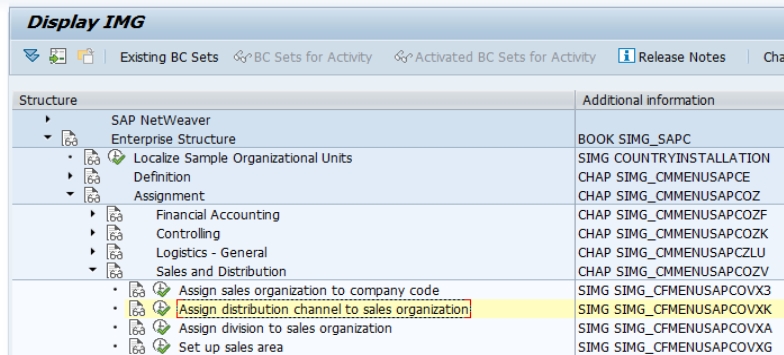
Run transaction OVXK directly, or follow the IMG path: SPRO → Enterprise Structure → Assignment → Sales and Distribution → Assign Distribution Channel to Sales Organization.
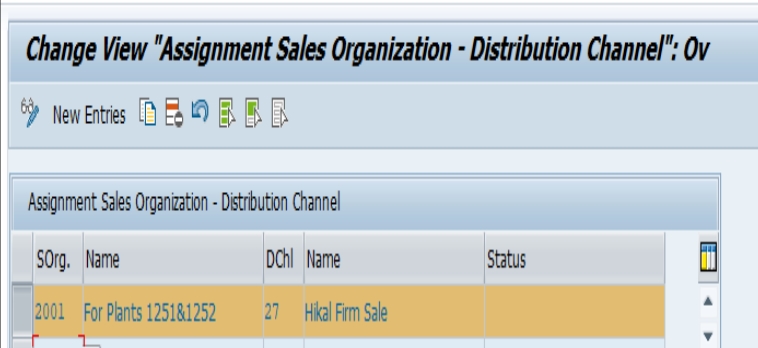
Select Sales Organization 2001 and enter Distribution Channel 27 in the row, linking the two together.
Select Save. The system will usually prompt for a transport request if the system is configured to require one, which is standard practice for enterprise structure changes so they can be tracked and migrated through the landscape (Development → Quality → Production) in a controlled way.
📋 What to Configure Next After OVXK
Confirming the sales organization to distribution channel link is an early step, not the final one. Before sales documents can actually reference the combination, further steps are required:
- Assign a division to the same sales organization using transaction OVXA, since a sales area needs all three elements - sales organization, distribution channel, and division - individually linked.
- Build the sales area using transaction OVXG, combining the sales organization, the newly assigned distribution channel, and the relevant division. The resulting sales area is what actually gets assigned to customer master records and referenced on sales orders, deliveries, and billing documents.
- Maintain distribution-channel-specific master data where relevant, such as customer-material info records or channel-specific pricing conditions, so the channel behaves distinctly once it's live.
- Extend customers to the new sales area where needed, confirming customer master records are maintained for the sales organization, distribution channel, and division combination the business intends to sell through.
Only after these steps are complete can end users select sales documents against the new sales organization and distribution channel combination. A channel that has been assigned in OVXK but not yet built into a sales area typically will not appear as a valid combination at all, rather than producing a clear error message pointing back to the missing configuration.
💼 Real-World Scenario: Opening a New Route to Market
Pooja Mishra, an SAP SD consultant at Learn Pharma in Pune, was asked to enable a newly created distribution channel for the company's existing sales organization, 2001, so the business could start selling directly to certain large accounts without routing every order through its existing wholesale channel. Sales manager Akshay Kumar confirmed the new distribution channel, 27, had already been created and represented this new direct-sales route to market.
Working with functional consultant Priya Patil, Pooja used OVXK to explicitly assign distribution channel 27 to sales organization 2001, confirming to the system that this sales organization genuinely sells through the new channel. Business analyst Anita Shah asked whether this step alone was enough for order-entry users to start creating direct-sales orders, and Pooja explained that the sales area still needed to be built in OVXG, combining sales organization 2001, distribution channel 27, and the existing division, before the combination would be usable on a live sales order.
After completing the OVXK assignment and the OVXG sales area build in a sandbox client, Pooja's team confirmed channel-specific pricing conditions were already set up for the direct-sales route, then extended the relevant large accounts to the new sales area. Once live, Suresh's team could see direct-sales performance reported as its own distinct channel, separate from the existing wholesale numbers - confirming that the OVXK entry, while quick to configure, was genuinely just the first of several required links in a multi-step rollout.
❗ Common Mistakes When Assigning Distribution Channel to Sales Organization
- Assuming that creating a distribution channel independently automatically makes it usable for every sales organization, when it must be explicitly assigned to each sales organization separately in OVXK.
- Skipping the OVXK assignment and going straight to the sales area build in OVXG, which then fails with an error that the distribution channel isn't valid for the chosen sales organization.
- Assigning a distribution channel to a sales organization that has no genuine business need to sell through that channel, which clutters reporting with combinations that are never actually used.
- Forgetting that division also needs to be assigned to the sales organization separately, treating the distribution channel assignment as if it alone completes the sales area prerequisites.
- Not maintaining channel-specific pricing or master data after the assignment, which leaves the new channel technically usable but commercially inconsistent with how the business intended it to operate.
- Making this assignment directly in a production client instead of testing the downstream sales area build in a sandbox or development client first.
✅ Best Practices for This Assignment
- Confirm the business genuinely needs the distribution channel available under this sales organization before assigning it, rather than assigning channels broadly just in case.
- Complete the OVXK assignment and the division assignment together, since a sales area build in OVXG needs both before it will succeed.
- Document every sales organization to distribution channel assignment in a configuration workbook so the mapping is auditable during testing and go-live.
- Test the full sales area build and a sample sales order in a sandbox or development client immediately after completing the OVXK entry, rather than assuming it works.
- Coordinate with the pricing and master data teams so channel-specific conditions are ready by the time the sales area goes live.
- Move enterprise structure changes like this through a transport request and test them in the Quality system before they reach Production, the same as any other configuration change.
📈 How This Assignment Powers Market Segmentation and Reporting
Once a distribution channel is assigned to a sales organization and folded into a complete sales area, it becomes one of the most commonly used slicing fields in SD sales reporting, precisely because it maps directly onto how a business already talks about its own routes to market - wholesale versus retail versus direct - rather than a purely technical grouping that only makes sense to configuration teams. Standard SD reports, along with most custom or embedded analytics reports built on top of sales order and billing data, allow filtering and grouping by distribution channel without any additional development, which is one of the strongest arguments for completing this assignment properly rather than routing every sale through a single generic channel regardless of how it actually reached the customer.
This reporting value only holds up if the correct distribution channel is selected consistently on every order created through that route to market. A rollout where some users select the correct channel and others default to whichever channel is listed first produces reporting that looks unreliable during the transition period, with figures for both channels appearing to shift for reasons that have nothing to do with actual sales performance. Training order-entry users on which channel to select, alongside the configuration itself, avoids this entirely and gives stakeholders clean, trustworthy numbers from the very first reporting cycle after go-live.
✅ Validating the Assignment Before Go-Live
Once OVXK is complete and the sales area has been built in OVXG, it's worth running through a short validation checklist before considering the setup ready for end users. Confirm a representative customer has been extended to the new sales area and displays correctly in the customer master. Create a test sales order using that customer and confirm the document processes correctly end-to-end, including pricing that reflects the channel's specific conditions if configured. Run a basic sales report filtered by the distribution channel to confirm it appears as its own distinct segment under the correct sales organization. Finally, confirm no unrelated sales organizations were accidentally given access to the channel, since an overly broad OVXK assignment can quietly let the wrong sales organization sell through a route to market it was never meant to use.
Skipping this validation step is one of the more common reasons a newly configured distribution channel generates confusion in its first reporting cycle - usually a sales area that was never completed, or pricing conditions that were never set up for the new channel - both of which are far faster to catch in a short test than to explain away after the fact in front of stakeholders expecting clean, separated numbers.
📱 This Configuration in SAP S/4HANA
Transaction OVXK and the underlying concept of assigning a distribution channel to a sales organization work the same way in SAP S/4HANA as in classic ECC, since this assignment remains a foundational, cross-application organizational element unaffected by the Universal Journal or the simplified data model. The downstream sales area build in OVXG and channel-specific pricing and master data are also unchanged. What differs in S/4HANA is mainly on the analytics side: embedded analytics and Fiori reporting apps make it considerably easier to slice sales performance by distribution channel in near real time, which raises the practical importance of getting this assignment right from the start, since a poorly planned channel rollout becomes more visible, more quickly, once it feeds directly into live dashboards.
📋 Related SAP Transactions
| Transaction | Purpose |
|---|---|
| OVXK | Assign distribution channel to sales organization. |
| OVXI | Define, copy, delete, and check distribution channels. |
| OVX5 | Define, copy, delete, and check sales organizations. |
| OVXA | Assign division to sales organization. |
| OVXG | Set up a sales area by combining sales organization, distribution channel, and division. |
| VK11 / VK12 | Create or change pricing condition records, often maintained by distribution channel. |
🎓 Interview-Style Questions and Answers
Q: Why is this assignment needed if distribution channel and sales organization are both already defined independently?
Because defining a distribution channel or a sales organization on its own doesn't tell SAP which channels a particular sales organization is actually allowed to sell through - OVXK is the explicit link that confirms that pairing before it can be used in a sales area.
Q: What error typically results from skipping the OVXK assignment?
Attempting to build a sales area in OVXG with a distribution channel that hasn't been assigned to the chosen sales organization in OVXK will fail, since the sales area build requires the channel to already be a valid combination for that sales organization.
Q: Can the same distribution channel be assigned to more than one sales organization?
Yes. A distribution channel such as wholesale or online sales can be assigned to multiple sales organizations, which is common when several selling entities all use the same route to market.
Q: Is assigning a distribution channel to a sales organization the same as building a sales area?
No. OVXK only confirms the channel is valid for the sales organization. The sales area itself - the combination actually used on sales documents - still needs to be built separately in OVXG, combining sales organization, distribution channel, and division together.
📚 Quick Glossary of Terms Used in This Guide
- Sales Organization: The top-level SD organizational unit responsible for selling and distributing goods.
- Distribution Channel: An organizational element describing how goods reach the customer - for example wholesale, retail, direct sales, or online.
- Sales Area: The combination of sales organization, distribution channel, and division actually referenced on sales documents.
- Division: Groups materials or products by product line or business unit, one of the three elements that make up a sales area.
- Market Segmentation: The business practice of serving different customer groups through different distribution channels, supported by this assignment.
- Transport Request: The mechanism used to move enterprise structure changes like this assignment through Development, Quality, and Production systems in a controlled way.
📝 Governance for Distribution Channel to Sales Organization Assignments
Because a single distribution channel can be shared across multiple sales organizations, it's worth deciding early who owns the decision to extend a channel's reach into a new sales organization. Most SD teams treat this as a business-driven decision rather than a purely technical one - confirming that the sales organization genuinely intends to sell through that route to market before making the assignment, rather than assigning channels broadly on the assumption they might be useful later.
Governance matters here for similar reasons it does for the distribution channel definition itself. An enterprise structure where channels are assigned to sales organizations inconsistently, without clear documentation of why each pairing exists, becomes genuinely difficult to audit later - especially when a business wants to understand exactly which routes to market a given sales organization is authorized to use. Keeping a simple, current mapping of sales organization to distribution channel assignments alongside the sales area configuration workbook is a small effort that pays off significantly during later audits or reorganizations.
🎯 Conclusion
Assigning a distribution channel to a sales organization in OVXK is a short transaction on the surface, but it is the required bridge between two organizational elements that are each defined independently - without it, a perfectly well-configured distribution channel simply cannot be used by a sales organization that needs to sell through it. Confirming the business genuinely needs the pairing, completing the division assignment alongside it, and following through with the sales area build in OVXG are what turn this quick configuration step into a working, reportable route-to-market setup. Keep this guide handy the next time your project needs to open a new sales channel for an existing sales organization, or extend an established distribution channel into a newly created one.