VK11 in SAP: How to Create Condition Records for Pricing (Step-by-Step Guide)
Every price on a sales order comes from a condition record. When the record is missing, the order stops with a pricing error, and nobody can quote or sell the material. This guide shows how to create the record with VK11: how to choose the condition type and the key combination, how to enter material, batch, amount and validity dates, how to save and check the result, and how the price is then found in a sales document. It also explains scales, validity, bulk loading and the errors you are most likely to meet. If you run into any errors while following along, feel free to send a screenshot to pramod@learntosap.com for help.
📑 What You Will Learn in This Guide
✅ What Is a Condition Record in SAP SD?
Create condition record VK11 – condition records in SAP SD: enter the detailed information for the condition record, including customer, material, and other relevant data. Depending on the condition type, this may involve specifying the pricing scale, percentage, or fixed amount. This step defines the precise conditions under which the pricing will be applied.
In plain words, a condition record is one stored price rule. It says: for this material, in this batch, between these dates, the price is this amount. Every price, discount, surcharge, freight value and tax rate that appears in a sales document comes from a condition record like this. Without records, SAP has the structure for pricing but no numbers to put into it, and the sales order stops with a pricing error.
You create condition records with transaction VK11, change them with VK12 and display them with VK13. The records are normally maintained by the pricing team or by SD consultants, and they are the data that a pricing procedure, such as the one described in Pricing Procedure VOK0, reads each time a quotation or order is priced.
📋 The Condition Technique in One Table
A condition record does not work alone. It is the last link of a chain called the condition technique. Knowing the chain makes it much easier to understand what you enter in VK11 and why a price may not appear.
| Element | What It Is | Example in This Guide |
|---|---|---|
| Pricing procedure | The ordered list of condition types that SAP works through for a document. | The procedure determined for the sales area and document type. |
| Condition type | The code for one kind of price element, such as a price, discount or surcharge. | EPR0, the Energy Unit Price |
| Access sequence | The search strategy: which condition tables SAP reads, and in what order, to find a record. | The sequence assigned to EPR0 |
| Condition table | The set of key fields that identify a record. Its fields become the key combination. | Material and batch |
| Condition record | The stored value for one key, with a validity period. | Material 200072, batch SAL03, amount 101 |
When you price a sales document, SAP takes each condition type from the pricing procedure, uses the access sequence to read the condition tables one after the other, and takes the first valid record it finds. VK11 is the transaction in which you create that last element.
📝 Condition Record Transactions at a Glance (VK11, VK12, VK13)
| Tcode | Purpose | Typical User |
|---|---|---|
| VK11 | Create a condition record, for example a price or a discount. | Pricing analyst, SD consultant |
| VK12 | Change a condition record: amount, validity or scale. | Pricing analyst |
| VK13 | Display a condition record, including its change documents. | Sales manager, auditor |
| VA01 | Create a sales order, which reads the record during pricing. | Sales representative |
| VA21 | Create a quotation, which also reads the record during pricing. | Sales representative |
The menu path to the create transaction is Logistics → Sales and Distribution → Master Data → Conditions → Select Using Condition Type → Create. Change and Display sit in the same folder. Because prices are commercially sensitive, most companies give many users display rights and keep create and change for a small group.
✅ VK11 – Create Condition Records in SAP SD | Complete Tutorial
Follow these steps to create the condition record. The values below match the screenshots.
Go to tcode VK11. You can also use the menu path shown above.
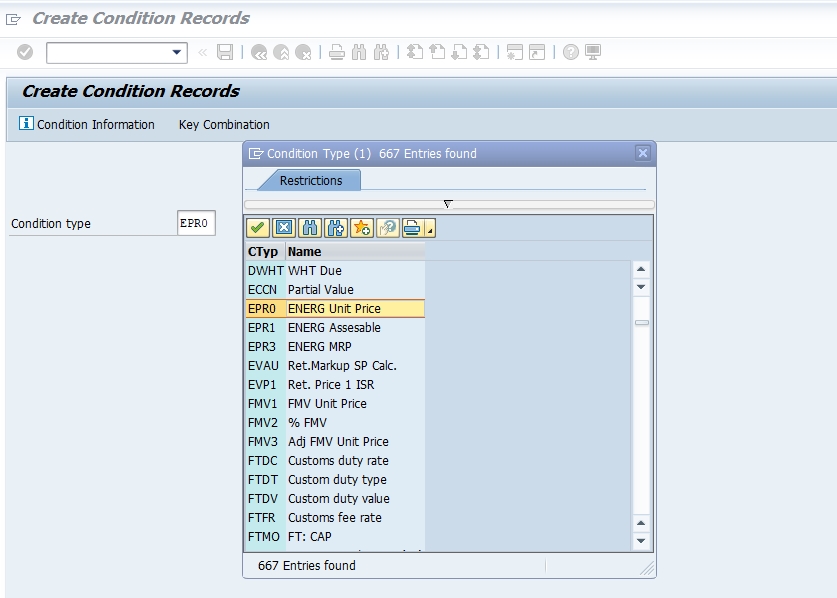
Follow steps. Select the condition type: EPR0 – Energy Unit Price. Press Enter, and SAP offers the possible key combinations for this condition type.
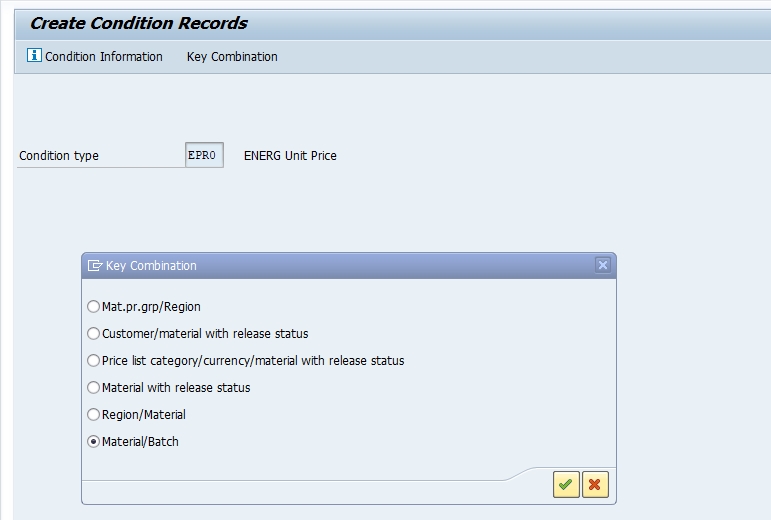
Select the key combination: Material/Batch. The key combination decides which fields identify the record.
*) Select the material number: 200072. This is the material for which the price is valid.
*) Select the batch: SAL03. The price applies to this batch of the material.
*) Select the amount: 101. This is the price in the condition currency, per the unit shown on the screen.
*) Select the validity: valid from 23.09.2023 to 31.12.9999. The end date 31.12.9999 means that the record has no practical end.
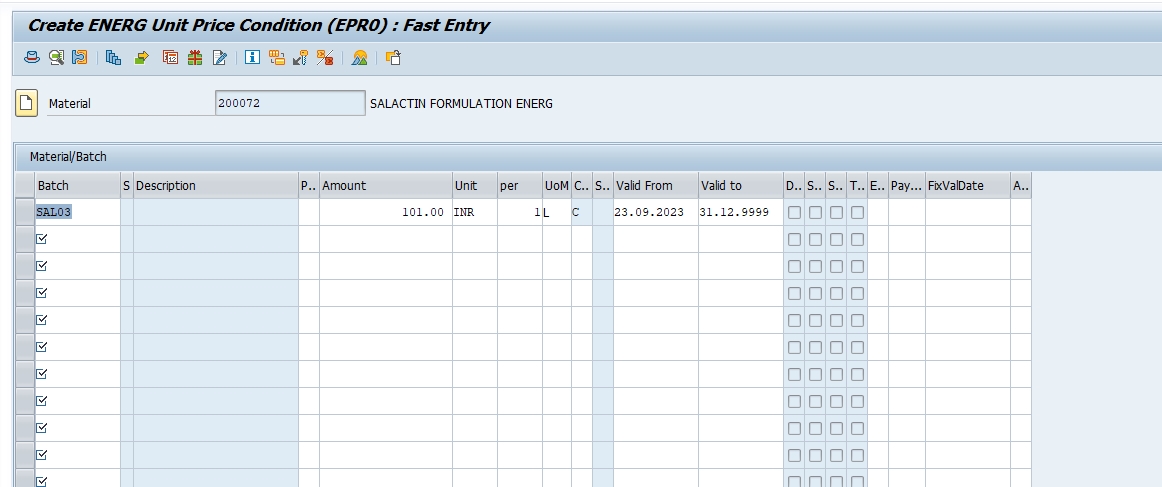
Save. SAP confirms that the condition record was saved. Display it with VK13 to check it.
📋 Values Used in This Tutorial at a Glance
| Field | Value in the Example | Note |
|---|---|---|
| Transaction | VK11 | Create the condition record. |
| Condition type | EPR0 – Energy Unit Price | Written with the digit zero, as in the related error guide. |
| Key combination | Material/Batch | Which fields identify the record. |
| Material | 200072 | Replace with your own material. |
| Batch | SAL03 | Replace with your own batch. |
| Amount | 101 | In the condition currency. |
| Valid from | 23.09.2023 | Use the date the price should start. |
| Valid to | 31.12.9999 | No practical end date. |
The numbers come from the original screenshots. The condition type was written EPRO with the letter O in the earlier version of this tutorial. It is spelled with the digit zero here, to match the error message in the related guide, so confirm the exact code in your own system.
💡 Understanding the Condition Type EPR0
The condition type is the first thing you enter, and it controls most of what follows. It tells SAP what kind of value you are maintaining, whether it is a price, a discount or a surcharge, whether it is an amount or a percentage, which access sequence to use and whether scales are allowed. EPR0 is the energy unit price used in the original example, so it holds an amount per unit, not a percentage.
The same screen would look different for another condition type. Common standard examples help to see the range:
| Condition Type | Typical Meaning | Usually Entered As |
|---|---|---|
| PR00 | Base price | Amount per unit |
| K004 | Material discount | Percentage or amount |
| K005 | Customer/material discount | Percentage or amount |
| K007 | Customer discount | Percentage |
| EPR0 | Energy Unit Price (this guide) | Amount per unit |
Your system may use different codes, because many companies define their own condition types. If SAP says that the condition type does not exist or cannot be maintained, ask your SD configuration team which type to use. If a document stops with the message that a mandatory condition is missing, the matching record is often exactly what this guide creates: see Pricing error: Mandatory condition EPR0 is missing.
🔑 Understanding the Key Combination
The key combination decides how specific a price is. In the example it is material and batch, which is very specific: the price applies only to material 200072 when it is in batch SAL03. A broader key, such as the material alone, would apply to every batch of that material.
| Key Combination | Meaning | When It Fits |
|---|---|---|
| Material | One price for the material, for every customer and batch. | Standard list prices |
| Customer/Material | A special price for one customer and one material. | Negotiated customer prices |
| Material/Batch | A price for one batch of one material. | Batch-managed goods with batch-specific pricing, as in this guide |
| Price list/Currency/Material | A price from a price list in a currency. | Price list pricing for regions or channels |
Where several keys could apply, the access sequence decides which one wins. It reads the most specific table first, and uses a broader one only if nothing specific is found. That is why a customer-specific record usually overrides a general price.
A material/batch key needs one extra caution. It matches only when the batch is known at the moment pricing runs. If your process assigns the batch later, for example in the delivery, the sales order may be priced without it, and SAP will not find the record at order entry. Check when batches are assigned in your process before you rely on batch-specific prices. Condition tables are created in Customizing, for example with transaction V/03, and then added to an access sequence.
💰 Amount, Unit and Currency
The amount in the example is 101. What it means depends on the condition type. For a price it is an amount in a currency, for a percentage discount it is a percentage, and for a surcharge it may be a fixed amount. Next to the amount SAP shows the currency or percent sign, the pricing quantity (the "per" value) and the unit of measure. A price of 101 per 1 piece is very different from 101 per 100 pieces, so always read the whole line, not just the number.
Discounts and surcharges need extra attention. Many companies enter a discount as a positive number and let the condition type settings turn it into a reduction, while others use a negative sign. Follow the practice of your system and check the result in a test document.
Currency matters too. If the document currency differs from the condition currency, SAP converts it with the exchange rate valid on the pricing date. A missing exchange rate can stop pricing, so make sure the rates are maintained.
📅 Validity Dates and the Value 31.12.9999
Every condition record has a valid-from and a valid-to date. SAP compares them with the pricing date of the sales document, which is normally the document date. If the pricing date falls inside the validity period, the record can be used. If it falls outside, the record is ignored, even though it exists.
In the example the record is valid from 23.09.2023 to 31.12.9999. The date 31.12.9999 is the largest date SAP accepts, and it is used to say that the record has no planned end. This is convenient, but it also means the price stays in force until someone changes it, so review long-running prices regularly.
When you create a record whose dates overlap an existing one for the same key, SAP can adjust the validity of the older record for you, depending on the condition type, and it shows a message when you save. Read that message with care, because it tells you which earlier price was shortened. The date format follows your user settings, so it may appear as DD.MM.YYYY, as in the example.
📊 Scales: Prices That Depend on Quantity
The introduction says that, depending on the condition type, you may specify a pricing scale. A scale makes the price depend on the quantity or value ordered, so a customer who orders more pays less per unit. You maintain it in VK11 with the scales function on the condition screen, for condition types that allow scales.
| Quantity From | Price per Unit (Illustration) |
|---|---|
| 1 | 101 |
| 100 | 98 |
| 500 | 95 |
The table is only an illustration. With a scale like this, an order for 120 units would be priced at the second line, as each scale line applies from its starting quantity. Whether the scale is a from-scale or a to-scale, and what it is based on, is defined in the condition type, so check the settings before you maintain scales. Always test the result with orders just below and just above each scale limit.
🔄 How the Record Is Found in a Sales Order
After you save, the record waits in the database until a document needs it. Then SAP follows a fixed route. It determines the pricing procedure from the sales area, customer and document type. It takes the condition type EPR0 from the procedure and reads the access sequence of that type. It reads the condition table for material and batch, looks for material 200072 with batch SAL03, and checks that the pricing date lies between 23.09.2023 and 31.12.9999. When it finds the record, it puts the amount 101 on the item.
You can follow this route yourself. Open the item in VA01 or VA21, go to the conditions screen and use the analysis function. It shows which condition types were processed, which tables were read and why a record was or was not found. It is the fastest way to find out why a price is missing.
The same record is used by quotations too, so the price you maintain here also appears when you create a quotation with VA21 or when a customer asks for a debit memo request.
💼 Real-World Scenario: Fixing a Missing Price with VK11
Pradnya Pawar, an SAP SD consultant working with a beverage distributor in Pune, was training a new sales assistant when an order for material 200072 stopped with the message that the mandatory condition EPR0 was missing. The material and the customer were set up correctly, but no price had ever been maintained for the batch the customer wanted.
Sales manager Anand Rathi confirmed the price of 101 for batch SAL03, valid from 23.09.2023. Pradnya opened VK11, entered the condition type EPR0 and chose the key combination material and batch. She typed material 200072, batch SAL03 and the amount 101, entered the valid-from date 23.09.2023 and left the valid-to date as 31.12.9999. After she saved, she displayed the record with VK13 to check it.
The sales assistant created the order again. This time the price 101 appeared on the item, and Pradnya showed her the pricing analysis on the conditions screen to see how SAP had found the record. Anand asked that every new price request be sent with a short approval, so that the pricing team always knows who agreed the amount.
🔍 What Happens Behind the Scenes
A condition record is stored in two layers. The header is kept in table KONH and holds the condition type, the validity and the administrative data. The values, such as the amount, the unit and the scale lines, are kept in table KONP and its scale tables. The key fields, here material and batch, are stored in the condition table that you chose as the key combination. Condition tables are named with the letter A and a number.
When you save in VK11, SAP assigns a condition record number and writes these entries. Changes are recorded in change documents, which you can read from the display transaction, so every change of a price can be traced to a user and a date. Understanding this explains why a record can exist and still not be found: the header, the key fields and the validity must all fit the document that is being priced.
📦 Creating Many Condition Records at Once
VK11 is ideal for one record at a time, but price changes often affect hundreds of materials. For larger volumes, companies use mass tools instead of typing every record. One option is to load prices from a file with the Legacy System Migration Workbench, as described in How To Import Data (LSMW). SAP also offers fast entry and mass maintenance functions for condition records, and many teams prepare prices in a spreadsheet and upload them with a standard tool.
Whichever method you choose, test it first in the quality system with a small file, check the result with VK13, and keep the source file as evidence. A bulk upload that writes wrong prices can affect every order in minutes, so it deserves the same approval as a single record.
📝 Governance: Who May Change Prices?
Prices decide your margin, so the right to maintain them should be limited. Give display rights widely and create and change rights only to a small, trained group. Agree a simple routine: a request with the material, key, amount, dates and the name of the approver, followed by the maintenance, followed by a check with VK13. Review the change documents once a month and look for prices without an end date that nobody has reviewed for years.
❗ Common Mistakes When Creating Condition Records
- Choosing the wrong key combination, so the record is too broad or too narrow for the documents that need it.
- Entering a valid-from date that is later than the date of the documents being priced.
- Reading only the amount and ignoring the "per" quantity and the unit of measure.
- Using a material/batch key when the batch is not known at pricing time.
- Creating overlapping records and not reading the message about the adjusted validity.
- Forgetting that the condition type must be part of the pricing procedure of the document.
- Typing the condition type with the letter O instead of the digit zero.
- Not testing the price in a real sales document after saving.
🔧 Troubleshooting: When the Price Does Not Appear
The exact message wording differs by release, so the descriptions below name the symptom rather than quoting a message.
The mandatory condition EPR0 is missing
SAP could not find a valid record for the condition type. Create it with VK11, then check the dates and key fields. See the full error guide.
The record exists but is not found
Compare the pricing date of the document with the validity dates, then compare every key field with the document: material, batch and any other field of the key. The pricing analysis shows which key SAP searched.
The batch is not known when the order is priced
A material/batch record can only match when the batch is in the document at pricing time. Enter the batch in the order, or use a key without the batch if your process assigns batches later.
The condition type is not in the pricing procedure
Even a perfect record is ignored if its condition type is missing from the procedure of the document. Ask the configuration team to check the procedure.
No pricing procedure could be determined
SAP cannot find a procedure for the sales area, customer and document type. See the fix for V1212.
The material is not defined for the sales organization
The material master lacks the sales views for the sales area. Extend it first. See this guide for material 200072.
The price is wrong by a factor
Check the "per" quantity and the unit of measure of the record, and the unit conversion of the material.
You cannot create or change the record
You may lack authorization for the condition type or the sales organization. Ask your security team which role you need.
✅ Best Practices for Condition Records
- Use the broadest key that is correct, and specific keys only where the business needs them.
- Keep a written request with an approval for every new or changed price.
- Set realistic end dates and review open-ended prices regularly.
- Check every new record with VK13 and with a test document.
- Use the pricing analysis whenever a price is missing, instead of guessing.
- Document the condition type, key combination and tables used for each price.
- Use mass tools for large volumes, and test them in the quality system first.
- Restrict create and change rights, and review the change documents monthly.
📋 Condition Record Checklist
| Check | Done When |
|---|---|
| Request | A written, approved price request exists. |
| Condition type | The correct type, here EPR0, is selected. |
| Key combination | The key matches how the documents are priced. |
| Key values | Material, batch and other fields are correct. |
| Amount and unit | Amount, currency, per quantity and unit are correct. |
| Validity | Valid-from and valid-to dates are set. |
| Save and display | The record is saved and checked with VK13. |
| Test | A sales document shows the expected price. |
Going through this list takes about a minute, and it prevents most of the problems described above.
📊 Reviewing Prices Over Time
Condition records are master data, and master data needs regular care. A few simple reviews keep pricing healthy:
- Expiring prices: records whose valid-to date is approaching, so that renewals are not forgotten.
- Open-ended prices: records ending 31.12.9999 that have not been reviewed for a long time.
- Overlaps and gaps: periods without a price, which cause missing-price errors.
- Change history: who changed which price and when, taken from the change documents.
- Price versus margin: a comparison of the maintained prices with your costs.
📱 Condition Records in SAP S/4HANA
Condition records remain the basis of pricing in SAP S/4HANA, and the classic transactions VK11, VK12 and VK13 are still available. Fiori apps for maintaining prices and condition records are also offered, with search, filters and mass changes. Menu paths, apps and some fields differ from the classic examples used here, so confirm the exact steps in your own release. The principle does not change: a condition record stores a value for a key and a validity period, and the pricing procedure reads it when a document is priced.
🎓 Interview-Style Questions and Answers
Q: What is a condition record?
A stored price, discount, surcharge or tax value for a key combination and a validity period.
Q: Which tcode creates it?
VK11. VK12 changes it and VK13 displays it.
Q: What is the condition technique?
The chain of pricing procedure, condition type, access sequence, condition table and condition record that SAP uses to find a price.
Q: What does the key combination do?
It decides which fields identify the record, and therefore how specific the price is.
Q: What does 31.12.9999 mean as the valid-to date?
The record has no practical end date.
Q: How do you find out why a price is missing?
Use the pricing analysis on the item conditions screen of the sales document.
📚 Quick Glossary
- Condition record: a stored value for one key and validity period.
- Condition type: the code for a kind of price element.
- Condition table: the set of key fields that identify a record.
- Access sequence: the search order of the condition tables.
- Key combination: the fields chosen to identify the record.
- Pricing procedure: the ordered list of condition types for a document.
- Pricing date: the date SAP compares with the validity period.
- Scale: a price that depends on the quantity or value ordered.
🎯 Conclusion
Creating a condition record in SAP SD is a short task once you understand the pieces: run VK11, enter the condition type EPR0, choose the key combination material and batch, enter material 200072, batch SAL03, the amount 101 and the validity from 23.09.2023 to 31.12.9999, and save. Check the record with VK13 and test the price in a sales document. Choose the key with care, watch the dates and the unit, and review old prices from time to time, and your pricing stays accurate and easy to explain. If you run into any errors while following along, feel free to send a screenshot to pramod@learntosap.com for help.