HTML Form Attributes Tag: Complete Guide to All Form Attributes, Examples, and Usage in Web Development
HTML Tutorials · HTML Form Attributes Tag · Introduction
HTML Form Attributes Tutorial: Step-by-Step Guide with Examples for Beginners and Experts
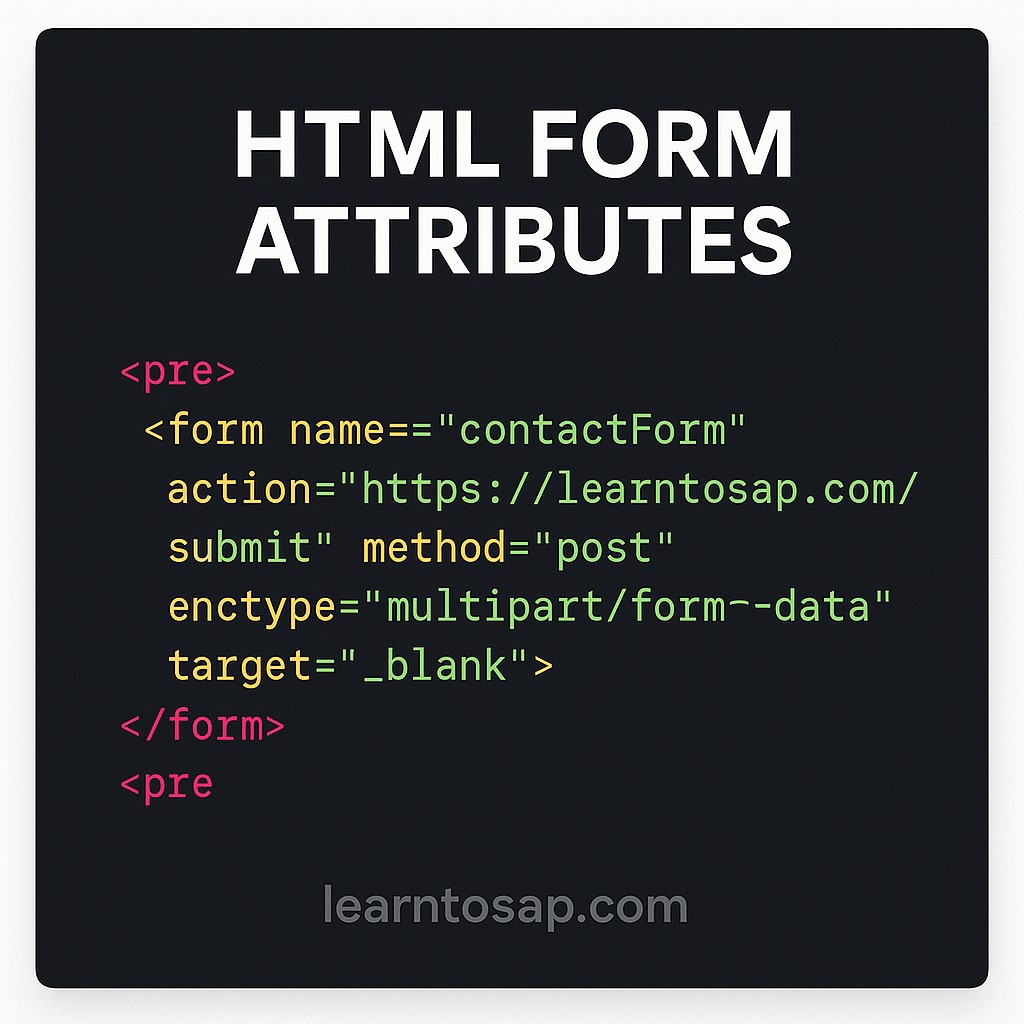
🔹 HTML form attributes are used to define the behavior and functionality of the <form> element. They control where the data goes, how it is sent, how it is encoded, and how the browser handles validation. Here are the most commonly used attributes, with a working example for each one.
🔍 Quick Reference: All HTML Form Attributes
| Attribute | Purpose |
|---|---|
| action | URL where the form data is sent on submit |
| method | HTTP method used to send data — GET or POST |
| enctype | How the form data is encoded before sending |
| target | Where to display the response after submission |
| autocomplete | Toggles browser auto-fill suggestions on form fields |
| novalidate | Skips built-in HTML5 validation on submit |
| name | Names the form for scripting/DOM access |
| accept-charset | Specifies the character encodings the server accepts |
| rel | Defines the relationship between the current page and the linked resource in action |
Why Form Attributes Matter for Security and UX
🔹 Choosing the right form attributes isn't just a syntax detail — it directly affects security and how smoothly a real user can complete your form. Sending a password field with method="get" means that password ends up sitting in plain text in the browser's address bar, in the server's access logs, and in the user's browser history, all of which are exactly the places you don't want sensitive data exposed. On the usability side, an autocomplete="off" that's applied too broadly can frustrate returning visitors who expect their name and address to auto-fill on a normal checkout form.
🔹 A well-configured form also protects your backend. If enctype is wrong for a file upload, the server may receive a garbled or empty file field instead of throwing a clear error, which makes the bug harder to trace later. Getting these attributes right the first time saves debugging time down the road and keeps user data handled responsibly.
✅ 1. action
Specifies where to send the form data when the form is submitted.
<form action="/submit-form">
</form>
🔹 If action is left empty or omitted, the form submits to the current page's own URL, which is the default behavior most browsers fall back to.
✅ 2. method
🔹 Defines the HTTP method used to send form data.
- 🔹 get (default): Appends data to the URL.
- 🔹 post: Sends data in the body (more secure for sensitive info).
<form method="post">
</form>
GET vs POST at a Glance
| Aspect | GET | POST |
|---|---|---|
| Data location | Appended to the URL as a query string | Sent in the request body |
| Visibility | Visible in the browser address bar and history | Not visible in the URL |
| Data size limit | Limited by URL length (browser/server dependent) | No practical size limit |
| Best for | Search forms, filters, bookmarkable requests | Login forms, file uploads, sensitive data |
| Caching | Can be cached and bookmarked | Not cached by default |
✅ 3. enctype
🔹 All Specifies how the form data should be encoded when submitting to the servers.
- 🔹 application/x-www-form-urlencoded (default)
- 🔹 multipart/form-data (for file uploads).
- 🔹 text/plain.
<form enctype="multipart/form-data">
</form>
🔹 enctype only matters when method="post". Forgetting to set it to multipart/form-data is one of the most common reasons a file upload input silently fails to send the actual file.
✅ 4. target
🔹 All Specifies where to display the response received after form submission.
- 🔹 _self (default)
- 🔹 _blank (new tab)
- 🔹 _parent
- 🔹 _top
<form target="_blank">
  <!-- Form fields go here -->
</form>
✅ 5. autocomplete
🔹 Toggles browser auto-complete features on form fields.
<form autocomplete="off">
</form>
🔹 Setting this to off is common on one-time forms like OTP entry or payment forms, where auto-filled old values could cause mistakes.
✅ 6. novalidate
🔹 Disables HTML5 validation when submitting the form.
<form novalidate>
</form>
🔹 This is useful when you want to run your own custom JavaScript validation and error messages instead of the browser's default validation bubbles.
✅ 7. name
🔹 Gives the form a name for scripting purposes.
<form name="contactForm">
</form>
🔹 A named form can be accessed directly in JavaScript via document.forms['contactForm'], which is handy for older-style scripts that don't use querySelector.
✅ 8. accept-charset
🔹 Specifies the character encodings that the server accepts for the submitted form data. Modern sites almost always use UTF-8, so this attribute is rarely set explicitly today, but it's worth knowing it exists.
<form accept-charset="UTF-8">
</form>
✅ 9. rel
🔹 Defines the relationship between the current document and the URL in action, similar to how rel works on an <a> tag. Common values include nofollow, noopener, and noreferrer.
<form action="https://example.com/submit" rel="noopener noreferrer">
</form>
Form Attributes vs Input Attributes: What's the Difference?
🔹 It's easy to mix up attributes that belong on the <form> tag itself with attributes that belong on individual <input>, <select>, or <textarea> fields inside it. The nine attributes covered above — action, method, enctype, target, autocomplete, novalidate, name, accept-charset, and rel — all live on the <form> tag and affect the whole form at once.
🔹 Individual fields have their own separate attributes, such as required, placeholder, pattern, minlength/maxlength, and disabled. A field-level form attribute can even connect an input to a form elsewhere on the page, without the input needing to physically sit inside the <form></form> tags.
<form id="orderForm" action="/order" method="post">
  <input type="text" name="product" required>
</form>

<!-- This input is outside the form tag, but still submits with it -->
<input type="text" name="coupon" form="orderForm">
How Browsers Handle Form Attributes in Practice
🔹 When a form is submitted, the browser reads the attributes on the <form> tag in a specific order of importance. First it checks novalidate to decide whether to run HTML5 validation at all. If validation passes (or is skipped), it then looks at method to decide whether to build a query string (GET) or a request body (POST). If the method is POST, it checks enctype to decide how to package that body — plain URL-encoded text, or a multipart package that can carry binary files. Finally it sends the request to whatever URL is set in action, and decides where to load the response using target.
🔹 Understanding this order helps when debugging a form that "isn't submitting right" — work through the attributes in that same sequence (validation, method, enctype, action, target) and you'll usually find the misconfigured one quickly.
Common Mistakes with HTML Form Attributes
- 🔹 Uploading files without enctype="multipart/form-data": the file name is sent but the actual file content is not.
- 🔹 Using GET for sensitive data: passwords or personal data sent via GET end up visible in the URL, browser history, and server logs.
- 🔹 Relying only on novalidate without a replacement: turning off HTML5 validation without adding your own JavaScript validation leaves the form unprotected against bad input.
- 🔹 Forgetting action on multi-step forms: leaving it blank can accidentally resubmit to the wrong step of a multi-page form flow.
- 🔹 Overusing target="_blank": opening every form response in a new tab can confuse users who expect normal page navigation.
HTML Form Attributes Best Practices
- 🔹 Always use method="post" for anything involving passwords, personal data, or file uploads.
- 🔹 Pair file inputs with enctype="multipart/form-data" every time.
- 🔹 Keep native HTML5 validation enabled unless you have a complete custom validation flow ready to replace it.
- 🔹 Use autocomplete="off" sparingly — it can hurt usability on normal forms like sign-up pages.
- 🔹 Add rel="noopener noreferrer" when a form's action points to an external domain and target="_blank" is used, to avoid security and performance issues.
Try It Yourself (Copy This Code and Paste. See how it works). Paste any of the attribute examples above into the live playground below.
Live Code Preview
Frequently Asked Questions About HTML Form Attributes
What are HTML form attributes?
HTML form attributes control how a form behaves and how data is sent to the server.
What is the action attribute?
The action attribute defines the URL where the form data is sent.
What is the method attribute?
The method attribute specifies whether data is sent using GET or POST.
Why use POST instead of GET?
POST is more secure and is used for sending sensitive data.
When should I use enctype multipart/form-data?
Use multipart/form-data whenever your form includes a file upload input, since the default encoding cannot send binary file data.
Does novalidate turn off all validation?
novalidate turns off the browser's built-in HTML5 validation for that form submission, but you can still validate manually with JavaScript.
Browser Support for HTML Form Attributes
| Attribute | Support Level | Notes |
|---|---|---|
| action / method | Universal | Supported since the earliest HTML form specifications |
| enctype | Universal | All modern browsers; required for file uploads |
| target | Universal | Same values as the anchor tag's target attribute |
| autocomplete | Widely supported | Some browsers ignore off on login fields for security/UX reasons |
| novalidate | Modern browsers (HTML5+) | Not available in very old browsers that predate HTML5 validation |
| name | Universal, but not recommended for new styling hooks | Prefer id for CSS/JS targeting on new projects |
🔹 In practice, every attribute covered in this guide works in all current major browsers — Chrome, Firefox, Safari, and Edge — so compatibility is rarely the reason a form misbehaves. The far more common cause is simply choosing the wrong value for the situation, such as GET instead of POST, or forgetting multipart/form-data on a file upload.
Conclusion
🔹 HTML form attributes give you fine control over exactly how a form talks to the server — where the data goes (action), how it travels (method and enctype), where the response opens (target), and how the browser assists the user (autocomplete and novalidate). Getting these right, especially method and enctype, is one of the fastest ways to fix a form that "isn't working" the way you expect. Try editing the live example above, swap the attributes around, and watch how the submitted behavior changes.