How to Add YouTube Videos in HTML Using <iframe> Tag: Complete Beginner's Guide with Responsive Embed Examples
HTML Tutorials · HTML YouTube Videos Tag · Introduction
How to Add YouTube Videos in HTML Using the <iframe> Tag | Complete Beginner's Guide
🔸All HTML YouTube videos in HTML, you can use the <iframe> tag provided by YouTube. Here's a basic example.
🔸Replace "video.mp4" with the path to your video file.
🔸controls adds play/pause, volume, etc.
🔸You can also add autoplay, loop, muted, or poster="thumbnail.jpg" as attributes.
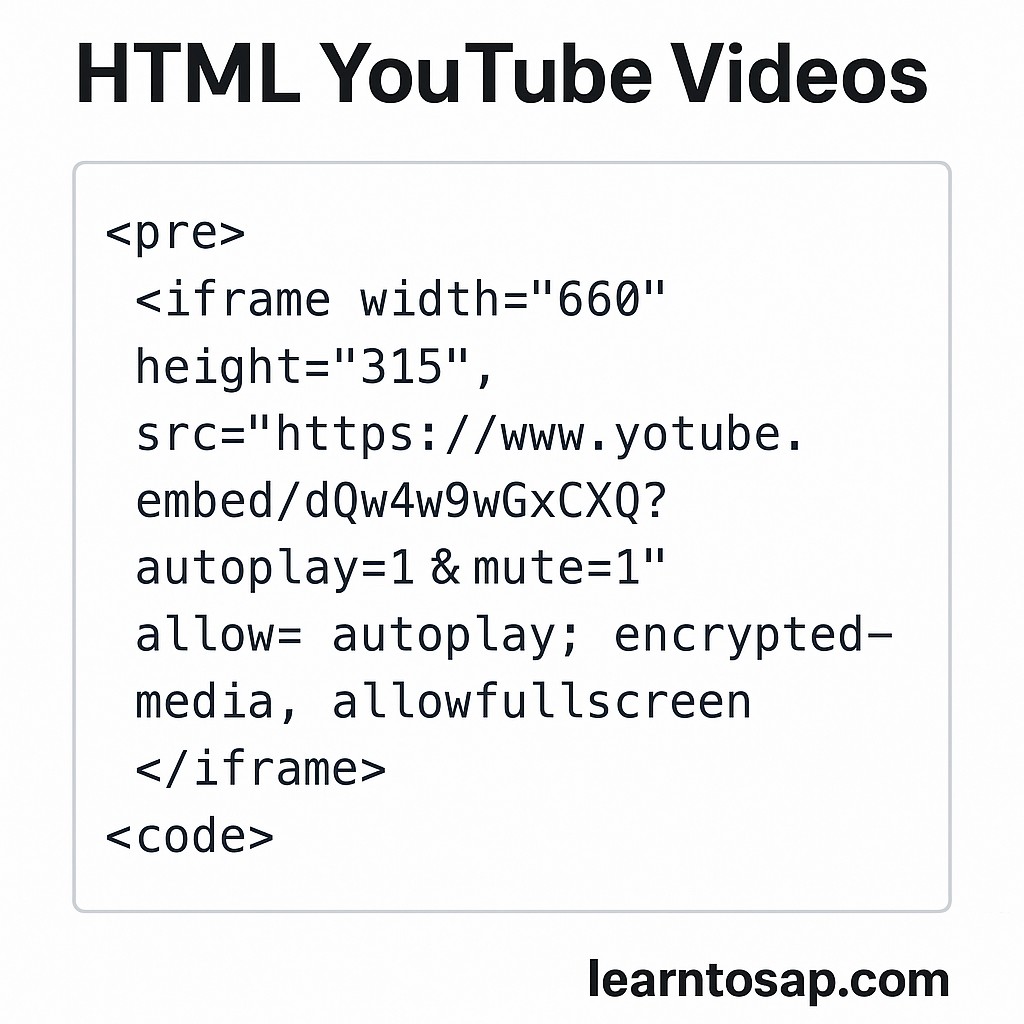
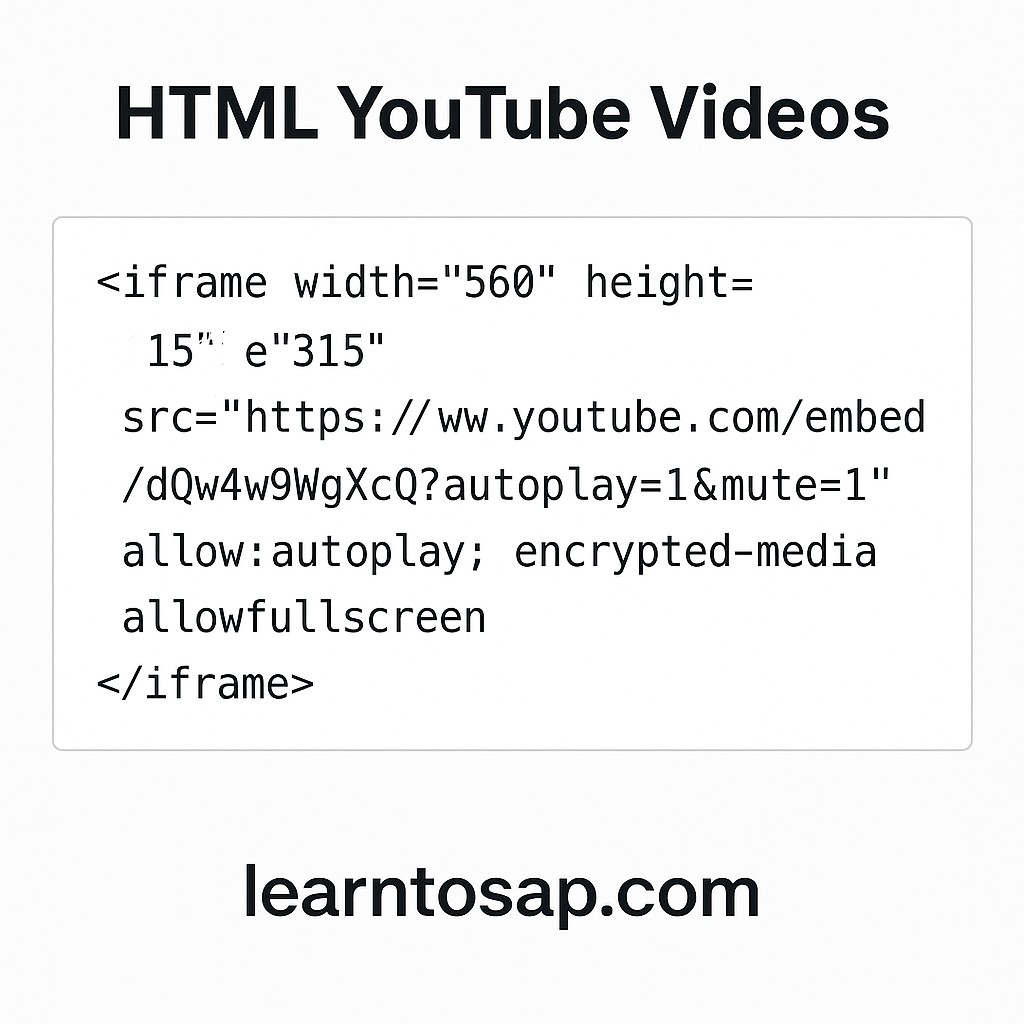
Why Use an iframe Instead of the video Tag for YouTube?
🔸 The native <video> element covered in this series' multimedia tutorial expects a direct link to a video file you host yourself, such as an MP4. YouTube deliberately does not expose that kind of direct file link for its hosted videos — instead, it provides its own embeddable player through an <iframe>, which loads YouTube's actual player interface (with its own play button, YouTube branding, related-video suggestions, and view-count tracking) inside a small window on your page. This is also why YouTube embedding doesn't require you to store or stream any video files on your own server at all.
✅How to Use It:-
🔸You can Replace VIDEO_ID with the actual ID of the YouTube video.
🔸You can Replace URL For example, for this URL: https://www.youtube.com/watch?v=KyVGxg5dCOQ
🔸Your The VIDEO_ID is KyVGxg5dCOQ
✅ Basic HTML to Embed a YouTube Videos:-
(Live embed — the video above is playing directly from YouTube)
<iframe width="560" height="315"
        src="https://www.youtube.com/embed/KyVGxg5dCOQ"
        title="YouTube video player"
        frameborder="0"
        allow="accelerometer; autoplay; clipboard-write; encrypted-media; gyroscope; picture-in-picture; web-share"
        allowfullscreen>
</iframe>
🔸 Notice the src URL uses the special /embed/VIDEO_ID path, not the regular /watch?v=VIDEO_ID URL you'd visit in a browser tab — only the embed path is designed to render inside another page. The long allow attribute is a permissions policy string telling the browser which advanced browser features (autoplay, fullscreen, picture-in-picture, and so on) the embedded player is allowed to use.
How to Find the Video ID Step by Step
| Step | What to Do |
|---|---|
| 1 | Open the video's normal YouTube watch page in your browser |
| 2 | Look at the address bar URL, e.g. https://www.youtube.com/watch?v=KyVGxg5dCOQ |
| 3 | Everything after v= is the Video ID — here, KyVGxg5dCOQ |
| 4 | Substitute that ID into https://www.youtube.com/embed/VIDEO_ID as the iframe's src |
🔸 Alternatively, clicking the Share button below any YouTube video and choosing "Embed" gives you a ready-made iframe snippet with the correct ID already filled in, exactly as the step-by-step guide below describes.
🎥 Optional Customizations:-
🔸Add autoplay=1 to the src URL to start the video automatically (note: muted videos autoplay more reliably).
(Live embed — autoplays muted, per browser autoplay policy)
<iframe width="560" height="315"
        src="https://www.youtube.com/embed/KyVGxg5dCOQ?autoplay=1&mute=1"
        allow="autoplay; encrypted-media"
        allowfullscreen>
</iframe>
🔸 Query parameters appended after ? in the embed URL, separated by &, control player behavior without changing the surrounding HTML at all — autoplay=1 starts playback immediately, but nearly every modern browser blocks autoplay with sound unless mute=1 is also present.
More Useful YouTube Embed Parameters
| Parameter | Effect |
|---|---|
| autoplay=1 | Starts the video automatically (pair with mute=1) |
| mute=1 | Starts the video muted, required for reliable autoplay |
| loop=1 | Replays the video automatically (also needs playlist=VIDEO_ID to loop a single video) |
| controls=0 | Hides YouTube's play/pause/seek bar controls |
| start=30 | Begins playback 30 seconds into the video |
| rel=0 | Limits related-video suggestions to the same channel after playback ends |
Making the YouTube Embed Responsive
🔸 Both examples above use fixed width="560" height="315" attributes, which is exactly how YouTube's own Share → Embed code works by default. On a narrow mobile screen, a fixed 560px width can overflow the viewport, so the standard fix is to wrap the iframe in a container that maintains a 16:9 aspect ratio while scaling fluidly to its parent's width.
<style>
  .responsive-embed {
    position: relative;
    width: 100%;
    max-width: 560px;
    padding-top: 56.25%; /* 16:9 aspect ratio */
    margin: 0 auto;
  }
  .responsive-embed iframe {
    position: absolute;
    top: 0;
    left: 0;
    width: 100%;
    height: 100%;
    border: none;
  }
</style>

<div class="responsive-embed">
  <iframe src="https://www.youtube.com/embed/KyVGxg5dCOQ"
          title="Responsive YouTube video player"
          frameborder="0"
          allowfullscreen>
  </iframe>
</div>
🔸 The padding-top: 56.25% trick works because percentage padding on a block element is calculated from its width, and 56.25% is exactly the height-to-width ratio of a 16:9 video (315 ÷ 560). The iframe is then positioned absolutely to fill that padded box completely, so it scales up and down fluidly with the container's width on any screen size.
YouTube Embed and SEO
🔸 Embedding a YouTube video keeps visitors on your page while still surfacing rich video content, and Google can index embedded YouTube videos and sometimes display a video thumbnail directly in search results for the page. Giving the iframe a descriptive title attribute, as both examples above do, also helps screen readers and search engines understand what the embedded content actually is, rather than announcing a generic, unlabeled frame.
Privacy-Enhanced Embeds With youtube-nocookie.com
🔸 A standard youtube.com/embed/ iframe can set tracking cookies even before a visitor presses play, which matters for sites subject to strict cookie-consent rules. Swapping the domain to YouTube's dedicated privacy-enhanced mode avoids this until the visitor actually interacts with the player.
<iframe width="560" height="315"
        src="https://www.youtube-nocookie.com/embed/KyVGxg5dCOQ"
        title="YouTube video player (privacy-enhanced)"
        frameborder="0"
        allowfullscreen>
</iframe>
Common Mistakes with YouTube iframe Embeds
- 🔸 Using the watch URL instead of the embed URL: pasting /watch?v=... directly into the src attribute won't render correctly; it must be /embed/VIDEO_ID.
- 🔸 Forgetting mute=1 with autoplay=1: most browsers silently block unmuted autoplay, so the video appears not to work at all.
- 🔸 Skipping the title attribute: this leaves the embedded frame unlabeled for screen readers and reduces its SEO clarity.
- 🔸 Not making the embed responsive: a fixed 560px-wide iframe can overflow and force horizontal scrolling on mobile devices.
- 🔸 Embedding many autoplaying videos on one page: this can seriously slow down page load, since each iframe loads YouTube's player scripts independently.
HTML YouTube Embed Best Practices
- 🔸 Always use the /embed/VIDEO_ID URL format, never the regular watch URL, inside the iframe's src.
- 🔸 Wrap embeds in a responsive aspect-ratio container so they scale correctly on every screen size.
- 🔸 Give every iframe a clear, descriptive title attribute for accessibility and SEO.
- 🔸 Pair autoplay=1 with mute=1 whenever autoplay is genuinely needed.
- 🔸 Consider youtube-nocookie.com for pages that need to minimize cookies before user interaction.
- 🔸 Avoid embedding more videos on a single page than visitors will realistically watch, to keep load time reasonable.
Try It Yourself (Copy This Code and Paste. See how it works). Paste any of the examples above into the live playground below.
Live Code Preview
Practice Exercises: Test YouTube iframe Embeds
- Take a YouTube watch URL of your choice, extract its Video ID, and build a working embed iframe from scratch.
- Add autoplay=1 and mute=1 to your embed and confirm it starts playing automatically.
- Wrap your embed in the responsive-embed CSS pattern shown above and shrink your browser window to test it.
- Add a start=30 parameter to your embed URL and confirm playback begins 30 seconds in.
- Swap the domain to youtube-nocookie.com and compare the embed's behavior.
Frequently Asked Questions About Embedding YouTube in HTML
How do I embed a YouTube video in HTML?
You can embed a YouTube video using the iframe tag by copying the embed code from YouTube.
What is the iframe tag in HTML?
The iframe tag is used to embed external content like videos, maps, or webpages inside an HTML page.
Can I resize a YouTube video in HTML?
Yes, you can change the width and height attributes in the iframe tag.
Is embedding YouTube videos free?
Yes, embedding YouTube videos using iframe is completely free.
How do I make an embedded YouTube video responsive?
Wrap the iframe in a container styled with a fixed aspect-ratio (or the classic padding-top percentage trick) and set the iframe itself to position: absolute with 100% width and height, so it scales fluidly with the container.
Does embedding a YouTube video slow down my page?
A standard iframe embed loads YouTube's player scripts immediately, which can add some load time. Using the youtube-nocookie.com domain or a lazy-loading facade technique can reduce this impact until the visitor actually clicks play.
Step-by-Step: How to Embed a YouTube Video
- Open YouTube — Go to YouTube and select your video.
- Click Share — Click the Share button below the video.
- Select Embed — Copy the iframe embed code.
- Paste in HTML — Paste the iframe code inside your HTML file.
Conclusion
🔸 Embedding a YouTube video comes down to one core idea: swap the regular watch URL for its /embed/VIDEO_ID equivalent and drop it into an <iframe>. From that simple foundation, query parameters like autoplay, mute, and start give you fine control over playback, while a responsive aspect-ratio wrapper keeps the player looking correct on any screen size. Work through the basic and autoplay examples above, then try building your own fully responsive embed in the live playground.