HTML Block and Inline Elements in HTML | Complete Guide with Examples for Beginners
By Pramod Behera · Updated: September 15, 2026 · 21 min read
- Block and Inline HTML Elements Explained
- Why Block vs Inline Matters
- 🔵 Block Elements
- 🟠 Inline Elements
- Common Block vs Inline Tags Reference Table
- Changing Behavior with CSS display
- Nesting Rules: What Can Go Inside What
- Block, Inline, and the CSS Box Model
- Why This Distinction Helps SEO and Layout
- Accessibility Considerations
- Common Mistakes to Avoid
- Best Practices Checklist
- Try It Yourself – Live Code Preview
- Practice Exercises
- Frequently Asked Questions
Block and Inline HTML Elements Explained for Web Developers with Practical Examples
Why Block vs Inline Matters
Every single HTML element renders according to one of two basic display behaviors by default, and understanding which one applies to a given tag is one of the most fundamental pieces of knowledge in front-end development. It determines whether an element automatically pushes everything after it onto a new line, whether it can sit comfortably in the middle of a sentence, which CSS properties like width and height will have any visible effect on it, and even which tags are legally allowed to be nested inside which. Once this single distinction clicks, page layout stops feeling unpredictable and starts feeling like a set of consistent, learnable rules.
Block Elements-
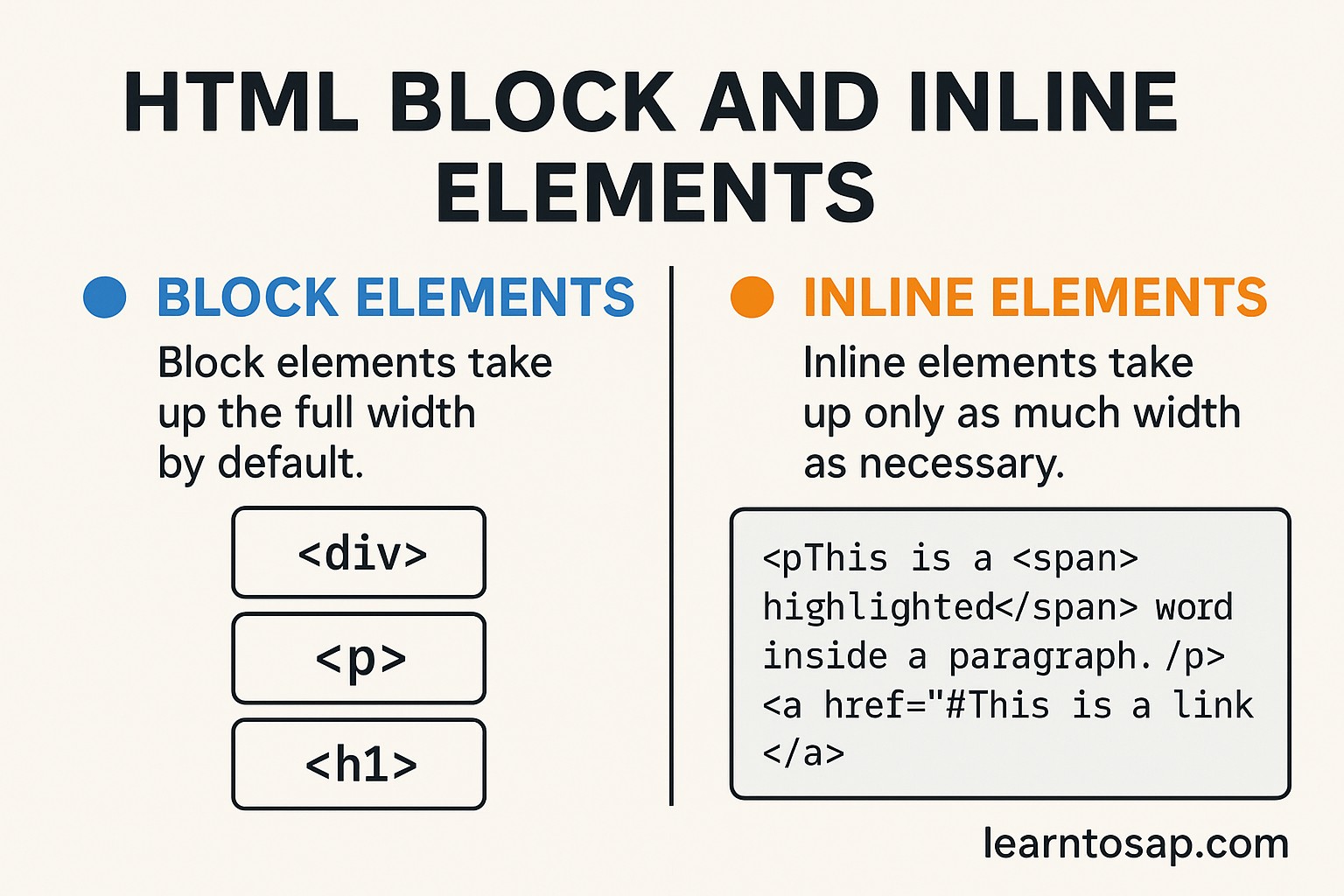
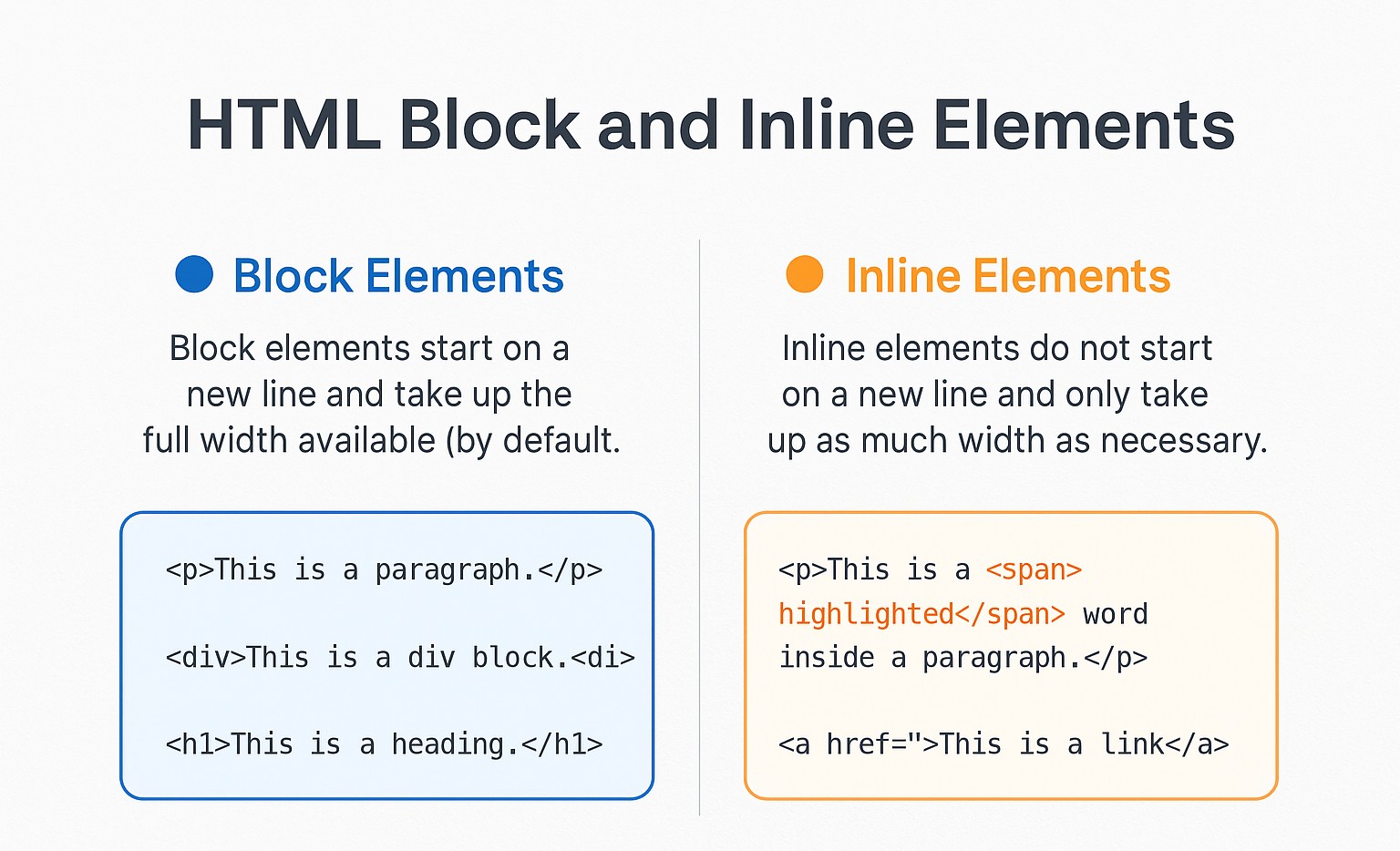
Block elements start on a new line and take up the full width available (by default) -
they often create a "block" of content -
Example tags: - <span>, <a>, <strong>, <em>, <img>, <input>, <label>, <small>,
✅ Example: 👇
<p>This is a paragraph.</p>
<div>This is a div block.</div>
<h1>This is a heading.</h1>
This is a paragraph.
This is a heading.
Notice how each of the three lines in the demo above starts on its own fresh line, with nothing else sharing that horizontal space, even though the actual text content is short. That automatic line break before and after the element, combined with stretching to fill the full width of its parent container by default, is the defining visual signature of a block-level element, and it is exactly why stacking paragraphs, headings, and divs on top of each other naturally builds the vertical structure of a typical web page.
Inline Elements:-
Inline elements do not start on a new line. -
They only take up as much width as necessary -
Example tags: - <div>, <p>, <h1>, <ul>, <li>, <section>, <article>, <header>, <footer>, <nav>
✅ Example: -👇
<p>This is a <span>highlighted</span> word inside a paragraph.</p>
<a href="#">This is a link</a>
This is a highlighted word inside a paragraph.
Here, the <span> wraps only the single word "highlighted" and continues flowing in the middle of the surrounding sentence rather than breaking onto a new line, and the <a> link behaves the same way - it takes up only as much horizontal space as the words "This is a link" require, sitting comfortably beside other content instead of pushing everything below it. This is the core behavior that lets you style individual words, wrap a single phrase in a link, or emphasize a term without disrupting the surrounding paragraph's flow.
🔍 Common Block vs Inline Tags Reference Table
| Category | Common Tags | Default Behavior |
|---|---|---|
| Block-level | <div>, <p>, <h1>–<h6>, <ul>, <li>, <section>, <article>, <header>, <footer>, <nav> | Starts on a new line, fills full available width |
| Inline | <span>, <a>, <strong>, <em>, <img>, <input>, <label>, <small> | Flows within the current line, width based on content |
Note: element groupings can vary slightly between sources and browser defaults - always check current browser default stylesheets or MDN if you need to confirm a specific tag's exact rendering behavior for a project.
Changing Behavior with CSS display
The block-versus-inline behavior described above is only the browser's default; CSS lets you override it completely with the display property.
| CSS Value | Effect |
|---|---|
| display: block; | Forces an inline element (like span) to behave like a block, starting on a new line |
| display: inline; | Forces a block element (like div) to flow inline with surrounding content |
| display: inline-block; | Flows inline like a span, but still accepts width, height, and vertical margin like a block |
| display: none; | Removes the element from the page layout entirely |
<span style="display:block;">I now behave like a block!</span>
<div style="display:inline;">I now flow inline!</div>
This flexibility is exactly why modern CSS layout systems like Flexbox and Grid can reshape how any element behaves visually, regardless of its native tag - the underlying HTML tag choice should still be based on semantic meaning, while the visual layout behavior is controlled separately through CSS.
Nesting Rules: What Can Go Inside What
As a general rule, block-level elements can contain both other block elements and inline elements, but inline elements should only contain other inline elements or plain text - placing a block-level element like a <div> or a <p> inside an inline element like <span> or <a> is invalid in most cases and can cause browsers to silently "fix" your markup in unexpected ways. Keeping this rule in mind while writing HTML prevents a whole category of layout bugs before they happen.
Block, Inline, and the CSS Box Model
The block-versus-inline distinction directly affects how the CSS box model applies to an element. Block-level elements fully respect width, height, and vertical margin, which is why setting a fixed width on a <div> works exactly as expected. Plain inline elements, by contrast, ignore explicit width and height and only apply horizontal margin and padding visually, while vertical margin and padding may not push surrounding lines apart the way you'd expect - which is precisely the kind of surprising behavior that display: inline-block; exists to solve.
Why This Distinction Helps SEO and Layout
Search engines and browsers both rely on a page's underlying block structure to understand its outline - headings, paragraphs, and sections are block-level precisely so that crawlers and assistive tools can build an accurate document outline. Using block and inline tags for their intended semantic purpose, rather than styling everything as generic divs and spans, keeps that outline meaningful and helps both search rankings and page maintainability over time.
Accessibility Considerations
- Screen readers use the natural block structure of a page (headings, paragraphs, lists) to build a navigable outline, so replacing meaningful block tags with generic divs reduces that navigability.
- Inline elements like <strong> and <em> carry semantic emphasis that screen readers can announce, which a purely visual bold or italic style applied to a <span> would not communicate.
- When changing display behavior with CSS, remember that the underlying semantic tag and its accessibility meaning do not change - a <div> styled with display: inline is still announced as a generic container, not as a link or button.
Common Mistakes to Avoid
❌ Mistake 1 – Nesting a block element inside an inline element
Placing a div inside a span or a tag is invalid HTML and can render unpredictably across browsers.
❌ Mistake 2 – Setting width and height on a plain inline element
These properties are ignored on default inline elements; use display: inline-block or display: block instead.
❌ Mistake 3 – Using divs and spans for everything
Choosing generic containers over semantic block tags like section, article, and nav discards meaning that helps both SEO and accessibility.
❌ Mistake 4 – Forgetting that display:inline removes block-only CSS effects
Switching a div to display:inline means its width, height, and vertical margin will no longer behave as expected.
❌ Mistake 5 – Assuming visual layout always matches the underlying tag
A div can be made to look and flow like a span through CSS, but that does not change its semantic meaning in the document.
Best Practices Checklist
✔️ 1) Choose tags for meaning first, layout second
Use CSS display to adjust visual behavior rather than picking the "wrong" tag to get a certain look.
✔️ 2) Keep block elements containing inline content, not the reverse
Avoid nesting block-level tags inside inline tags.
✔️ 3) Use display: inline-block for inline elements that need a fixed size
This preserves inline flow while allowing width, height, and vertical margin.
✔️ 4) Prefer semantic block tags over generic divs where possible
section, article, header, footer, and nav describe their purpose to browsers and search engines.
✔️ 5) Test how your layout responds after changing display values
A single display change can shift surrounding spacing and alignment in ways worth double-checking.
Try It Yourself (Copy This Code and Paste. See how it works)
Live Code Preview
Practice Exercises: Test Block and Inline Elements
- Write three block-level elements (p, div, h2) one after another and observe that each starts on its own line.
- Write a sentence containing two inline elements (span and strong) and observe that they flow within the line.
- Take a span and apply display: inline-block, then give it a fixed width and height to see the effect.
- Take a div and apply display: inline, then place it between two words in a sentence.
- List five semantic block tags (other than div) and write one sentence describing what each one is meant to represent.
Frequently Asked Questions About Block and Inline Elements
What is the difference between block and inline elements in HTML?
Block elements start on a new line and take up the full width available by default, while inline elements do not start on a new line and only take up as much width as their content needs.
What are examples of block-level elements in HTML?
Common block-level elements include div, p, h1 through h6, ul, li, section, article, header, footer, and nav, each of which forces a new line before and after itself.
What are examples of inline elements in HTML?
Common inline elements include span, a, strong, em, img, input, label, and small, all of which flow within the surrounding text rather than breaking onto their own line.
Can I change an inline element to behave like a block element?
Yes, using the CSS property display: block on an inline element makes it start on a new line and take up the full available width, just like a natively block-level element.
Why does it matter whether an element is block or inline?
Knowing whether an element is block or inline determines how it will lay out next to other content, which margins and widths apply to it, and which tags can legally be nested inside which.
Can a block element be placed inside an inline element?
Generally no. Placing a block-level element inside an inline element is invalid HTML in most cases and can cause unpredictable rendering, so block elements should contain inline elements, not the other way around.