SAP Error M7021: Deficit of BA Restricted-Use Stock (Full Fix Guide)
Example message: "Deficit of BA Restr.-use 253.840 KG: 26 1254 LR01 SALI001" - the exact material, plant, storage location, and batch numbers in your own error will differ, but the fix below is identical.
This common error, "Shortfall below the specified stock level or quantity amounting to 253.840 KG," means that the available restricted-use stock is lower than the required quantity for a particular transaction. This guide covers the exact fix using MMBE and MB1C, then goes deeper into what restricted-use stock actually is, how it differs from quality inspection stock, batch status management, a real business scenario, and a full prevention checklist.
✅ Possible Causes
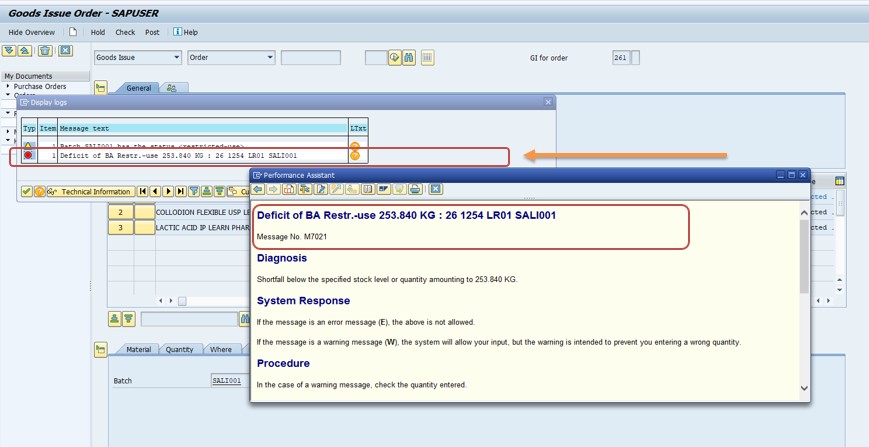
- Insufficient Stock - available stock is less than the requested quantity.
- Stock Reservation - this stock may be reserved for another transaction (e.g., sales order, production order).
- Stock in a Different Category - the stock exists, but not under the restricted-use status the transaction needs.
- Incorrect Storage Location - the stock exists in the plant, but not in the storage location referenced in the error.
🔧 Solution: MB1C - Check Stock First in MMBE
Check stock availability across the different categories (Unrestricted, Quality Inspection, Blocked, Restricted-use) in MMBE first. If stock is genuinely not available, create it manually as a documented correction.
If stock is not available - for example, requiring 253.840 KG when the required production quantity is 253.840 KG - create stock manually.
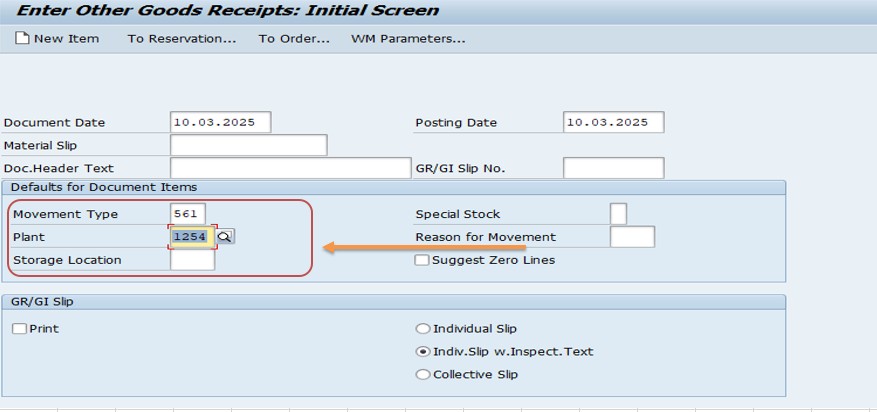
Go to MB1C - Create Stock Manually.
Tcode: MB1C
Select Movement Type - 561
Select Plant - 1254
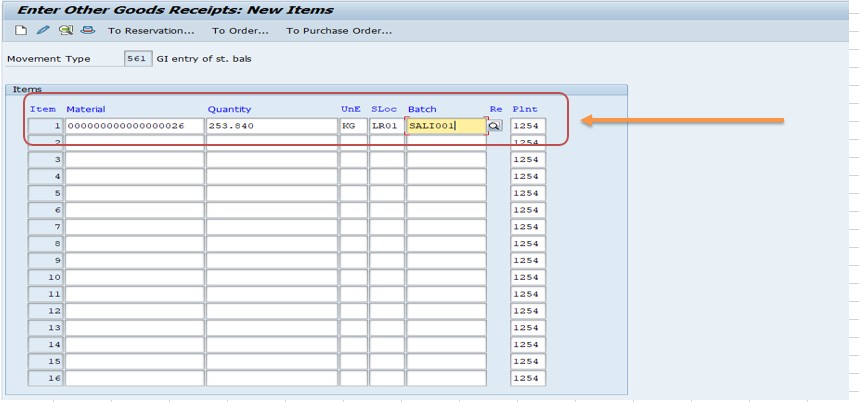
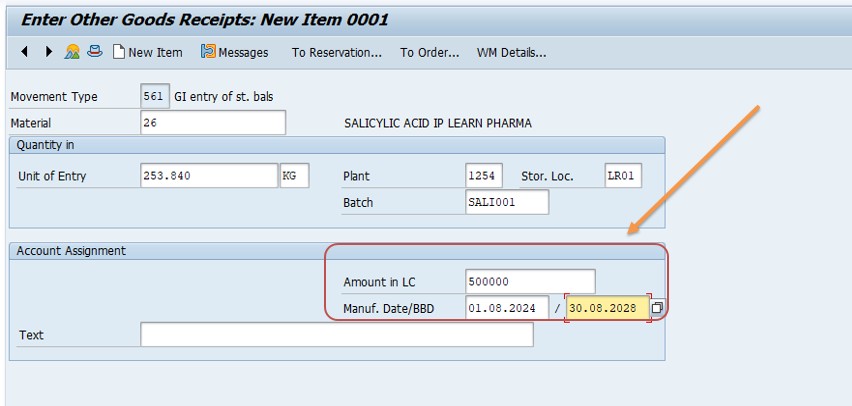
- Select Material No - 26
- Select Qty - 253.840 KG
- Select Unit of Entry - KG
- Select Storage Location - LR01
- Select Batch - SALI001
- Select Plant - 1254
- Select Amount (Local Currency) - 500000
- Select Save / Post
Then go to MMBE and check stock.
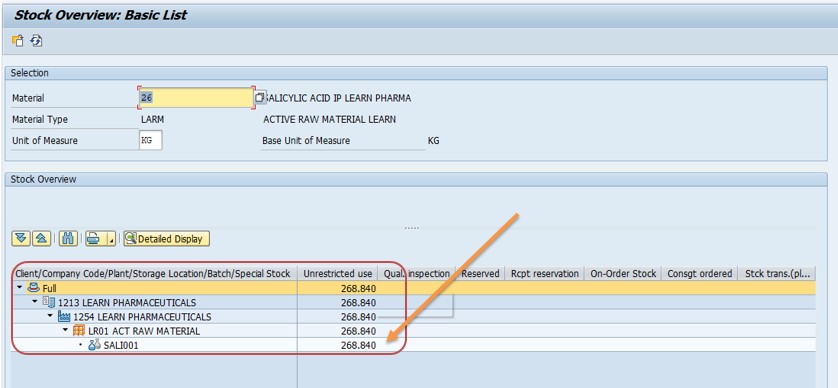
Save once the restricted-use quantity in MMBE covers the amount required, then retry the original posting.
🔍 What "Restricted-Use" Stock Actually Means
Restricted-use is a batch status in SAP, separate from the standard unrestricted, quality inspection, and blocked stock categories. It exists specifically for batch-managed materials and is controlled through a material master setting called batch status management. When batch status management is active for a material, every batch is flagged as either "unrestricted" (freely usable) or "restricted" (excluded from normal availability), and this flag can be set manually, changed as part of a QM usage decision, or driven by batch classification rules depending on how your organization has configured it.
The key distinction from quality inspection stock is important: quality inspection stock is a separate stock category created automatically at goods receipt when a material has an active inspection setup, and it moves into unrestricted-use once an inspector completes a usage decision. Restricted-use, by contrast, is a status applied directly to a batch and can apply even to stock that already has a "clean" quality history - for example, a batch deliberately held back from general use for business reasons rather than a pending quality check.
❓ Common Reasons a Batch Gets Marked Restricted-Use
- A quality concern was flagged that falls short of a full block, pending further investigation or a supplier response.
- The batch is reserved for a specific customer, contract, or project and should not be consumed by general demand.
- The batch is approaching its shelf-life expiration and should only be released for specific, lower-priority uses.
- A manual hold was applied by quality, warehouse, or planning staff while a decision is pending, without going through the formal QM inspection lot process.
- Regulatory or compliance reasons in industries like pharmaceuticals or food, where a batch must clear an additional review step before general release.
⚙️ How Batch Status Management Is Configured
Also Batch status management is switched on per material in the material master's Batch Management or Plant Data/Storage 1 view (depending on your SAP version), alongside the standard batch management indicator. Once active, every batch of that material carries an explicit status field that can be viewed and changed in MSC2N (Change Batch). Changing a batch from unrestricted to restricted - or back again - is itself a stock-relevant transaction, and SAP records it as a movement (often using movement type 344/343 pairs conceptually similar to the quality-inspection transfer posting, though the exact movement types depend on configuration).
Because the restriction lives on the batch, not on the storage location or stock category alone, MMBE will show the restricted-use quantity as its own line within the batch's stock overview, separate from unrestricted and quality inspection quantities for the very same batch. This is exactly why a plant-level total can look sufficient while the specific batch a transaction needs sits entirely in restricted-use - the total misleads unless you check the breakdown by status.
📑 Restricted-Use vs Quality Inspection vs Blocked Stock
| Category | How It's Set | Typical Trigger | How It's Released |
|---|---|---|---|
| Quality Inspection | Automatic, via inspection setup on the material master | Goods receipt of a material requiring inspection | QM usage decision (QA32) or transfer posting (MIGO 321) |
| Blocked Stock | Manual or automatic, via movement or rejection during usage decision | Failed inspection, damaged goods, return awaiting disposition | Transfer posting once a disposition decision is made |
| Restricted-Use | Batch status field, set manually or via batch status management rules | Business hold, customer reservation, expiry-driven restriction, pending review | Batch status change back to unrestricted (MSC2N) once the hold is lifted |
All three categories share one thing in common: none of them are counted as unrestricted-use, which is why any of the three can independently trigger a deficit error like M7021 if a transaction specifically expects that category and status to hold enough quantity.
🛠️ Restricted-Use Stock in Warehouse Management (WM) and EWM
In classic Warehouse Management (WM), batch status is an inventory management (IM) level attribute, and the WM-level quant does not automatically know a batch has been restricted unless a corresponding transfer requirement or transfer order updates the storage type. This means a WM putaway or picking strategy can sometimes still propose a restricted batch unless your configuration explicitly excludes restricted stock from picking strategies - worth confirming with your WM consultant if restricted batches keep appearing in pick lists despite being flagged restricted at the IM level.
For sites running SAP Extended Warehouse Management (EWM), stock status (unrestricted, blocked, or in QI) is managed at the EWM quant level and synchronized with ERP/S4 inventory management. Restricted-use as a batch status specifically is an ERP-side concept; if your EWM setup needs an equivalent restriction, it is typically modeled through EWM's own stock type and putaway/removal strategy configuration rather than a literal one-to-one mapping of the ERP batch status field. If restricted-use deficits keep appearing on EWM-managed materials, a stock reconciliation between EWM and ERP is usually a more productive first step than repeating the ERP-side troubleshooting in this guide.
📑 M7021 Restricted-Use vs Other Related SAP Deficit Messages
| Message | Stock Type Referenced | Typical Root Cause |
|---|---|---|
| M7021 – Deficit of BA Restr.-use | Restricted-use batch status | Batch flagged restricted via MSC2N or batch status management, insufficient unrestricted equivalent available |
| M7021 – Deficit of BA Unrestricted-use | Unrestricted-use stock | Genuine stock shortage, or stock sitting in quality inspection/blocked status instead |
| M7021 – Deficit of BA Quality Inspection | Quality inspection stock | Insufficient stock still pending inspection when a QI-specific movement is attempted |
| M7053 – Negative stock not allowed | Any category, tied to OMJ1 configuration | The negative stock control setting itself is what's blocking the posting |
All of these share the same family resemblance - a deficit check preventing a posting - but the fix differs based on exactly which stock type and status the message references, which is why reading the exact wording of your own error message carefully (not just recognizing "M7021" generically) matters before choosing a fix.
📱 Restricted-Use Stock and Batch Status in SAP S/4HANA
Batch status management and the restricted-use stock category work the same way conceptually in SAP S/4HANA as in ECC, since both are governed by the same batch master and material master settings rather than anything specific to the Universal Journal. What changes in S/4HANA is the visibility: the Fiori app "Stock – Single Material" presents the same unrestricted, quality inspection, blocked, and restricted-use breakdown as MMBE in a cleaner, filterable card view, and batch attributes including status can be reviewed through the "Manage Batches" or equivalent Fiori app depending on your organization's rollout.
Because S/4HANA updates stock quantities in real time through the simplified MATDOC-based data model, a batch status change made in MSC2N is reflected instantly in MMBE or its Fiori equivalent, with no batch job delay. If a batch was just released from restricted-use and the deficit still shows, that's a strong signal the release didn't actually post correctly for the exact batch and storage location in question, rather than a system refresh delay - re-check the batch change document itself.
💰 Why Restricted-Use Status Matters for Costing and Valuation
Restricted-use stock is not simply a visibility or convenience flag - it directly affects what a material's available-to-promise and planning-relevant quantity looks like to other processes. MRP, for instance, generally does not count restricted-use stock as available supply when calculating net requirements, meaning a large restricted-use balance sitting on the shelf can still trigger MRP to propose new procurement or production, because from a planning perspective that stock effectively doesn't exist yet. This is precisely why a plant can show a comfortable total quantity in MMBE while simultaneously generating purchase requisitions for the same material - the total is misleading when a meaningful share sits in a non-unrestricted status.
From a valuation standpoint, restricted-use stock is still owned inventory and carries value on the balance sheet the same as unrestricted stock - the restriction is a usability constraint, not a write-off. However, if a batch remains restricted for an extended period without resolution, that can be a signal for inventory management or finance to review whether the stock should instead be reclassified as blocked, written down, or scrapped, since indefinitely restricted stock ties up working capital without contributing to fulfillable supply.
📈 Troubleshooting Decision Tree for M7021 (Restricted-Use)
- Run MMBE for the exact batch. Confirm the total plant quantity and the batch-level breakdown separately - don't rely on the total alone.
- Is the shortfall specifically in restricted-use status? If yes, check MSC3N to see the batch's current status and any classification notes.
- Was the restriction applied deliberately? Contact quality, planning, or warehouse staff to confirm the reason before requesting a release.
- If the restriction should be lifted, use MSC2N to change the batch status to unrestricted, with a documented reason.
- If the batch genuinely doesn't have enough stock anywhere (confirmed by a physical count), only then consider MB1C with a documented correction reason.
🎓 Interview-Style Questions and Answers
Q: What is the functional difference between restricted-use stock and blocked stock?
Blocked stock is generally the result of a failed inspection or a rejected usage decision and typically requires a formal disposition (rework, return, scrap) before it can move anywhere else. Restricted-use stock is a batch status that can be applied and lifted more flexibly, often for business or compliance reasons short of an outright quality failure, and does not necessarily require a QM usage decision to resolve.
Q: Does MRP count restricted-use stock as available supply?
No, in standard configuration MRP typically excludes restricted-use stock from available supply when calculating net requirements, which is why a material with plenty of total stock can still generate new procurement or production proposals if most of that stock sits in restricted-use status.
Q: If you see M7021 referencing restricted-use stock, what should you check before creating stock with MB1C?
Check MMBE for the batch-level breakdown to see whether restricted-use stock already exists elsewhere, and check MSC3N to understand the batch's current status and why it may have been restricted, since the correct fix is very often a status change or transfer rather than creating new stock value.
📚 Quick Glossary of Terms Used in This Guide
- Restricted-use stock: A batch status, independent of quality inspection or blocked stock, marking a batch as unavailable for normal unrestricted use.
- Batch status management: A material master setting that enables the restricted/unrestricted status flag on batches for that material.
- BA (Bestand Art): The German-derived abbreviation used in SAP stock messages to denote a stock type or category, such as restricted-use.
- Usage decision: The formal QM outcome (accept, reject, or partial) recorded for an inspection lot, distinct from a manual batch status change.
- Movement type 561: The movement type used in MB1C to create new stock value with no source document reference, typically for corrections.
💼 Real-World Scenario: A Held Batch Blocking Production
Pramod Behera a shift supervisor at a specialty chemicals plant, hit M7021 for a raw material while trying to issue components for a production order. MMBE showed a healthy total quantity for the material at the plant, so he initially assumed it was a system glitch. Drilling into the batch-level breakdown, he found that almost the entire quantity for the exact batch his production order needed sat under restricted-use status, not unrestricted.
Checking with the quality team, Arjun learned the batch had been manually restricted the previous week pending a supplier certificate of analysis that hadn't yet arrived - a routine compliance hold unrelated to any actual quality failure. Once the certificate arrived and quality released the batch back to unrestricted status in MSC2N, the production order could pull the material without any further changes. This is the everyday shape of restricted-use deficits: the stock is rarely "missing" in the way MB1C would fix - it is usually sitting exactly where it should be, waiting on a business or compliance decision that has nothing to do with the transaction that's currently blocked.
❗ Common Mistakes When Fixing M7021 for Restricted-Use Stock
- Using MB1C to manually create stock when the real fix is releasing an existing batch from restricted status via MSC2N.
- Not checking the batch-level breakdown in MMBE, and assuming a healthy plant total means the specific batch needed is available.
- Releasing a batch from restricted-use without confirming with quality or the person who applied the hold in the first place.
- Confusing restricted-use with quality inspection stock and looking in QA32 for a usage decision that doesn't exist because the hold was applied manually, not through an inspection lot.
- Creating stock with MB1C directly into restricted-use status by mistake, which does not solve the underlying deficit since the transaction needs the stock to be genuinely accessible for its purpose.
✅ Prevention Checklist for Restricted-Use Deficits
- Run MMBE (or the S/4HANA Fiori "Stock – Single Material" app) for the exact material, plant, storage location, and batch shown in the error before assuming stock is missing.
- Check batch status directly in MSC3N (display batch) to confirm whether the batch is currently flagged restricted or unrestricted.
- If restricted, find out who applied the restriction and why before requesting a release.
- Only use MB1C with movement type 561 when a physical count confirms stock is genuinely missing, backed by a documented reason.
- Keep a log of restricted batches and the reason for the hold, so production and warehouse teams aren't left guessing when they hit a deficit.
📋 Related SAP Transactions
| Transaction | Purpose |
|---|---|
| MMBE | Stock overview showing unrestricted, quality inspection, blocked, and restricted-use quantities by batch. |
| MB1C | Manually create stock (movement type 561), used only for genuine, documented corrections. |
| MSC2N | Change batch, including changing batch status between restricted and unrestricted. |
| MSC3N | Display batch, useful to confirm current batch status and attributes. |
| QA32 | Process quality inspection lots and usage decisions (for quality-inspection stock, not restricted-use). |
| MIGO | Transfer postings between stock categories (movement type 321 for quality-to-unrestricted). |