SAP WM Error: "Storage Bin WH9 998 AUFNAHME Does Not Exist (Check Your Entry)" – Causes and Step-by-Step Fix
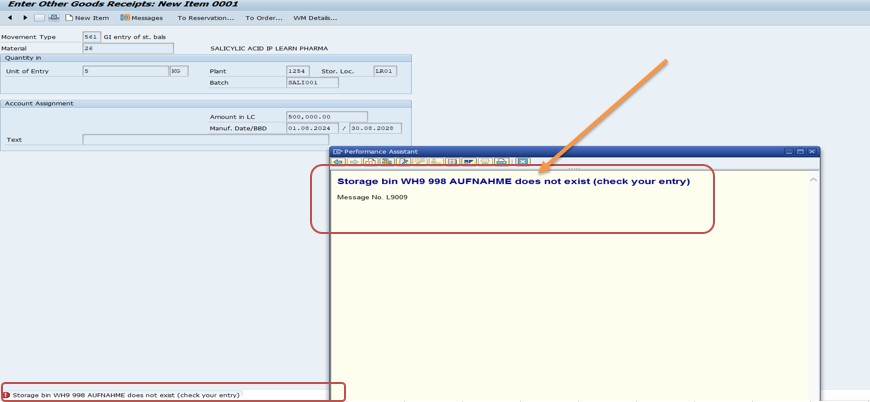
A goods receipt is posted, a transfer order is created, or a warehouse clerk confirms a movement, and SAP stops with a short message: the storage bin does not exist, check your entry. The material is fine, the quantity is right and the user is authorized, yet the movement will not go through. The message names three things: a warehouse number, a storage type and a bin. One of these does not match a bin master record, and the fix is usually to create the missing bin or to correct the entry. This guide explains what the message means, how a bin is identified in SAP Warehouse Management, how to create the missing bin step by step, and how to prevent the problem when new warehouses and storage types are set up. If you run into any errors while following along, feel free to send a screenshot to pramod@learntosap.com for help.
❌ The Error Message at a Glance
| Item | Value in This Example |
|---|---|
| Message text | Storage bin WH9 998 AUFNAHME does not exist (check your entry) |
| Warehouse number | WH9 |
| Storage type | 998 |
| Storage bin | AUFNAHME |
| Module | SAP WM (Warehouse Management), linked to MM and PP |
| Where to fix it | LX20 (monitor) and LS01N (create storage bin) |
| Message type | Error: the warehouse movement cannot be processed |
The error occurs when you try to process a warehouse movement in SAP WM and the specified storage bin does not exist in the system. The wording can differ slightly by release and language, but the principle does not change. If your message shows other values, the same steps apply with your own warehouse number, storage type and bin.
📑 What You Will Learn in This Guide
- What the message means
- How a bin is identified in WM
- Interim storage types and special bins
- Why the error appears
- Where you meet the error
- Diagnose the problem
- Solution: create the bin
- Important fields of a storage bin
- Verify the fix
- Bin naming and planning
- Real-world scenario
- Master data and transports
- Common mistakes
- Troubleshooting
- Frequently asked questions
✅ What Does "Storage Bin Does Not Exist" Mean?
In SAP Warehouse Management, every physical location where stock can be placed is described by a storage bin master record. When a movement is processed, for example a putaway of received goods or a removal for production, SAP reads the bin that is named in the transfer order or in the configuration. If no master record exists for that bin, the system cannot place or remove stock, and it stops with this message.
The message contains the whole address of the bin in one line: WH9 is the warehouse number, 998 is the storage type and AUFNAHME is the bin. The text in brackets, check your entry, is a hint that the value may have been typed wrongly or may point to a place that has not been set up yet.
It is a master data problem, not a configuration problem in the strict sense. You do not need to change the structure of the warehouse. In most cases you either create the missing bin or correct the entry that points to it. The only task is to find out which of the two applies before you start, because creating a bin for a typing mistake adds clutter to the master data.
📝 How a Storage Bin Is Identified in SAP WM
A warehouse in SAP WM has a clear hierarchy. Understanding it makes the message easy to read.
| Level | Example | Meaning |
|---|---|---|
| Warehouse number | WH9 | The complete warehouse complex, with its own configuration. It has three characters. |
| Storage type | 998 | A functional or physical area within the warehouse, such as high-rack storage or a goods receipt zone. It has three characters. |
| Storage section | Optional | A group of bins in a storage type, used for example to separate fast-moving items. |
| Storage bin | AUFNAHME | The smallest address of stock. The name can be up to ten characters. |
The three parts must fit together. A bin named AUFNAHME may exist in storage type 902 but not in 998. The system treats them as different bins, because the storage type is part of the key. This is why a message that looks as if the bin is there can still be correct: the bin exists, but in a different storage type or a different warehouse number.
The warehouse number in WM is not the same as a plant or a storage location in Inventory Management. A storage location is linked to a warehouse number in Customizing, and this link decides which warehouse is used for a movement. If the link points to the wrong warehouse, SAP looks for the bin in the wrong place and reports that it does not exist.
💡 Interim Storage Types and Special Bins
Not every bin is a rack position for stock. Many warehouses use interim storage types, which are areas where goods stay briefly, for example the goods receipt area, the goods issue area, the production supply area or an area for differences. In these storage types, the bin is often a single named location, and the name is often chosen from a list agreed during the project.
AUFNAHME is the German word for intake or reception, and bin names of this kind are common in systems with a German template or with names borrowed from it. In this example the bin belongs to storage type 998 and serves as a landing point for movements. Whether storage type 998 is an interim type in your warehouse depends on your own configuration, so check the definition of the storage type before you decide how to create the bin.
| Kind of Storage Type | Typical Use | Typical Bin |
|---|---|---|
| Goods receipt area | Temporary place for received goods before putaway | One named bin or a bin per delivery |
| Goods issue area | Temporary place for goods ready to ship | One named bin or a bin per order |
| Production supply | Place where components wait for production | A bin for each production supply area |
| Differences | Place for stock differences found in counting | A named bin |
| Storage area for stock | Normal shelves or racks | Many bins with coordinates |
The interim bins that the system proposes for a movement come from Customizing for the interfaces between Inventory Management and WM. If that setting names a bin that was never created, every movement that uses it fails with this message. This is the most common reason why many users see the same error at once.
💡 Why Does This Error Appear? Common Causes
- The bin was never created: the warehouse and storage type were set up, but nobody created the bin that the configuration or the movement refers to.
- Incorrect storage type or section entered: the bin exists, but in another storage type or section, so the combination does not match.
- Typing mistake: an extra space, a wrong character or lower-case letters where upper-case is used.
- The bin was deleted: someone removed the bin, for example during a clean-up, while Customizing still points to it.
- Wrong warehouse number: the storage location is assigned to a different warehouse than expected.
- Missing bin after a copy or migration: master data was not loaded completely into the new system.
📋 Where You Meet This Error in Daily Work
| Activity | Typical Transaction |
|---|---|
| Posting a goods receipt that creates a transfer requirement | MIGO |
| Creating a transfer order from a transfer requirement | LT04 |
| Creating a transfer order manually | LT01 |
| Confirming a transfer order | LT12 |
| Posting a stock change or initial entry of stock | LI01N, LT10 |
The message can also appear while you post inventory differences or load initial stock. Anything that wants to use the bin as a source or destination can raise it.
🔧 Step-by-Step: Diagnose the Problem
Read the message. Write down the warehouse number WH9, the storage type 998 and the bin AUFNAHME, exactly as shown.
Look for the bin in display mode. Use LS03N to display a storage bin, or the bin status report LX03 to list bins of a storage type. If you find AUFNAHME in another storage type, you have a wrong entry.
Check who supplied the entry. Did a user type it, or did the system propose it from Customizing? A typed entry points to a typing mistake. A proposed entry points to a missing bin.
Check the storage type definition. Confirm that storage type 998 exists in warehouse WH9 and what kind of storage type it is. Ask the WM consultant if you are unsure.
🔧 Solution: Create the Missing Storage Bin
When the diagnosis shows that the bin does not exist, create it. The steps below follow the path from the original tutorial and add the standard transaction for bin creation.
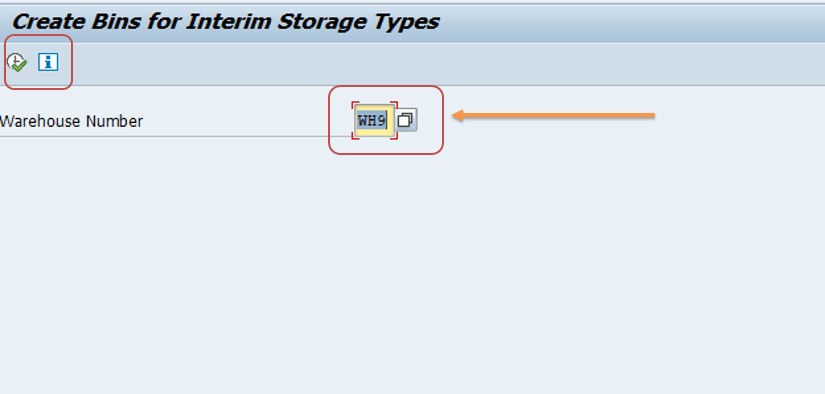
Follow the path SPRO → Logistics → Logistics Execution → Warehouse Management → Information System → Warehouse Activity Monitor, or run transaction LX20 directly.
Select the warehouse WH9 and choose the Execute button.
Create the bin. Enter the storage type 998 and the bin name AUFNAHME for warehouse WH9. Standard SAP also offers transaction LS01N (Create Storage Bin), which opens the full bin master screen if you prefer to maintain all fields in one place.
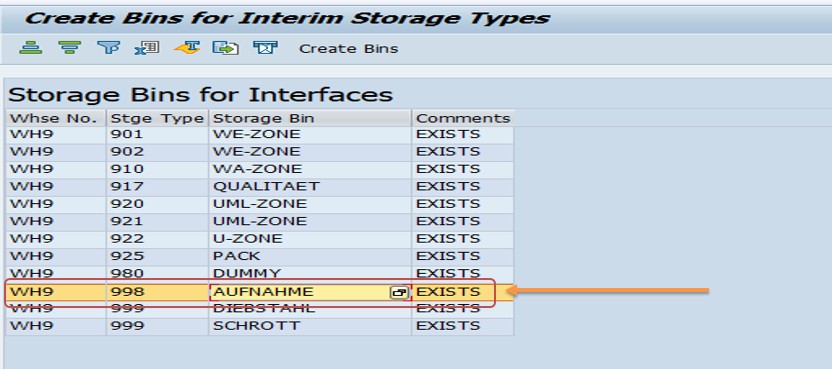
Check the storage section and the bin type that SAP proposes, and correct them if your warehouse design needs other values.
Save the bin. SAP confirms that the storage bin was created.
Return to the warehouse movement that failed and repeat it.
📋 Important Fields of a Storage Bin
When you create a bin, SAP asks for several fields. Most of them can keep their default values for an interim bin, but it helps to know what they do.
| Field | Meaning |
|---|---|
| Warehouse number | The warehouse where the bin belongs, here WH9. |
| Storage type | The area of the warehouse, here 998. |
| Storage bin | The name of the bin, here AUFNAHME. Up to ten characters. |
| Storage section | Groups bins within a storage type, for example fast-moving items. |
| Storage bin type | Describes the size or kind of the bin, which is used for capacity checks and putaway rules. |
| Maximum weight and total capacity | Limits that the putaway strategy respects. |
| Blocking indicators | Block the bin for putaway, for removal or for both. |
| Fire containment section | Used to limit the amount of dangerous goods in one area. |
A bin that is blocked for putaway exists, but the system will not place stock in it. In that case the message is different, but the effect for users feels the same, so check the blocking indicators when stock cannot be placed even though the bin exists.
✅ How to Verify That the Fix Worked
- Display the new bin in LS03N and confirm the warehouse number, storage type and name.
- Repeat the movement that failed, for example the goods receipt or the transfer order creation.
- Check that the transfer order was created without the message.
- Confirm the transfer order with LT12 if your process needs it.
- Look at the stock in the bin with LX02 after the movement is complete.
- Test a second movement of the same kind, to be sure that other users will not meet the message again.
If a different message appears, the first error was only hiding the next one. Typical examples are a blocked bin, a capacity problem or a missing putaway strategy. Handle each message in turn.
💡 Bin Naming and Planning
A clear naming convention saves time later. A bin name has at most ten characters, and many companies use a structure such as aisle, stack and level, written like 01-02-03. For interim storage types, a descriptive name, such as the German AUFNAHME in this example, is also common because there is only one bin or a few.
| Type of Bin | Naming Idea | Example |
|---|---|---|
| Rack bin | Aisle, stack and level | 01-02-03 |
| Interim bin | Short descriptive name | AUFNAHME |
| Floor storage | Zone and number | FL-001 |
| Differences | Fixed name agreed in the project | DIFF |
Whatever convention you choose, write it down and apply it everywhere. When a new warehouse is added, copy the convention and the list of special bins, and create them before the first movement. A small list with each storage type and its required bins is enough to avoid the error at go-live.
💼 Real-World Scenario: Goods Receipts Fail in a New Warehouse
This is an illustrative example based on a typical project. A manufacturer in Pune set up a new warehouse number, WH9, by copying the structure of an existing warehouse. Storage types and configuration were transported to the quality system. On the first day of testing, the first goods receipt of a purchase order ended with the message that storage bin WH9 998 AUFNAHME does not exist.
The SAP WM consultant opened the monitor, selected warehouse WH9 and looked at storage type 998. The storage type existed because it had been transported, but the bin did not, because bins are master data and are not part of a normal transport. She created the bin AUFNAHME for storage type 998 and asked the tester to repeat the goods receipt. The transfer requirement was created, and the transfer order followed without error.
After this the team created a list of special bins for every interim storage type of the new warehouse and loaded all of them at once. They also added "create special bins" to the go-live checklist for every new warehouse. Later warehouses went live without the message.
🔄 Master Data and Transports: Why the Bin Is Missing in Another System
Storage bins are master data. The warehouse number, storage types and their settings are Customizing and move with transport requests. The bins themselves do not. This is the reason why a warehouse can look complete in a test system, where the settings arrived by transport, and still produce this error because no bins were created.
| Object | Kind of Data | How It Reaches Another System |
|---|---|---|
| Warehouse number | Customizing | Transport request |
| Storage type definition | Customizing | Transport request |
| Interface settings for special bins | Customizing | Transport request |
| Storage bin | Master data | Created in each system, or loaded with a migration tool |
For a large warehouse with thousands of bins, create them with a data load, for example with the legacy system migration workbench, rather than by hand. Always load a small test file first and check the result in LS03N.
❗ Common Mistakes When Fixing This Error
- Creating a bin without checking whether the entry was a typing mistake.
- Creating the bin in the wrong storage type or warehouse number.
- Forgetting that bins do not move with transports, and fixing only one system.
- Using lower-case letters or spaces that differ from the name in Customizing.
- Deleting bins during a clean-up while Customizing still points to them.
- Creating a bin with a block for putaway, and then wondering why stock cannot be placed.
- Not testing a full movement after the fix.
- Not recording which special bins exist, so that the next warehouse starts from zero.
🔧 Troubleshooting: When the Fix Does Not Work
The message still shows the same bin after saving
Check that the bin was created in the same warehouse number and storage type, and that the name matches exactly. Start a new session and repeat the movement.
The bin exists but the system still complains
Compare the name character by character. A trailing space, a zero instead of the letter O or a different case can cause the mismatch.
The error appears in quality but not in production
The bin exists only in one system. Create it in the other, since bins are not transported.
A different message appears after the fix
This is normal. Look for a block on the bin, a capacity limit or a missing putaway strategy.
The system proposes a bin that nobody created
The proposal comes from Customizing. Either create that bin, or change the Customizing entry to point to an existing one.
Users cannot create bins
They may lack authorization for the warehouse number. Send the request to the WM team with the values from the message.
✅ How to Prevent This Error in the Future
- Keep a list of all special bins for each warehouse number and storage type.
- Add "create special bins" to the go-live checklist for every new warehouse.
- Load bins with a data migration tool and check the result in a report.
- Avoid deleting bins without checking Customizing and open documents.
- Use one naming convention and write it down.
- Test a goods receipt, a transfer order and a goods issue in quality before go-live.
- Train users to report the full message, including warehouse number, storage type and bin.
- Review the bin list once a year with the warehouse manager.
💡 Best Practices for Storage Bin Master Data
Treat bins as controlled master data
Decide who may create, change and delete bins, and keep this group small. Uncontrolled changes lead to duplicates, typing mistakes and stock in the wrong place. A simple request process, even by e-mail, with the values to be created, gives a clear history.
Separate planning from creation
Plan the bin structure before creating anything. Agree the storage types, sections, bin types and naming with the warehouse manager. A plan on one page is enough, and it avoids repeated changes later.
Check blocked and empty bins regularly
Run the bin status report from time to time. Bins that are blocked for no reason waste space, and empty bins that are never used may be candidates for removal or for a new purpose.
Keep Customizing and master data aligned
Whenever Customizing refers to a special bin, record the bin name next to the setting. When someone changes either side, the other can be updated at once. This single habit prevents most cases of this error.
🔒 Authorization Considerations
Creating a storage bin changes the structure of the warehouse, so authorization is usually restricted by warehouse number. Warehouse operators can often display bins but not create them. If you cannot create the bin, do not look for a way around the restriction. Send the support team the message, the warehouse number, the storage type, the bin name, the transaction where it appeared and your proposed fix: "create storage bin AUFNAHME in storage type 998 of warehouse WH9". A precise request is handled faster than a screenshot alone.
📱 Storage Bins in SAP S/4HANA and EWM
Classic Warehouse Management is still available in some SAP S/4HANA on-premise releases, and the transactions and the logic in this guide apply there. SAP positions Extended Warehouse Management, either embedded in S/4HANA or as a separate system, as the strategic solution for warehouse processes. In EWM the storage bin is also a master data object, but it is maintained in different transactions and apps, and some field names differ. If you work in EWM, the idea remains the same: a movement refers to a bin that does not exist, and you create or correct the bin. Check the current statement of SAP for your release, since the roadmap for warehouse solutions can change.
📋 Quick Fix Checklist
- Note the warehouse number, storage type and bin from the message.
- Check whether the bin exists in another storage type or warehouse.
- Check the entry for typing mistakes and extra spaces.
- Check the storage type definition in the warehouse.
- Open LX20, select the warehouse and execute, or use LS01N.
- Create the bin with the right storage type, section and bin type.
- Save and display the bin in LS03N.
- Repeat the movement and check the result.
- Create the bin in every system where it is missing, and record what was done.
📋 Related SAP Transactions
| Transaction | Purpose |
|---|---|
| LX20 | Warehouse activity monitor. |
| LS01N | Create a storage bin. |
| LS02N | Change a storage bin, including blocks. |
| LS03N | Display a storage bin. |
| LX03 | Bin status report. |
| LX02 | Stock overview per bin. |
| LT01 / LT04 | Create a transfer order manually or from a transfer requirement. |
| LT12 | Confirm a transfer order. |
🎓 Interview-Style Questions and Answers
Q: What does the message mean?
SAP cannot find a storage bin master record for the warehouse number, storage type and bin in the message.
Q: Is it a Customizing or a master data problem?
Mainly master data, because the bin is missing or wrongly entered. Customizing may point to the bin.
Q: Which transaction creates a bin?
LS01N, and the bin can also be reached from the warehouse monitor.
Q: Are bins moved with transports?
No. They are master data and must be created in each system.
Q: How long can a bin name be?
Up to ten characters.
Q: Why might a bin exist and the message still appear?
Because it exists in another storage type or warehouse number, or the name differs slightly.
📚 Quick Glossary
- Warehouse number: The top-level organizational unit of SAP WM.
- Storage type: A functional or physical area within a warehouse.
- Storage bin: The smallest address at which stock is stored.
- Storage section: A group of bins within a storage type.
- Interim storage type: An area used for temporary placement, such as goods receipt.
- Transfer order: The document that instructs a movement of stock between bins.
- Transfer requirement: A request for a movement that leads to a transfer order.
🎯 Conclusion
The message "storage bin does not exist, check your entry" is clear once you can read it. WH9 is the warehouse, 998 is the storage type and AUFNAHME is the bin. Check whether the bin exists elsewhere or was mistyped, and if not, create it through the warehouse monitor LX20 or with LS01N, save it and repeat the movement. Remember that bins are master data and do not move with transports, so create them in every system. Keep a list of special bins and add it to your go-live checklist, and the error will not return. If something still blocks you, send the details to pramod@learntosap.com and we will help you find the next step.